Acridotheres
| Acridotheres[1] | |||
| Vieillot, 1816[2] | |||
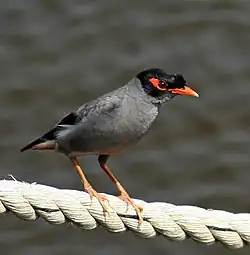 Majna norowa (A. ginginianus) | |||
| Systematyka | |||
| Domena | |||
|---|---|---|---|
| Królestwo | |||
| Typ | |||
| Podtyp | |||
| Gromada | |||
| Podgromada | |||
| Infragromada | |||
| Rząd | |||
| Podrząd | |||
| Rodzina | |||
| Podrodzina | |||
| Rodzaj |
Acridotheres | ||
| Typ nomenklatoryczny | |||
|
Paradisea tristis Linnaeus, 1766 | |||
| Synonimy | |||
|
| |||
| Gatunki | |||
| |||
Acridotheres – rodzaj ptaków z podrodziny szpaków (Sturninae) w rodzinie szpakowatych (Sturnidae).
Zasięg występowania
Morfologia
Długość ciała 21–25 cm; masa ciała 64–143 g[5].
Systematyka
Etymologia
- Acridotheres: gr. ακρις akris, ακριδος akridos – „szarańcza”; -θηρας -thēras – „łowca”, od θηραω thēraō – „łowić”, od θηρ thēr, θηρος thēros – „bestia, zwierzę”[6].
- Aethiopsar: gr. αιθιοψ aithiops – „czarny, poczerniały”, od αιθω aithō – „palić się”; ωψ ōps, ωπος ōpos – „twarz”; ψαρ psar, ψαρος psaros – „szpak”. Gatunek typowy: Pastor fuscus Wagler[7].
Podział systematyczny
Do rodzaju należą następujące gatunki[8]:
- Acridotheres tristis (Linnaeus, 1766) – majna brunatna
- Acridotheres ginginianus (Latham, 1790) – majna norowa
- Acridotheres burmannicus (Jerdon, 1862) – majna birmańska
- Acridotheres melanopterus (Daudin, 1800) – majna czarnoskrzydła
- Acridotheres fuscus (Wagler, 1827) – majna szara
- Acridotheres cinereus Bonaparte, 1850 – majna popielata
- Acridotheres javanicus Cabanis, 1851 – majna jawajska
- Acridotheres albocinctus Godwin-Austen & Walden, 1875 – majna obrożna
- Acridotheres grandis F. Moore, 1858 – majna żałobna
- Acridotheres cristatellus (Linnaeus, 1758) – majna czubata
Przypisy
- ↑ Acridotheres, [w:] Integrated Taxonomic Information System (ang.).
- ↑ L.J.P. Vieillot: Analyse d'une nouvelle ornithologie élémentaire. Paris: Deteville, libraire, rue Hautefeuille, 1817, s. 42. (fr.).
- ↑ R.B. Sharpe: Catalogue of the Passeriformes, or perching birds in the Collection of the British Museum. Sturniformes, containing the families Artamidae, Sturnidae, Ploceidae, Alaudidae. Also the families Atrichidae and Menuridae. T. 13. London: The Trustees, 1890, s. 666. (ang.).
- ↑ F. Gill, D. Donsker & P. Rasmussen (red.): Nuthatches, Wallcreeper, treecreepers, mockingbirds, starlings, oxpeckers. IOC World Bird List (v11.2). [dostęp 2021-07-16]. (ang.).
- ↑ A. Craig & Ch. Feare: Family Sturnidae (Starlings). W: J. del Hoyo, A. Elliott & D.A. Christie: Handbook of the Birds of the World. Cz. 14: Bush-shrikes to Old World Sparrows. Barcelona: Lynx Edicions, 2009, s. 733–736. ISBN 978-84-96553-50-7. (ang.).
- ↑ Acridotheres, [w:] The Key to Scientific Names, J.A. Jobling (red.), [w:] Birds of the World, S.M. Billerman et al. (red.), Cornell Lab of Ornithology, Ithaca [dostęp 2025-04-08] (ang.).
- ↑ Aethiopsar, [w:] The Key to Scientific Names, J.A. Jobling (red.), [w:] Birds of the World, S.M. Billerman et al. (red.), Cornell Lab of Ornithology, Ithaca [dostęp 2025-04-08] (ang.).
- ↑ Systematyka i nazwy polskie za: P. Mielczarek & M. Kuziemko: Podrodzina: Sturninae Rafinesque, 1815 – szpaki (wersja: 2024-12-24). [w:] Kompletna lista ptaków świata [on-line]. Instytut Nauk o Środowisku Uniwersytetu Jagiellońskiego. [dostęp 2025-04-08].