Actinodium
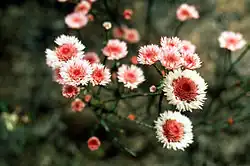 Actinodium cunninghamii | |||
| Systematyka[1][2] | |||
| Domena | |||
|---|---|---|---|
| Królestwo | |||
| Podkrólestwo | |||
| Nadgromada | |||
| Gromada | |||
| Podgromada | |||
| Nadklasa | |||
| Klasa | |||
| Nadrząd | |||
| Rząd | |||
| Rodzina | |||
| Rodzaj |
Actinodium | ||
| Nazwa systematyczna | |||
| Actinodium J. C. Schauer Linnaea 10: 311. Feb-Mar 1836; J. C. Schauer in Lindley, Nat. Syst. Bot. ed. 2. 440. Jul 1836[3] | |||
| Typ nomenklatoryczny | |||
|
A. cunninghamii J. C. Schauer[3] | |||
| Synonimy | |||
| |||
Actinodium – rodzaj roślin z rodziny mirtowatych (Myrtaceae). Jest to takson monotypowy obejmujący tylko gatunek Actinodium cunninghamii Schauer ex Lindl.[4] występujący w zachodniej Australii[5].
Przypisy
- ↑ Michael A. Ruggiero i inni, A Higher Level Classification of All Living Organisms, „PLOS One”, 10 (4), 2015, art. nr e0119248, DOI: 10.1371/journal.pone.0119248, PMID: 25923521, PMCID: PMC4418965 [dostęp 2020-02-20] (ang.).
- ↑ Peter F. Stevens, Angiosperm Phylogeny Website, Missouri Botanical Garden, 2001– [dostęp 2013-10-16] (ang.).
- 1 2 3 Index Nominum Genericorum (ING). Smithsonian Institution. [dostęp 2015-12-24].
- ↑ Actinodium. [w:] The Plant List [on-line]. [dostęp 2015-12-24].
- ↑ David J. Mabberley: The Plant-book: A Portable Dictionary of the Vascular Plants. Cambridge University Press, 1997, s. 10. ISBN 0-521-41421-0.
Identyfikatory zewnętrzne (takson):