Anadenanthera peregrina
 | |
| Systematyka[1][2] | |
| Domena | |
|---|---|
| Królestwo | |
| Podkrólestwo | |
| Nadgromada | |
| Gromada | |
| Podgromada | |
| Nadklasa | |
| Klasa | |
| Nadrząd | |
| Rząd | |
| Rodzina | |
| Podrodzina | |
| Rodzaj | |
| Gatunek |
Anadenanthera peregrina |
| Nazwa systematyczna | |
| Anadenanthera peregrina Speg. Physis (Buenos Aires) 6: 314. 1923 | |
| Kategoria zagrożenia (CKGZ)[3] | |
 | |
| Zasięg | |
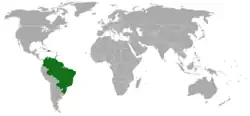 | |
Anadenanthera peregrina – gatunek wieloletnich roślin występujący w Ameryce Południowej i na Karaibach.
Właściwości fizyko-chemiczne
Zawiera znaczne ilości alkaloidów, pochodnych beta-karboliny i tryptamin jak np. DMT, 5-MeO-DMT i bufotenina.
Synonimy
Acacia angustiloba DC., Acacia microphylla Willd., Acacia peregrina (L.) Willd., Inga niopo Willd., Mimosa acacioides Benth., Mimosa niopo (Willd.) Poiret, Mimosa parvifolia Poiret, Mimosa peregrina L., Niopa peregrina (L.) Britton & Rose, Piptadenia niopo (Willd.) Spruce, Piptadenia peregrina (L.) Benth.
Bibliografia
- NCBI Taxonomy Homepage. [dostęp 2010-02-19].
- Germplasm Resources Information Network (GRIN). [dostęp 2010-02-05].
Przypisy
- ↑ Michael A. Ruggiero i inni, A Higher Level Classification of All Living Organisms, „PLOS One”, 10 (4), 2015, art. nr e0119248, DOI: 10.1371/journal.pone.0119248, PMID: 25923521, PMCID: PMC4418965 [dostęp 2020-02-20] (ang.).
- ↑ Peter F. Stevens, Fabales, [w:] Angiosperm Phylogeny Website, Missouri Botanical Garden, 2001– [dostęp 2009-09-23] (ang.).
- ↑ Anadenanthera peregrina, [w:] The IUCN Red List of Threatened Species (ang.).
Identyfikatory zewnętrzne:
- BioLib: 61278
- EoL: 638813
- Flora of North America: 242429787
- GBIF: 2952808
- iNaturalist: 63700
- IPNI: 1079624-2
- ITIS: 500958
- NCBI: 148672
- identyfikator Plant List (Royal Botanic Gardens, Kew): ild-15864
- Plants of the World: urn:lsid:ipni.org:names:12268-2
- identyfikator Tropicos: 13015662
- USDA PLANTS: ANPE13
- IRMNG: 10709346
- CoL: DCKQ