Ardipithecus kadabba
| Ardipithecus kadabba | |
| Haile-Selassie, 2001[1] | |
| Okres istnienia: 5,8–52 mln lat temu | |
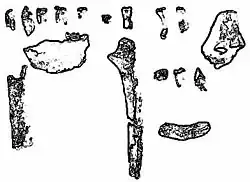 skamieniałości Ardipithecus kadabba | |
| Systematyka | |
| Domena | |
|---|---|
| Królestwo | |
| Typ | |
| Podtyp | |
| Gromada | |
| Rząd | |
| Rodzina | |
| Podrodzina | |
| Plemię | |
| Rodzaj | |
| Gatunek |
Ardipithecus kadabba |
Ardipithecus kadabba – wymarły ssak naczelny z rodziny człowiekowatych. Jego szczątki, liczące co najmniej 5,8–5,2 mln lat (późny miocen), znaleziono w dolinie Auasz w Etiopii w latach 1997–2001. Początkowo znaleziono sześć zębów, które uznano za należące do podgatunku Ardipithecus ramidus (Ardipithecus ramidus kadabba[2][1]). Dalsze prace doprowadziły do odkrycia kolejnych szczątków, na podstawie których w 2004 stwierdzono, że takson A. kadabba stanowi odrębny gatunek[3][4].
Zobacz też
Przypisy
- 1 2 Y. Haile-Selassie. Late Miocene hominids from the Middle Awash, Ethiopia. „Nature”. 412, s. 178–181, 2001. DOI: 10.1038/35084063. (ang.).
- ↑ C.J. Cela-Conde, F.J. Ayala, Genera of the human lineage, „Proceedings of the National Academy of Sciences of the United States of America”, 100 (13), s. 7684–7689, DOI: 10.1073/pnas.0832372100, PMID: 12794185, PMCID: PMC164648.
- ↑ Y. Haile-Selassie. G. Suwa & T.D. White. Late Miocene Teeth from Middle Awash, Ethiopia, and Early Hominid Dental Evolution. „Nature”. 303 (5663), s. 1503–1505, 2004. DOI: 10.1126/science.1092978. (ang.).
- ↑ D.R. Begun. The Earliest Hominins--Is Less More?. „Science”. 303 (5663), s. 1478–1480, 2004. DOI: 10.1126/science.1095516. (ang.).
Linki zewnętrzne
- Robert Sanders: New Ethiopian fossils are from 6-million-year-old hominid living just after split from chimpanzees. www.berkeley.edu, 2004-03-04. [dostęp 2017-07-06]. (ang.).