Astrophytum asterias
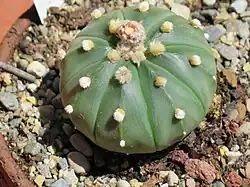
 Roślina widziana z góry | |||
| Systematyka[1][2] | |||
| Domena | |||
|---|---|---|---|
| Królestwo | |||
| Podkrólestwo | |||
| Nadgromada | |||
| Gromada | |||
| Podgromada | |||
| Nadklasa | |||
| Klasa | |||
| Nadrząd | |||
| Rząd | |||
| Rodzina | |||
| Rodzaj | |||
| Gatunek |
Astrophytum asterias | ||
| Nazwa systematyczna | |||
| Astrophytum asterias (Zucc.) Lem. Cactées 50. 1868 | |||
| Synonimy | |||
| |||
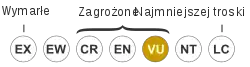
| Kategoria zagrożenia (CKGZ)[4] | |||
 | |||
Astrophytum asterias – gatunek rośliny z rodziny kaktusowatych. Pochodzi z Meksyku (Nuevo Leon, Tamaulipas) i Teksasu, poza tym jest uprawiany[3].
Morfologia
- Pokrój
- Osiąga do 10 cm wysokości.
- Kwiaty
- Średniej wielkości, żółte.
- Gatunki podobne
- Swoim wyglądem i liśćmi przypomina wilczomlecz opasły.

Zmienność
Uprawiana jest odmiana hodowlana 'SuperKabuto'.
Przypisy
- ↑ Michael A. Ruggiero i inni, A Higher Level Classification of All Living Organisms, „PLOS One”, 10 (4), 2015, art. nr e0119248, DOI: 10.1371/journal.pone.0119248, PMID: 25923521, PMCID: PMC4418965 [dostęp 2020-02-20] (ang.).
- ↑ Peter F. Stevens, Angiosperm Phylogeny Website, Missouri Botanical Garden, 2001– [dostęp 2010-05-07] (ang.).
- 1 2 Germplasm Resources Information Network (GRIN). [dostęp 2011-01-17].
- ↑ Astrophytum asterias, [w:] The IUCN Red List of Threatened Species (ang.).
Identyfikatory zewnętrzne (takson):
- EoL: 594932
- Flora of North America: 242412263
- GBIF: 5384219
- iNaturalist: 135434
- IPNI: 128907-1
- ITIS: 192203
- NCBI: 362977
- identyfikator Plant List (Royal Botanic Gardens, Kew): kew-2664164
- Plants of the World: urn:lsid:ipni.org:names:128907-1
- identyfikator Tropicos: 5102252
- USDA PLANTS: ASAS6
- IRMNG: 10976868
- CoL: 687TZ