Baranomyinae
| Baranomyinae | |||
| Kretzoi, 1955[1] | |||
| Okres istnienia: pliocen | |||
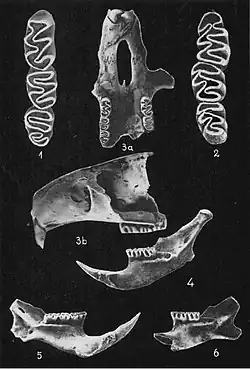 skamieliny Baranomys longidens | |||
| Systematyka | |||
| Domena | |||
|---|---|---|---|
| Królestwo | |||
| Typ | |||
| Podtyp | |||
| Nadgromada | |||
| Gromada | |||
| Infragromada | |||
| Rząd | |||
| Rodzina | |||
| Podrodzina |
Baranomyinae | ||
| Rodzaje[1] | |||
|
| |||
Baranomyinae – wymarła podrodzina gryzoni z rodziny chomikowatych. Baranomyinae wykształciły się w pliocenie. Obejmuje trzy taksony: Baranomys Kretzoi, 1933, Microtodon Miller, 1928[1][2], oraz Anatolomys Schaub, 1934[2].
Przypisy
- 1 2 3 Florian Heller. Die Wühlmäuse (Mammalia, Rodentia, Arvicolidae) des Ältest- und Altpleistozäns Europas: Eine übersieht über die bisher bekannten Gattungen und Arten. „Quartär – International Yearbook for Ice Age and Stone Age Research”. 1, 1968. Friedrich-Alexander-Universität Erlangen-Nürnberg. (niem.).
- 1 2 M. C. McKenna, S. K. Bell: Classification of mammals – above the species level. Nowy Jork: Columbia University Press, 1997, s. xii-631.