Ceratodontidae
| Ceratodontidae[1] | |
| Gill, 1872 | |
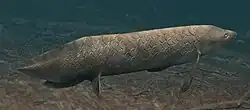 Rekonstrukcja Ceratodus sp. | |
| Systematyka | |
| Domena | |
|---|---|
| Królestwo | |
| Typ | |
| Podtyp | |
| Nadgromada | |
| Gromada | |
| Podgromada | |
| Rząd | |
| Rodzina |
Ceratodontidae |
Ceratodontidae – rodzina ryb dwudysznych (Dipnoi) utworzona przez Gilla w 1872. Początkowo obejmowała taksony wymarłe oraz jeden gatunek współcześnie żyjący – rogoząb australijski (Neoceratodus forsteri). Dokładniejsze badania wykazały, że Ceratodontidae sensu lato jest taksonem parafiletycznym[2]. N. forsteri został przeniesiony do odrębnej rodziny Neoceratodontidae[3][4][5], natomiast do obecnej Ceratodontidae zaliczane są rodzaje:
- †Ceratodus
- †Metaceratodus
Typem nomenklatorycznym rodziny jest Ceratodus.
Zobacz też
Przypisy
- ↑ Ceratodontidae, [w:] Integrated Taxonomic Information System (ang.).
- ↑ Joseph S. Nelson: Fishes of the World. John Wiley & Sons, 2006. ISBN 0-471-25031-7.
- ↑ A. Kemp. A revision of Australian Mesozoic and Cenozoic lungfish of the family Neoceratodontidae (Osteichthyes: Dipnoi), with a description of four new species. „Journal of Paleontology”. 71, s. 713–733, 1997. (ang.).
- ↑ Ron Fricke, William Neil Eschmeyer, Richard van der Laan (red.), SEARCH, [w:] Eschmeyer’s Catalog of Fishes, California Academy of Sciences, 7 czerwca 2012 [dostęp 2012-07-31] (ang.).
- ↑ Froese, R. & D. Pauly: Family Neoceratodontidae – Australian lungfish. FishBase. World Wide Web electronic publication. www.fishbase.org, 2012. [dostęp 2012-07-31]. (ang.).