Chilabothrus
| Chilabothrus[1] | |||
| A.M.C. Duméril & Bibron, 1844[2] | |||
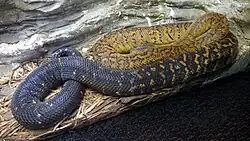 Przedstawiciel rodzaju – boa jamajski (Ch. subflavus) | |||
| Systematyka | |||
| Domena | |||
|---|---|---|---|
| Królestwo | |||
| Typ | |||
| Podtyp | |||
| Gromada | |||
| Podgromada | |||
| Rząd | |||
| Podrząd | |||
| Infrarząd | |||
| Nadrodzina |
Booidea | ||
| Rodzina | |||
| Podrodzina | |||
| Rodzaj |
Chilabothrus | ||
| Typ nomenklatoryczny | |||
|
Boa inornata Reinhardt, 1843 | |||
| Synonimy | |||
|
| |||
| Gatunki | |||
| |||
Chilabothrus – rodzaj węży z rodziny dusicielowatych (Boidae).
Zasięg występowania
Rodzaj obejmuje gatunki występujące na Kubie, Jamajce, Haiti, Bahamach, Portoryko, Wyspach Dziewiczych i Brytyjskich Wyspach Dziewiczych[6].
Systematyka
Etymologia
- Chilabothrus: gr. χειλος kheilos, χειλεος kheileos „warga, usta”; βοθρος bothros „otwór, rów”[2].
- Homalochilus: gr. ὁμαλος homalos „równy, gładki”; χειλος kheilos, χειλεος kheileos „warga, usta”[7]. Gatunek typowy: Homalochilus striatus Fischer, 1856.
- Piesigaster: gr. πιεσις piesis „uciskanie, ściskanie”; γαστηρ gastēr, γαστρος gastros „brzuch”[4]. Gatunek typowy: Piesigaster boettgeri Seoane, 1881 (= Boa inornata Reinhardt, 1843).
- Boella: zdrobnienie nazwy rodzaju Boa Linnaeus, 1758[8]. Gatunek typowy: Boella tenella Smith & Chiszar, 1992 (= Boa inornata Reinhardt, 1843).
Podział systematyczny
Gatunki z tego rodzaju tradycyjnie zaliczano do rodzaju Epicrates[9]. Do rodzaju należą następujące gatunki[6]:
- Chilabothrus angulifer – boa kubański[10]
- Chilabothrus argentum
- Chilabothrus chrysogaster
- Chilabothrus exsul
- Chilabothrus fordii
- Chilabothrus gracilis – boa wysmukły
- Chilabothrus granti
- Chilabothrus inornatus – boa portorykański
- Chilabothrus monensis
- Chilabothrus schwartzi
- Chilabothrus striatus
- Chilabothrus strigilatus
- Chilabothrus subflavus – boa jamajski
Przypisy
- ↑ Chilabothrus, [w:] Integrated Taxonomic Information System (ang.).
- 1 2 A.M.C. Duméril & G. Bibron: Erpétologie générale, ou, Histoire naturelle complète des reptiles. T. 6. Paris: Roret, 1844, s. 562. (fr.).
- ↑ Fischer 1856 ↓, s. 100.
- 1 2 V.L. Seoane. Neue Boïden-Gattung und -Art von den Philippinen. „Abhandlungen der Senckenbergischen Naturforschenden Gesellschaft”. 12 (1–2), s. 217, 1880. (niem.).
- ↑ Smith i Chiszar 1992 ↓, s. 20.
- 1 2 P. Uetz & J. Hallermann: Genus: Chilabothrus. The Reptile Database. [dostęp 2019-03-09]. (ang.).
- ↑ Fischer 1856 ↓, s. 101.
- ↑ Smith i Chiszar 1992 ↓, s. 22.
- ↑ R.A. Pyron, R.G. Reynolds & F.T. Burbrink. A Taxonomic Revision of Boas (Serpentes: Boidae). „Zootaxa”. 3846 (2), s. 249-260, 2014. DOI: 10.11646/zootaxa.3846.2.5. (ang.).
- ↑ Praca zbiorowa: Zwierzęta: encyklopedia ilustrowana. Warszawa: Wydawnictwo Naukowe PWN, 2005, s. 398. ISBN 83-01-14344-4.
Bibliografia
- J.G. Fischer. Neue Schlangen des Hamburgischen Naturhistorischen Museums. „Abhandlungen aus dem Gebiete der Naturwissenschaften herausgegeben vom Naturwissenschaftlichen Verein in Hamburg”. 3, s. 79–116, 1856. (niem.).
- H.M. Smith & D. Chiszar. A Mexican genus of tropidopheine snakes. „Bulletin of the Maryland Herpetological Society”. 28 (1), s. 19–28, 1992. (ang.).