Colibri
| Colibri[1] | |||
| von Spix, 1824[2] | |||
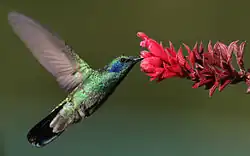 Uszatek zielony (C. thalassinus) | |||
| Systematyka | |||
| Domena | |||
|---|---|---|---|
| Królestwo | |||
| Typ | |||
| Podtyp | |||
| Gromada | |||
| Podgromada | |||
| Infragromada | |||
| Rząd | |||
| Rodzina | |||
| Podrodzina | |||
| Rodzaj |
Colibri | ||
| Typ nomenklatoryczny | |||
|
Trochilus serrirostris Vieillot, 1816 | |||
| Synonimy | |||
|
| |||
| Gatunki | |||
| |||
Colibri – rodzaj ptaków z podrodziny kolibrzyków (Polytminae) w rodzinie kolibrowatych (Trochilidae).
Zasięg występowania
Morfologia
Długość ciała 10,5–14 cm; masa ciała 4,8–8,5 g[9].
Systematyka
Etymologia
- Colibri: hiszp. nazwa Colibri dla kolibrów (podobno oparta na karaibskiej nazwie)[10].
- Petasophora (Petasophorus): epitet gatunkowy Trochilus petasophorus zu Wied-Neuwied, 1821[a]; gr. πετασος petasos „filcowy kapelusz z szerokim rondem”; -φορος -phoros „noszenie, ubieranie”, od φερω pherō „nosić”[11]. Gatunek typowy: Trochilus petasophorus zu Wied-Neuwied, 1821 (= Trochilus serrirostris Vieillot, 1816).
- Delphinella: zdrobnienie epitetu gatunkowego Ornismya delphinae Lesson, 1839[12]. Gatunek typowy: Ornismya delphinae Lesson, 1839.
- Praxilla: Praxila (żyła w V wieku p.n.e.), liryczna poetka z Sykionu[13]. Gatunek typowy: Trochilus (Petasophora) coruscans Gould, 1846.
- Telesiella (Telesilla): Telesilla (żyła w VI wieku p.n.e.), liryczna poetka z Argos, która według legend skutecznie obroniła swoje miasto przed Spartanami[14]. Gatunek typowy: Ornismya delphinae Lesson, 1839.
Podział systematyczny
Do rodzaju należą następujące gatunki[15]:
- Colibri serrirostris (Vieillot, 1816) – uszatek zielonobrzuchy
- Colibri coruscans (Gould, 1846) – uszatek niebieskobrzuchy
- Colibri thalassinus (Swainson, 1827) – uszatek zielony
- Colibri cyanotus (Bourcier, 1843) – uszatek szmaragdowy – takson wyodrębniony z C. thalassinus[16]
- Colibri delphinae (Lesson, 1839) – uszatek brązowy
Uwagi
- ↑ Synonim C. serrirostris.
Przypisy
- ↑ Colibri, [w:] Integrated Taxonomic Information System (ang.).
- ↑ J.B. von Spix: Avium species novae, quas in itinere annis MDCCCXVII-MDCCCXX per Brasiliam. T. 1. Monachii: Typis Franc. Seraph. Hübschmanni, 1824, s. 80. (łac.).
- ↑ G.R. Gray: A list of the genera of birds: with their synonyma an indication of the typical species of each genus. (London): R. and J.E. Taylor, 1840, s. 13. (ang.).
- ↑ Ch.-L. Bonaparte. Conspectus Systematis Ornithologiæ. „Annales des Sciences Naturelles, Zoologie”. Quatrième Série. 1, s. 137, 1854. (fr.).
- ↑ Reichenbach 1853 ↓, s. 5, 13.
- ↑ Reichenbach 1853 ↓, s. 5.
- ↑ J. Cabanis, F. Heine: Museum Heineanum: Verzeichniss der ornithologischen Sammlung des Oberamtmann Ferdinand Heine, auf Gut St. Burchard vor Halberstadt. Cz. 3. Halberstadt: In Commission bei R. Frantz, 1860, s. 27. (niem.).
- ↑ É. Mulsant, J. Verreaux, E. Verreaux. Essai une Classification Méthodique des Trochilidés. „Mémoires de la Société impériale des sciences naturelles de Cherbourg”. 12, s. 192, 1866. (fr.).
- 1 2 K.L. Schuchmann: Family Trochilidae (Hummingbirds). W: J. del Hoyo, A. Elliott & J. Sargatal: Handbook of the Birds of the World. Cz. 5: Barn-owls to Hummingbirds. Barcelona: Lynx Edicions, 1999, s. 557–558. ISBN 84-87334-25-3. (ang.).
- ↑ The Key to Scientific Names ↓, Colibri [dostęp 2019-11-13].
- ↑ The Key to Scientific Names ↓, Petasophora [dostęp 2019-11-13].
- ↑ The Key to Scientific Names ↓, Delphinella [dostęp 2019-11-13].
- ↑ The Key to Scientific Names ↓, Praxilla [dostęp 2019-11-13].
- ↑ The Key to Scientific Names ↓, Telesiella [dostęp 2019-11-13].
- ↑ Systematyka i nazwy polskie za: P. Mielczarek & M. Kuziemko: Podrodzina: Polytminae Reichenbach, 1849 – kolibrzyki (wersja: 2024-09-15). [w:] Kompletna lista ptaków świata [on-line]. Instytut Nauk o Środowisku Uniwersytetu Jagiellońskiego. [dostęp 2025-01-05].
- ↑ J.V. Remsen Jr., F.G. Stiles, J.A. McGuire. Classification of the Polytminae (Aves: Trochilidae). „Zootaxa”. 3957 (1), s. 143–150, 2015. (ang.).
Bibliografia
- H.G.L. Reichenbach. Aufzählung der Colibris oder Trochilideen in ihrer wahren natürlichen Verwandtschaft, nebst Schlüssel ihrer Synonymik. „Journal für Ornithologie”. 1, s. 1–24, 1853. (niem.).
- The Key to Scientific Names, J.A. Jobling (red.), [w:] Birds of the World, S.M. Billerman et al. (red.), Cornell Lab of Ornithology, Ithaca (ang.).