Coryphantha elephantidens
 | |||
| Systematyka[1][2] | |||
| Domena | |||
|---|---|---|---|
| Królestwo | |||
| Podkrólestwo | |||
| Nadgromada | |||
| Gromada | |||
| Podgromada | |||
| Nadklasa | |||
| Klasa | |||
| Nadrząd | |||
| Rząd | |||
| Rodzina | |||
| Rodzaj | |||
| Gatunek |
Coryphantha elephantidens | ||
| Nazwa systematyczna | |||
| Coryphantha elephantidens (Lem.) Lem. Cactées 35 1868[3] | |||
| Synonimy | |||
| |||
| Kategoria zagrożenia (CKGZ)[4] | |||
 | |||
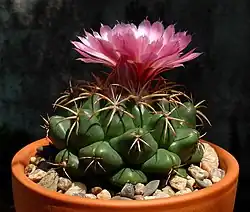
Coryphantha elephantidens (Lem.) Lem. – gatunek rośliny z rodziny kaktusowatych (Cactaceae Juss.). Występuje naturalnie w meksykańskim stanie Michoacán[5][6].
Morfologia
- Pokrój
- Półkrzewiasty kaktus dorastający do 15 cm wysokości. Łodyga ma kulisty kształt, dorasta do 18–20 cm średnicy, z brzegami pokrytymi guzkami. Areole mają 6–8 kolców promieniowych o długości 20 mm[6].
- Kwiaty
- Są pojedyncze, rozwijają się prawie na wierzchołku łodygi. Okwiat ma dzwonkowaty kształt, mierzy 8–10 mm długości, listki okwiatu mają różowawą barwę[6].
Zmienność
W obrębie tego gatunku oprócz podgatunku nominatywnego wyróżniono dwa podgatunki[3]:
- Coryphantha elephantidens subsp. bumamma (Ehrenb.) Dicht & A.Lüthy
- Coryphantha elephantidens subsp. greenwoodii (Bravo) Dicht & A.Lüthy
Przypisy
- ↑ Michael A. Ruggiero i inni, A Higher Level Classification of All Living Organisms, „PLOS One”, 10 (4), 2015, art. nr e0119248, DOI: 10.1371/journal.pone.0119248, PMID: 25923521, PMCID: PMC4418965 [dostęp 2020-02-20] (ang.).
- ↑ Peter F. Stevens, Angiosperm Phylogeny Website, Missouri Botanical Garden, 2001– [dostęp 2009-06-01] (ang.).
- 1 2 3 Coryphantha elephantidens (Lem.) Lem.. The Plant List. [dostęp 2016-05-12]. (ang.).
- ↑ Coryphantha elephantidens, [w:] The IUCN Red List of Threatened Species (ang.).
- ↑ Discover Life: Point Map of Coryphantha elephantidens. Encyclopedia of Life. [dostęp 2016-05-12]. (ang.).
- 1 2 3 Coryphantha elephantidens. Plantes & botanique. [dostęp 2016-05-12]. (fr.).
Identyfikatory zewnętrzne (takson):