Cyclarhis
| Cyclarhis | |||
| Swainson, 1824[1] | |||
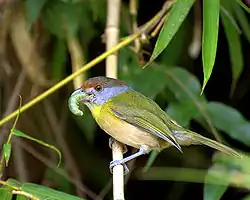 Cyklara gujańska (C. gujanensis) | |||
| Systematyka | |||
| Domena | |||
|---|---|---|---|
| Królestwo | |||
| Typ | |||
| Podtyp | |||
| Gromada | |||
| Podgromada | |||
| Infragromada | |||
| Rząd | |||
| Podrząd | |||
| Rodzina | |||
| Podrodzina | |||
| Rodzaj |
Cyclarhis | ||
| Typ nomenklatoryczny | |||
|
Tanagra gujanensis J.F. Gmelin, 1789 | |||
| Synonimy | |||
|
| |||
| Gatunki | |||
| |||
Cyclarhis – rodzaj ptaków z podrodziny wireonków (Vireoninae) w obrębie rodziny wireonkowatych (Vireonidae).
Zasięg występowania
Rodzaj obejmuje gatunki występujące w Meksyku, Ameryce Centralnej i Ameryce Południowej[9].
Morfologia
Długość ciała 14–16 cm; masa ciała 22–35 g[10].
Systematyka
Etymologia
- Cyclarhis (Cyclorhis, Cyclaris, Cychloris, Cycloris, Cyclorrhis, Cychlorhis): gr. κυκλος kuklos „koło”; ῥις rhis, ῥινος rhinos „nozdrza”[11].
- Laniagra: zbitka wyrazowa nazw rodzajowych: Lanius Linnaeus, 1758 (dzierzba) i Tanagra Linnaeus, 1764 (organka)[12]. Typ nomenklatoryczny: Tanagra gujanensis J.F. Gmelin, 1789.
Podział systematyczny
Do rodzaju należą następujące gatunki[13]:
- Cyclarhis gujanensis (J.F. Gmelin, 1789) – cyklara gujańska
- Cyclarhis nigrirostris Lafresnaye, 1842 – cyklara czarnodzioba
Uwagi
Przypisy
- ↑ W. Swainson. An Inquiry into the natural Affinities of the Lianiadæ, or Shrikes; preceded by some Observations on the present State of Ornithology in this Country. „The Zoological Journal”. 1 (3), s. 274, 1824–1825. (ang.).
- ↑ W. Swainson. On several Groups and Forms in Ornithology, not hitherto defined. „The Zoological Journal”. 3 (10), s. 162, 1828. (ang.).
- ↑ W. Swainson: Observations on several of the genera and species of the order Passeres of Cuvier. W: G. Cuvier & E. Griffith (red.): Aves. Cz. 8. London: G.B. Whittaker, 1829, s. 303. (ang.).
- ↑ F. de Lafresnaye & A. d’Orbigny. Synopsis Avium. „Magasin de zoologie”. 7 (2), s. 9, 1837. (łac.).
- ↑ R.-P. Lesson. Révision de la famille des Pie-grièches. „Revue zoologique”. 2, s. 134, 1839. (fr.).
- ↑ Ch.L. Bonaparte: Conspectus generum avium. T. 1. Lugduni Batavorum: Apud E.J. Brill, 1850, s. 330. (łac.).
- ↑ H.G.L. Reichenbach: Avium systema naturale. Das natürliche system der vögel mit hundert tafeln grösstentheils original-abbildungen der bis jetzt entdecken fast zwölfhundert typischen formen. Vorlaüfer einer iconographie der arten der vögel aller welttheile. Dresden und Leipzig: Expedition der vollständigsten naturgeschichte, 1850, s. ryc. lxx. (niem.).
- ↑ G.R. Gray: Hand-list of genera and species of birds, distinguishing those contained in the British Museum. Cz. 3: Struthiones, Grallæ, and Anseres, with indices of genekic and specific names. London: printed by order of the Trustees, 1871, s. 144. (ang.).
- ↑ F. Gill, D. Donsker & P. Rasmussen (redaktorzy), Shrikes, vireos, shrike-babblers [online], IOC World Bird List (v13.1) [dostęp 2023-06-09] (ang.).
- ↑ D.W. Winkler, S.M. Billerman & I.J. Lovette, Vireos, Shrike-Babblers, and Erpornis (Vireonidae), version 1.0, [w:] S.M. Billerman, B.K. Keeney, P.G. Rodewald & T.S. Schulenberg (redaktorzy), Birds of the World, Cornell Lab of Ornithology, Ithaca, NY 2020, Cyclarhis, DOI: 10.2173/bow.vireon1.01 [dostęp 2023-06-09] (ang.).

- ↑ The Key to Scientific Names ↓, Cyclarhis [dostęp 2023-06-09].
- ↑ The Key to Scientific Names ↓, Laniagra [dostęp 2023-06-09].
- ↑ Systematyka i nazwy polskie za: P. Mielczarek & M. Kuziemko, Podrodzina: Vireoninae Swainson, 1837 - wireonki (wersja: 2024-10-11), [w:] Kompletna lista ptaków świata [online], Instytut Nauk o Środowisku Uniwersytetu Jagiellońskiego [dostęp 2025-04-13].
Bibliografia
- The Key to Scientific Names, J.A. Jobling (red.), [w:] Birds of the World, S.M. Billerman et al. (red.), Cornell Lab of Ornithology, Ithaca (ang.).