Diasporus
| Diasporus[1] | |||
| Hedges, Duellman & Heinicke, 2008[2] | |||
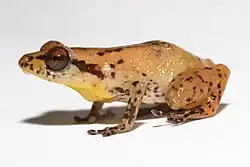 Przedstawiciel rodzaju – D. diastema | |||
| Systematyka | |||
| Domena | |||
|---|---|---|---|
| Królestwo | |||
| Typ | |||
| Podtyp | |||
| Gromada | |||
| Rząd | |||
| Podrząd | |||
| Nadrodzina |
Brachycephaloidea | ||
| Rodzina | |||
| Podrodzina | |||
| Rodzaj |
Diasporus | ||
| Typ nomenklatoryczny | |||
|
Lithodytes diastema Cope, 1875 | |||
| Gatunki | |||
| |||
Diasporus – rodzaj płazów bezogonowych z podrodziny Eleutherodactylinae w rodzinie Eleutherodactylidae.
Zasięg występowania
Rodzaj obejmuje gatunki występujące od skrajnie wschodniego Hondurasu na południe wzdłuż atlantyckiej równiny przybrzeżnej Nikaragui do Kostaryki (po obu stronach wybrzeża), a następnie na wschód do zachodniej Kolumbii i północno-zachodniego Ekwadoru[3].
Systematyka
Etymologia
Podział systematyczny
Do rodzaju należą następujące gatunki[3]:
- Diasporus amirae Arias, Chaves, Salazar, Salazar-Zúñiga & García-Rodríguez, 2019
- Diasporus anthrax (Lynch, 2001)
- Diasporus citrinobapheus Hertz, Hauenschild, Lotzkat & Köhler, 2012
- Diasporus darienensis Batista, Köhler, Mebert, Hertz & Vesely, 2016
- Diasporus diastema (Cope, 1875)
- Diasporus gularis (Boulenger, 1898)
- Diasporus hylaeformis (Cope, 1875)
- Diasporus igneus Batista, Ponce & Hertz, 2012
- Diasporus lynchi Ospina-Sarria, Velásquez-Trujillo, Castaño Saavedra, Castillo & Bolívar-García, 2022
- Diasporus majeensis Batista, Köhler, Mebert, Hertz & Vesely, 2016
- Diasporus pequeno Batista, Köhler, Mebert, Hertz & Vesely, 2016
- Diasporus quidditus (Lynch, 2001)
- Diasporus sapo Batista, Köhler, Mebert, Hertz & Vesely, 2016
- Diasporus tigrillo (Savage, 1997)
- Diasporus tinker (Lynch, 2001)
- Diasporus ventrimaculatus Chaves, García-Rodríguez, Mora & Leal, 2009
- Diasporus vocator (Taylor, 1955)
Przypisy
- ↑ Diasporus, [w:] Integrated Taxonomic Information System (ang.).
- ↑ Hedges, Duellman i Heinicke 2008 ↓, s. 49.
- 1 2 Darrel R. Frost: Diasporus Hedges, Duellman, and Heinicke, 2008. [w:] Amphibian Species of the World 6.2, an Online Reference [on-line]. American Museum of Natural History. [dostęp 2023-12-07]. (ang.).
- ↑ Hedges, Duellman i Heinicke 2008 ↓, s. 50.
Bibliografia
- S.B. Hedges, W.E. Duellman & M.P. Heinicke. New World direct-developing frogs (Anura: Terrarana): Molecular phylogeny, classification, biogeography, and conservation. „Zootaxa”. 1737, s. 1–182, 2008. (ang.).