Dzierzbogłowy
| Pteruthiinae | |||
| Sangster, Cibois & Reddy, 2022[1] | |||
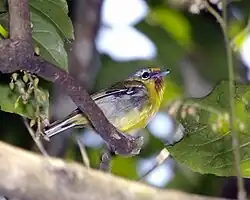 Dzierzbogłów rdzawoczelny (P. aenobarbus) | |||
| Systematyka | |||
| Domena | |||
|---|---|---|---|
| Królestwo | |||
| Typ | |||
| Podtyp | |||
| Gromada | |||
| Podgromada | |||
| Infragromada | |||
| Rząd | |||
| Podrząd | |||
| Rodzina | |||
| Podrodzina |
dzierzbogłowy | ||
| Typ nomenklatoryczny | |||
|
Podrodzina: Pteruthius Swainson, 1832 | |||
| Synonimy | |||
| |||
| Rodzaje i gatunki | |||
| |||
Dzierzbogłowy[11] (Pteruthiinae) – monotypowa podrodzina ptaków z rodziny wireonkowatych (Vireonidae).
Rozmieszczenie geograficzne
Podrodzina obejmuje gatunki występujące w Himalajach, Azji Południowo-Wschodniej i południowej Chińskiej Republice Ludowej[12].
Morfologia
Długość ciała 11–20 cm; masa ciała 10–48 g[13].
Systematyka
Rodzaj Pteruthius zdefiniował w 1832 roku angielski zoolog William Swainson w załączniku dotyczącym cech rodzajów i podrodzajów dotychczas nieokreślonych, opublikowanym w publikacji pod redakcją Johna Richardsona i Swainsona poświęconej północnoamerykańskiej faunie[10]. Gatunkiem typowym jest (oryginalne oznaczenie (również monotypowe)) podgatunek dzierzbogłowa rododendronowego, P. aeralatus validirostris.
Etymologia
- Pteruthius (Ptererythrius, Pterythrius, Ptererythius, Pterutius): gr. πτερον pteron ‘skrzydło’; ερυθαινω eruthainō ‘zabarwione na czerwono’, od ερυθραινω eruthrainō ‘malować na czerwono’, od ερυθρος eruthros ‘czerwony’[14].
- Allotrius (Allothrius): gr. αλλοτριος allotrios ‘dziwny’, od αλλος allos ‘inny’[15]. Gatunek typowy (późniejsze oznaczenie)[6]: Allotrius ænobarbus Temminck, 1836.
- Aenopogon: łac. aeneus ‘w kolorze brązu’, od aes, aeris ‘brąz’; gr. πωγων pōgōn, πωγωνος pōgōnos ‘broda’[16]. Gatunek typowy (oznaczenie monotypowe): Allotrius ænobarbus Temminck, 1836.
- Hilarocichla: gr. ἱλαρος hilaros ‘wesoły, radosny’, od ἱλαος hilaos ‘pomyślny, łaskawy’; κιχλη kikhlē ‘drozd’[17]. Gatunek typowy (oznaczenie monotypowe): Pteruthius rufiventer Blyth, 1842.
Podział systematyczny
Do podrodziny należy jeden rodzaj Pteruthius z następującymi gatunkami[11]:
- Pteruthius xanthochlorus J.E. Gray & G.R. Gray, 1847 – dzierzbogłów zielony
- Pteruthius aenobarbus (Temminck, 1836) – dzierzbogłów rdzawoczelny
- Pteruthius intermedius (Hume, 1877) – dzierzbogłów trzaskający
- Pteruthius melanotis Hodgson, 1847 – dzierzbogłów rdzawogardły
- Pteruthius rufiventer Blyth, 1842 – dzierzbogłów czarnogłowy
- Pteruthius flaviscapis (Temminck, 1836) – dzierzbogłów białobrewy
- Pteruthius aeralatus Blyth, 1855 – dzierzbogłów rododendronowy
Uwagi
Przypisy
- ↑ G. Sangster, A. Cibois & S. Reddy. Pteruthiidae and Erpornithidae (Aves: Corvides): two new family-group names for babbler-like outgroups of the vireos (Vireonidae). „Bulletin of the British Ornithologists’ Club”. 142 (2), s. 239–243, 2022. DOI: 10.25226/bboc.v142i2.2022.a8. (ang.).
- ↑ C.J. Temminck: Nouveau recueil de planches coloriées d’oiseaux: pour servir de suite et de complément aux planches enluminées de Buffon, édition in-folio et in-4⁰ de l’Imprimerie royale, 1770. Strasbourg: Chez Legras Imbert et Comp., 1838, s. ryc. 589. (fr.).
- ↑ H.E. Strickland. Commentary on Mr. G.R. Gray’s 'Genera of Birds'. „The Annals and Magazine of Natural History”. 7, s. 29, 1841. (ang.).
- ↑ J. Cabanis. Ornithologische Notizen. „Archiv für Naturgeschichte”. 13 (1), s. 322, 1847. (niem.).
- ↑ Ch.-L. Bonaparte. Notes sur les Collections rapportées en 1853, par M.A. Delattre, de son voyage en Californie et dans le Nicaragua. „Comptes Rendus Hebdomadaires des Séances de l’Académie des Sciences”. 38, s. 386, 536, 1854. (fr.).
- 1 2 G.R. Gray: Catalogue of the genera and subgenera of birds contained in the British Museum. London: The Trustees, 1855, s. 54. (ang.).
- ↑ L. Fitzinger. Über das System und die Charakteristik der natürlichen Familien der Vögel. „Sitzungsberichte der Kaiserlichen Akademie der Wissenschaften. Mathematisch-Naturwissenschaftliche Classe”. 46, s. 196, 1863. (niem.).
- ↑ E.W. Oates: The fauna of British India, including Ceylon and Burma. Cz. 1: Birds. Londyn: Taylor and Francis, 1889, s. 243. (ang.).
- ↑ W. Widodo. Studi keanekaan jenis burung dan habitatnya di lereng timur hutan pegunungan slamet, Purbalingga, Jawa Tengah. „Bionatura-Jurnal Ilmu-ilmu Hayati dan Fisik”. 12 (2), s. 74, 2010. (indonez.).
- 1 2 W. Swainson: Appendix, No. I. Characters of genera and sub-genera hitherto undefined. W: J. Richardson & W. Swainson: Fauna boreali-americana, or, The zoology of the northern parts of British America: containing descriptions of the objects of natural history collected on the late northern land expeditions, under command of Captain Sir John Franklin, R.N.. Cz. 2: The Birds. Londyn: J. Murray [etc.], 1831, s. 491. (ang.).
- 1 2 Systematyka i nazwy polskie za: P. Mielczarek & M. Kuziemko, Podrodzina: Pteruthiinae Sangster, Cibois & Reddy, 2022 – dzierzbogłowy (wersja: 2024-10-11), [w:] Kompletna lista ptaków świata [online], Instytut Nauk o Środowisku Uniwersytetu Jagiellońskiego [dostęp 2024-12-07].
- ↑ F. Gill, D. Donsker & P. Rasmussen (red.): Shrikes, vireos, shrike-babblers. IOC World Bird List (v14.2). [dostęp 2024-12-07]. (ang.).
- ↑ D.W. Winkler, S.M. Billerman & I.J. Lovette, Vireos, Shrike-Babblers, and Erpornis (Vireonidae), version 1.0, [w:] S.M. Billerman, B.K. Keeney, P.G. Rodewald & T.S. Schulenberg (redaktorzy), Birds of the World, Cornell Lab of Ornithology, Ithaca, NY 2021, Pteruthius, DOI: 10.2173/bow.vireon1.01 [dostęp 2023-06-09] (ang.).

- ↑ The Key to Scientific Names ↓, Pteruthius [dostęp 2017-10-12].
- ↑ The Key to Scientific Names ↓, Allotrius [dostęp 2017-10-12].
- ↑ The Key to Scientific Names ↓, Aenopogon [dostęp 2017-10-12].
- ↑ The Key to Scientific Names ↓, Hilarocichla [dostęp 2017-10-12].
Bibliografia
- The Key to Scientific Names, J.A. Jobling (red.), [w:] Birds of the World, S.M. Billerman et al. (red.), Cornell Lab of Ornithology, Ithaca (ang.).