Epinecrophylla
| Epinecrophylla[1] | |||
| M.L. Isler & Brumfield, 2006[2] | |||
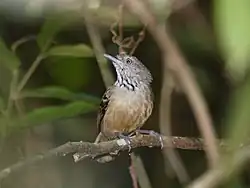 Gardlinek brunatny (E. fulviventris) | |||
| Systematyka | |||
| Domena | |||
|---|---|---|---|
| Królestwo | |||
| Typ | |||
| Podtyp | |||
| Gromada | |||
| Podgromada | |||
| Infragromada | |||
| Rząd | |||
| Podrząd | |||
| Rodzina | |||
| Podrodzina | |||
| Plemię | |||
| Rodzaj |
Epinecrophylla | ||
| Typ nomenklatoryczny | |||
|
Formicivora haematonota P.L. Sclater, 1857 | |||
| Gatunki | |||
| |||
Epinecrophylla – rodzaj ptaków z podrodziny chronek (Thamnophilinae) w rodzinie chronkowatych (Thamnophilidae).
Zasięg występowania
Rodzaj obejmuje gatunki występujące w Ameryce Południowej i Centralnej[3].
Morfologia
Długość ciała 9,5–11 cm; masa ciała 7,5–12,5 g[4].
Systematyka
Nazewnictwo
Epinecrophylla: gr. επι epi „na”; νεκρος nekros „martwy”; φυλλον phullon „liść”[5].
Podział systematyczny
Takson wyodrębniony z rodzaju Myrmotherula[2][6]. Do rodzaju należą następujące gatunki[7]:
- Epinecrophylla fulviventris (Lawrence, 1862) – gardlinek brunatny
- Epinecrophylla ornata (P.L. Sclater, 1853) – gardlinek ozdobny
- Epinecrophylla erythrura (P.L. Sclater, 1890) – gardlinek rudosterny
- Epinecrophylla leucophthalma (von Pelzeln, 1868) – gardlinek białooki
- Epinecrophylla gutturalis (P.L. Sclater & Salvin, 1881) – gardlinek płowy
- Epinecrophylla haematonota (P.L. Sclater, 1857) – gardlinek rudogrzbiety
- Epinecrophylla spodionota (P.L. Sclater & Salvin, 1880) – gardlinek stokowy
- Epinecrophylla amazonica (H. von Ihering, 1905) – gardlinek amazoński – takson wyodrębniony ostatnio z E. haematonota[8]
Przypisy
- ↑ Epinecrophylla, [w:] Integrated Taxonomic Information System (ang.).
- 1 2 M.L. Isler, D.R. Lacerda, P.R. Isler, S.J. Hackett, K.V. Rosenberg & R.T. Brumfield. Epinecrophylla, a new genus of antwrens (Aves: Passeriformes: Thamnophilidae). „Proceedings of the Biological Society of Washington”. 119 (4), s. 522-527, 2006. (ang.).
- ↑ F. Gill, D. Donsker & P. Rasmussen (red.): Antbirds. IOC World Bird List (v10.2). [dostęp 2020-12-10]. (ang.).
- ↑ K. Zimmer & M.I. Isler: Family Thamnophilidae (Typical Antbirds). W: J. del Hoyo, A. Elliott & D.A. Christie: Handbook of the Birds of the World. Cz. 8: Broadbills to Tapaculos. Barcelona: Lynx Edicions, 2003, s. 584–586, 589. ISBN 84-87334-50-4. (ang.).
- ↑ Epinecrophylla, [w:] The Key to Scientific Names, J.A. Jobling (red.), [w:] Birds of the World, S.M. Billerman et al. (red.), Cornell Lab of Ornithology, Ithaca [dostęp 2022-02-17] (ang.), [archiwum].
- ↑ R.T. Brumfield, J.G. Tello, Z.A. Cheviron, M.D. Carling, N. Crochet & K.V. Rosenberg. Phylogenetic conservatism and antiquity of a tropical specialization: Army-ant-following in the typical antbirds (Thamnophilidae). „Molecular Phylogenetics and Evolution”. 45, s. 1-13, 2007. DOI: 10.1016/j.ympev.2007.07.019. (ang.).
- ↑ Systematyka i nazwy polskie za: P. Mielczarek & M. Kuziemko: Plemię: Microrhopiini Moyle, Chesser, Brumfield, Tello, Marchese & Cracraft, 2009 (wersja: 2024-07-07). [w:] Kompletna lista ptaków świata [on-line]. Instytut Nauk o Środowisku Uniwersytetu Jagiellońskiego. [dostęp 2025-03-20].
- ↑ B.M. Whitney, M.L. Isler, G.A. Bravo, N. Aristizábal, F. Schunck, L.F. Silveira & V. de Q. Piacentini: A new species of Epinecrophylla antwren from the Aripuanã-Machado interfluvium in central Amazonian Brazil with revision of the "stipple-throated antwren" complex. W: J. del Hoyo, A. Elliott, J.Sargatal & D.A. Christie: Handbook of the Birds of the World. Cz. Specjalna: New Species and Global Index. Barcelona: Lynx Edicions, 2013, s. 263–267. ISBN 978-84-96553-88-0. (ang.).