Geospiza
| Geospiza[1] | |||
| Gould, 1837[2] | |||
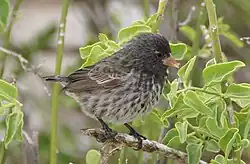 Darwinka mała (G. fuliginosa) | |||
| Systematyka | |||
| Domena | |||
|---|---|---|---|
| Królestwo | |||
| Typ | |||
| Podtyp | |||
| Gromada | |||
| Podgromada | |||
| Infragromada | |||
| Rząd | |||
| Podrząd | |||
| Rodzina | |||
| Podrodzina | |||
| Rodzaj |
Geospiza | ||
| Typ nomenklatoryczny | |||
|
Geospiza magnirostris Gould, 1837 | |||
| Gatunki | |||
| |||
Geospiza – rodzaj ptaków z podrodziny cukrzyków (Coerebinae) w rodzinie tanagrowatych (Thraupidae).
Zasięg występowania
Rodzaj obejmuje gatunki występujące na archipelagu Galapagos w Ameryce Południowej[3].
Morfologia
Długość ciała 10–16 cm; masa ciała 12–39 g[4].
Systematyka
Etymologia
Geospiza: gr. γεω- geō- – ziemny-, od γη gē – ziemia; σπιζα spiza – zięba, od σπιζω spizō – ćwierkać[5].
Podział systematyczny
Do rodzaju należą następujące gatunki[6]:
- Geospiza difficilis Sharpe, 1888 – darwinka ostrodzioba
- Geospiza septentrionalis Rothschild & E. Hartert, 1899 – darwinka północna – takson wyodrębniony ostatnio z G. difficilis[7]
- Geospiza fuliginosa Gould, 1837 – darwinka mała
- Geospiza fortis Gould, 1837 – darwinka czarna
- Geospiza acutirostris Ridgway, 1894 – darwinka szydłodzioba – takson wyodrębniony ostatnio z G. difficilis[7]
- Geospiza scandens (Gould, 1837) – darwinka kaktusowa
- Geospiza propinqua Ridgway, 1894 – darwinka duża – takson wyodrębniony ostatnio z G. conirostris[7]
- Geospiza magnirostris Gould, 1837 – darwinka wielkodzioba
- Geospiza conirostris Ridgway, 1890 – darwinka grubodzioba
Zobacz też
Przypisy
- ↑ Geospiza, [w:] Integrated Taxonomic Information System (ang.).
- ↑ J. Gould. Exhibited from Mr. Darwin's collection of Birds, a series of Ground Finches, so peculiar in form that he was induced to regard them as constituting an entirely new group, containing 14 species, and appearing to be strictly confined to the Galapagos Islands. „Proceedings of the Zoological Society of London”. 5, s. 5, 1837. (ang.).
- ↑ F. Gill, D. Donsker & P. Rasmussen (red.): Tanagers and allies. IOC World Bird List (v11.1). [dostęp 2021-03-12]. (ang.).
- ↑ J. Rising, A. Jaramillo, J.L. Copete, S. Madge & P. Ryan: Family Emberizidae (Buntings and New World Sparrows). W: J. del Hoyo, A. Elliott & D.A. Christie: Handbook of the Birds of the World. Cz. 16: Tanagers to New World Blackbirds. Barcelona: Lynx Edicions, 2011, s. 680–682. ISBN 978-84-96553-78-1. (ang.).
- ↑ Geospiza, [w:] The Key to Scientific Names, J.A. Jobling (red.), [w:] Birds of the World, S.M. Billerman et al. (red.), Cornell Lab of Ornithology, Ithaca [dostęp 2022-02-17] (ang.), [archiwum].
- ↑ Systematyka i nazwy polskie za: P. Mielczarek & M. Kuziemko: Podrodzina: Coerebinae d'Orbigny & Lafresnaye, 1838 - cukrzyki - Dome-nesting tanagers (wersja: 2024-10-23). [w:] Kompletna lista ptaków świata [on-line]. Instytut Nauk o Środowisku Uniwersytetu Jagiellońskiego. [dostęp 2025-02-20].
- 1 2 3 S. Lamichhaney, J. Berglund, M.S. Almeén, K. Maqbool, M. Grabherr, A. Martinez-Barrio, M. Promerová, C.-J. Rubin, C. Wang, N. Zamani, B.R. Grant, P.R. Grant, M.T. Webster & L. Andersson. Evolution of Darwin's finches and their beaks revealed by genome sequencing. „Nature”. 518, s. 371–375, 2015. DOI: 10.1038/nature14181. (ang.).