Grayiinae
| Grayiinae[1] | |||
| Vidal, Delmas, David, Cruaud, Couloux & Hedges, 2007[2] | |||
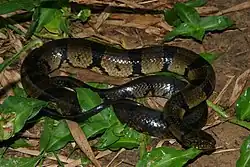 Grayia ornata | |||
| Systematyka | |||
| Domena | |||
|---|---|---|---|
| Królestwo | |||
| Typ | |||
| Podtyp | |||
| Gromada | |||
| Podgromada | |||
| Rząd | |||
| Podrząd | |||
| Infrarząd | |||
| Nadrodzina |
Colubroidea | ||
| Rodzina | |||
| Podrodzina |
Grayiinae | ||
| Typ nomenklatoryczny | |||
|
Grayia silurophaga Günther, 1858 (= Coluber smythii Leach, 1818) | |||
| Synonimy | |||
| |||
| Rodzaje i gatunki | |||
|
| |||
Grayiinae – monotypowa podrodzina węży z rodziny połozowatych (Colubridae).
Zasięg występowania
Podrodzina obejmuje gatunki występujące w Sudanie, Czadzie, Mali, Nigrze, Senegalu, Gambii, Gwinei Bissau, Gwinei, Sierra Leone, Liberii, Wybrzeżu Kości Słoniowej, Burkinie Faso, Ghanie, Togo, Beninie, Republice Środkowoafrykańskiej, Nigerii, Kamerunie, Gwinei Równikowej, Gabonie, Kongu, Demokratycznej Republice Konga, Ugandzie, Rwandzie, Burundi, Kenii, Tanzanii, Angoli i Zambii[6].
Systematyka
Etymologia
- Grayia: John Edward Gray (1800–1875), brytyjski zoolog[5].
- Xenurophis: gr. ξενος xenos „obcy, dziwny”[7]; ουρα oura „ogon”[8]; οφις ophis, οφεως opheōs „wąż”[9]. Gatunek typowy: Xenurophis caesar Günther, 1863.
- Macrophis: gr. μακρος makros „długi”[10]; οφις ophis, οφεως opheōs „wąż”[9]. Gatunek typowy: Macrophis ornatus Barbosa du Bocage, 1866.
Podział systematyczny
Do podrodziny należy jeden rodzaj z następującymi gatunkami[6]:
Przypisy
- ↑ Grayiinae, [w:] Integrated Taxonomic Information System (ang.).
- ↑ N. Vidal, A.-S. Delmas, P. David, C. Cruaud, A. Couloux, & B. Hedges. The phylogeny and classification of caenophidian snakes inferred from seven nuclear protein-coding genes / La phylogénie et la classification des Caenophidia (Serpentes) inférée à partir de sept gènes nucléaires codants. „Comptes Rendus Biologies”. 330 (2), s. 185, 2007. DOI: 10.1016/j.crvi.2006.10.001. (ang. • fr.).
- ↑ A.C.L.G. Günther. Third Account of new Species of Snakes in the Collection of the British Museum. „The Annals and Magazine of Natural History”. Third Series. 13, s. 357, 1863. (ang.).
- ↑ J.V. Barbosa du Bocage. Reptiles nouveaux ou peu recueillis dans les possessions portugaises d l’Afrique occidentale, qui se trouvent au Muséum de Lisbonne. „Jornal de Sciencias Mathematicas, Physicas e Naturaes”. 1, s. 67, 1866. (fr.).
- 1 2 A.C.L.G. Günther: Catalogue of colubrine snakes in the collection of the British Museum. London: Printed by order of the Trustees, 1858, s. 50. (ang.).
- 1 2 P. Uetz & J. Hallermann: Higher taxa: Grayiinae. The Reptile Database. [dostęp 2025-05-27]. (ang.).
- ↑ Jaeger 1944 ↓, s. 253.
- ↑ Jaeger 1944 ↓, s. 247.
- 1 2 Jaeger 1944 ↓, s. 154.
- ↑ Jaeger 1944 ↓, s. 130.
Bibliografia
- Edmund C. Jaeger, Source-book of biological names and terms, wyd. 1, Springfield: Charles C. Thomas, 1944, s. 1–256, OCLC 637083062 (ang.).