Halitherium
| Halitherium | |
| Kaup, 1838 | |
 | |
| Systematyka | |
| Domena | |
|---|---|
| Królestwo | |
| Gromada | |
| Podgromada | |
| Infragromada | |
| Rząd | |
| Rodzina | |
| Podrodzina |
Halitheriinae |
| Rodzaj |
Halitherium |
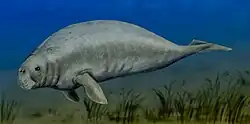
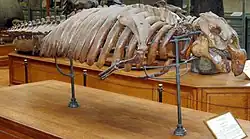
Halitherium – rodzaj wczesnego brzegowca z późnego eocenu i oligocenu. Skamieniałości są częste w europejskich łupkach. W obrębie płetw posiadał nie wystawające kości palców. Zachowały się także pozostałości kończyn tylnych, z zewnątrz niewidoczne. Kość udowa łączyła się ze zredukowaną miednicą. Żebra z kolei wydłużyły się, prawdopodobnie miało to związek ze zwiększeniem pojemności płuc, co z kolei pozwalało zwierzęciu na lepszą regulację swej wyporności.
Gatunki
- Halitherium alleni
- Halitherium antillense
- Halitherium christolii
- Halitherium schinzii
- Halitherium taulannense
Bibliografia
- National Geographic Prehistoric Mammals (National Geographic) by Alan Turner
- Marine Mammals: Evolutionary Biology by Annalisa Berta, James L. Sumich, and Kit M. Kovacs
- The Beginning of the Age of Mammals by Kenneth D. Rose
- Encyclopedia of Marine Mammals by William F. Perrin, Bernd Wursig, and J. G.M. Thewissen
- Colbert's Evolution of the Vertebrates: A History of the Backboned Animals Through Time by Edwin H. Colbert, Michael Morales, and Eli C. Minkoff
- Origin of Species by Charles Darwin
- Classification of Mammals by Malcolm C. McKenna and Susan K. Bell
- The Rise of Placental Mammals: Origins and Relationships of the Major Extant Clades by Kenneth D. Rose and J. David Archibald