Hirola
| Beatragus | |||
| E. Heller, 1912[1] | |||
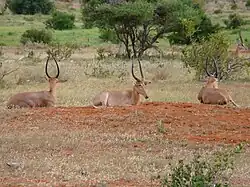 Przedstawiciele rodzaju – stado hiroli okularowej (B. hunteri) | |||
| Systematyka | |||
| Domena | |||
|---|---|---|---|
| Królestwo | |||
| Gromada | |||
| Podgromada | |||
| Infragromada | |||
| Rząd | |||
| Podrząd | |||
| Infrarząd | |||
| Rodzina | |||
| Podrodzina | |||
| Plemię | |||
| Rodzaj |
hirola | ||
| Typ nomenklatoryczny | |||
|
Cobus hunteri P.L. Sclater, 1889 | |||
| Gatunki | |||
| |||
Hirola[2] (Beatragus) – rodzaj ssaków z podrodziny antylop (Antilopinae) w obrębie rodziny wołowatych (Bovidae).
Zasięg występowania
Rodzaj obejmuje jeden gatunek występujący w Afryce Wschodniej[3][4].
Systematyka
Rodzaj zdefiniował w 1912 roku amerykański zoolog Edmund Heller w artykule poświęconym nowym taksonom afrykańskich kopytnych opublikowanym na łamach Smithsonian miscellaneous collections[1]. Na gatunek typowy Heller wyznaczył (oryginalne oznaczenie) hirolę okularową (B. hunteri).
Etymologia
Beatragus: gr. βους bous, βοος boos ‘byk, wół’[5]; τραγος tragos ‘kozioł’[6].
Podział systematyczny
Do rodzaju należy jeden występujący współcześnie gatunek[7][8][3][2]:
- Beatragus hunteri P.L. Sclater, 1889 – hirola okularowa
Opisano również wymarłe późnoplioceńskie gatunki:
Przypisy
- 1 2 E. Heller. New genera and races of African ungulates. „Smithsonian miscellaneous collections”. 60 (8), s. 8, 1912. (ang.).
- 1 2 Nazwy zwyczajowe za: W. Cichocki, A. Ważna, J. Cichocki, E. Rajska-Jurgiel, A. Jasiński & W. Bogdanowicz: Polskie nazewnictwo ssaków świata. Warszawa: Muzeum i Instytut Zoologii PAN, 2015, s. 177. ISBN 978-83-88147-15-9. (pol. • ang.).
- 1 2 C.J. Burgin, D.E. Wilson, R.A. Mittermeier, A.B. Rylands, T.E. Lacher & W. Sechrest: Illustrated Checklist of the Mammals of the World. Cz. 2: Eulipotyphla to Carnivora. Barcelona: Lynx Edicions, 2020, s. 352–356. ISBN 978-84-16728-35-0. (ang.).
- ↑ D.E. Wilson & D.M. Reeder (redaktorzy): Genus Beatragus. [w:] Mammal Species of the World. A Taxonomic and Geographic Reference (Wyd. 3) [on-line]. Johns Hopkins University Press, 2005. [dostęp 2022-09-29].
- ↑ Jaeger 1959 ↓, s. 38.
- ↑ Jaeger 1959 ↓, s. 269.
- ↑ N. Upham, C. Burgin, J. Widness, M. Becker, C. Parker, S. Liphardt, I. Rochon & D. Huckaby: Treeview of Mammalian Taxonomy Hierarchy. [w:] ASM Mammal Diversity Database (Version 1.11) [on-line]. American Society of Mammalogists. [dostęp 2023-12-03]. (ang.).
- ↑ Class Mammalia. W: Lynx Nature Books: All the Mammals of the World. Barcelona: Lynx Edicions, 2023, s. 815. ISBN 978-84-16728-66-4. (ang.).
- ↑ L.S.B. Leakey: Mammalian fauna: Bovidae. W: L.S.B. Leakey: Olduvai Gorge 1951-61. Cz. 1: Fauna and Background. Cambridge: Cambridge University Press, 1965, s. 61. (ang.).
- ↑ F. Bibi, J. Rowan & K. Reed. Late Pliocene Bovidae from Ledi-Geraru (Lower Awash Valley, Ethiopia) and their implications for afar paleoecology. „Journal of Vertebrate Paleontology”. 37 (4), s. e1337639, 2017. DOI: 10.1080/02724634.2017.1337639. (ang.).
- ↑ E.S. Vrba. New fossils of Alcelaphini and Caprinae (Bovidae: Mammalia) from Awash, Ethiopia, and phylogenetic analysis of Alcelaphini. „Palaeontologia africana”. 34, s. 160, 1997. (ang.).
Bibliografia
- E.C. Jaeger: Source-book of biological names and terms. Wyd. 3 (Revised second printing). Springfield: Charles C. Thomas, 1959, s. 1–316. (ang.).