Jamraj
| Perameles | |||
| É. Geoffroy Saint-Hilaire, 1804[1][2] | |||
 Jamraj nosaty (P. nasuta) | |||
| Systematyka | |||
| Domena | |||
|---|---|---|---|
| Królestwo | |||
| Typ | |||
| Podtyp | |||
| Gromada | |||
| Podgromada | |||
| Infragromada | |||
| Nadrząd | |||
| Rząd | |||
| Rodzina | |||
| Podrodzina | |||
| Rodzaj |
jamraj | ||
| Typ nomenklatoryczny | |||
|
Perameles nasuta É. Geoffroy Saint-Hilaire, 1804 | |||
| Synonimy | |||
|
| |||
| Gatunki | |||
| |||
Jamraj[9] (Perameles) – rodzaj niewielkich ssaków z podrodziny jamrajów (Peramelinae) w obrębie rodziny jamrajowatych (Peramelidae).
Rozmieszczenie geograficzne
Rodzaj obejmuje gatunki występujące w Australii[10][11][12].
Morfologia
Długość ciała 17,3–44,5 cm, długość ogona 7–16 cm; masa ciała 165–1400 g[13][11][14].
Systematyka
Rodzaj zdefiniował w 1804 roku francuski przyrodnik Étienne Geoffroy Saint-Hilaire w artykule zatytułowanym Uwaga na temat rodzajów Phascolomis i Perameles, nowych rodzajów torbaczy, opublikowanym w czasopiśmie „Annales du Muséum d’Histoire Naturelle”[2]. Geoffroy Saint-Hilaire nie wymienił żadnego gatunku; gatunkiem typowym jest (późniejsze oznaczenie)[15] jamraj nosaty (P. nasuta).
Etymologia
Podział systematyczny
Do rodzaju należą następujące występujące współcześnie i wymarłe roku[e] gatunki[19][10][9]:
| Grafika | Gatunek | Autor i rok opisu | Nazwa zwyczajowa[9] | Podgatunki[11][10][14] | Rozmieszczenie geograficzne[11][10][14][20] | Podstawowe wymiary[11][13][14][f] | Status IUCN[21] |
|---|---|---|---|---|---|---|---|
 |
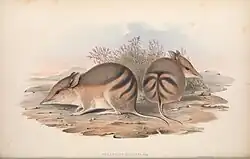
Perameles bougainville | Quoy & Gaimard, 1824 | jamraj zachodni | 2 podgatunki (w tym 1 wymarły) | Australia Zachodnia (Zatoka Rekina) i Australia Południowa (reintrodukowany w ramach projektu Arid Recovery) | DC: 17,3–23 cm DO: 8,1–10,6 cm MC: 165–300 g |
VU |
 |
Perameles fasciata | J.E. Gray, 1841 | gatunek monotypowy | Queensland i Nowa Południowa Walia[g] | DC: brak danych DO: brak danych MC: brak danych |
NE | |
| Perameles myosuros | J.A. Wagner, 1841 | gatunek monotypowy | dawniej lokalnie licznie występujący w Wheatbelt w południowo-zachodniej Australii Zachodniej; zapisy z jaskiń Nullarbor (Australia Zachodnia/Australia Południowa)[h] | DC: brak danych DO: 9,6–11 cm[22] MC: brak danych |
NE | ||
| Perameles notina | O. Thomas, 1922 | gatunek monotypowy | okazy zebrane głównie w południowo-wschodniej Australii Południowej; odnotowano również jako pospolite na rzece Murray (Wiktoria i Nowa Południowa Walia)[i] | DC: 28 cm[23] DO: 7,5–9 cm[23][22] MC: brak danych |
NE | ||
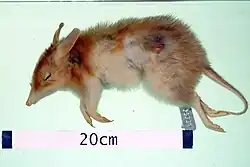 |
Perameles eremiana | W.B. Spencer, 1897 | jamraj pustynny | gatunek monotypowy | znany z południowego Terytorium Północnego aż daleko na północ do pustyni Tanami, rozciągający się na północno-zachodnią Australię Południową i Australię Zachodnią | DC: 18–28,5 cm DO: 7,7–13,5 cm MC: około 250 g |
EX |
| Perameles pallescens | O. Thomas, 1923 | gatunek monotypowy | północny Queensland (Wet Tropics i półwysep Jork) | DC: 31–44 cm DO: 12–16 cm MC: 0,52–1,3 kg |
NE | ||
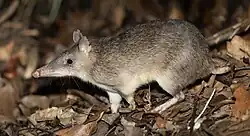 |
Perameles nasuta | É. Geoffroy Saint-Hilaire, 1804 | jamraj nosaty | gatunek monotypowy | środkowo-północny Queensland na południe do WIktorii | DC: 31–44 cm DO: 12–16 cm MC: 0,52–1,3 kg |
LC |
 |
Perameles gunnii | J.E. Gray, 1838 | jamraj pręgowany | gatunek monotypowy | północna i wschodnia Tasmania (wraz z wyspą Bruny) i południowa Wiktoria | DC: 27–35 cm DO: 7–11 cm MC: 0,5–1,4 kg |
VU |
| Perameles papillon | Travouillon & M.J. Phillips, 2018 | gatunek monotypowy | znany z jaskiń niziny Nullarbor oraz przylegającej niziny Roe (po obu stronach granicy pomiędzy Australią Zachodnią a Południową)[j] | DC: brak danych DO: 5,4–8,9 cm[22] MC: brak danych |
NE |
Kategorie IUCN: LC – gatunek najmniejszej troski, VU – gatunek narażony, EX – gatunek wymarły; NE – gatunki niepoddane jeszcze ocenie.
Opisano również gatunki wymarłe w czasach prehistorycznych:
- Perameles allinghamensis M. Archer & Wade, 1976 – gatunek wymarły z pliocenu Australii[24]
- Perameles bowensis Muirhead, Dawson & M. Archer, 1997 – gatunek wymarły z pliocenu Australii[25]
- Perameles sobbei Price, 2002 – gatunek wymarły z plejstocenu Australii[26]
- Perameles wilkinsonorum Travouillon, Louys, Price, M. Archer, Hand & Muirhead, 2017 – gatunek wymarły z pliocenu Australii[27].
Uwagi
- ↑ Nowa nazwa dla Perameles É. Geoffroy Saint-Hilaire.
- 1 2 Niepoprawna późniejsza pisownia Perameles É. Geoffroy Saint-Hilaire, 1804.
- ↑ Wariant pisowni Thylacis Illiger, 1811.
- 1 2 Nieuzasadniona poprawka Perameles É. Geoffroy Saint-Hilaire, 1804.
- ↑ W teriologii za taksony współczesne uważa się również gatunki wymarłe po 1500 roku[18].
- ↑ DC – długość ciała; DO – długość ogona; MC – masa ciała
- ↑ Takson wymarły, znany tylko ze szczątków subfosylnych znalezionych w kilku stanowiskach. Prawdopodobnie bardziej rozpowszechniony w plejstocenie, a w holocenie przetrwał na równinach Liverpool (Nowa Południowa Walia) aż do wyginięcia prawdopodobnie w połowie XIX wieku[22][20].
- ↑ Takson wymarły prawdopodbnie około 1910 roku[22][20].
- ↑ Takson wymarły, ostatnio okaz zaobserwowano i zebrano w 1857 roku, ale dokładna data wyginięcia jest nieznana[22][20]
- ↑ Takson wymarły. Znany z zebranych żywych okazów i szczątków subfosylnych; data wyginięcia nieznana, ale uważa się, że nastąpiło to około końca lat 30. XX wieku (ostatni okaz zebrano w 1928 roku)[22][20].
Przypisy
- ↑ É. Geoffroy Saint-Hilaire. Note sur les genres Phascolomis et Perameles, nouveaux genres d’animaux à bourse. „Bulletin des Sciences, par la Société Philmathique”. 3 (80), s. 150, 1804. (fr.).
- 1 2 É. Geoffroy Saint-Hilaire. Sur un nouveau genre de Mammifères à bourse, nommé Péramèles. „Annales du Muséum d’Histoire Naturelle”. 4, s. 56, 1804. (fr.).
- ↑ J.K.W. Illiger: Prodromus systematis mammalium et avium: additis terminis zoographicis utriusque classis, eorumque versione germanica. Berolini: Sumptibus C. Salfeld, 1811, s. 76. (łac.).
- ↑ J.G. Fischer von Waldheim: Zoognosia tabulis synopticis illustrata, in usum praelectionum Academiae imperialis medico-chirugicae mosquensis edita. Cz. 3. Mosquae: Nicolai S. Vsevolozsky, 1814, s. v. (łac.).
- ↑ L. Oken: Lehrbuch der Naturgeschichte. T. 3. Cz. 2. Jena: August Schmid, 1816, s. xvi, 1128. (niem.).
- ↑ J.E. Gray: Synopsis of the species of the class Mammalia. W: E. Griffith (red.): Animal Kingdom arranged in conformity with its organization, by the Baron Cuvier, member of the Institute of France, &c. &c. &c. with additional descriptions of all the species hitherto named, and of many not before noticed. Cz. 5. London: G.B. Whittaker, 1827, s. 194. (ang.).
- ↑ H.O. Lenz: Naturgeschichte der Säugethiere, nach Cuvier’s System bearbeitet. Gotha: Becker, 1831, s. 158. (niem.).
- ↑ H. Winge: Jordfundne og nulevende pungdyr (Marsupialia) fra Lagoa Santa, Minas Geraes, Brasilien: med udsigt over pungdyrenes slægtskab. Kjøbenhavn: F. Dreyer, 1893, s. 124. (duń.).
- 1 2 3 Nazwy polskie za: W. Cichocki, A. Ważna, J. Cichocki, E. Rajska-Jurgiel, A. Jasiński & W. Bogdanowicz: Polskie nazewnictwo ssaków świata. Warszawa: Muzeum i Instytut Zoologii PAN, 2015, s. 10. ISBN 978-83-88147-15-9. (pol. • ang.).
- 1 2 3 4 C.J. Burgin, D.E. Wilson, R.A. Mittermeier, A.B. Rylands, T.E. Lacher & W. Sechrest: Illustrated Checklist of the Mammals of the World. Cz. 1: Monotremata to Rodentia. Barcelona: Lynx Edicions, 2020, s. 60–70. ISBN 978-84-16728-34-3. (ang.).
- 1 2 3 4 5 Ch. Dickman: Family Peramelidae (Bandicoots and Echymiperas). W: D.E. Wilson & R.A. Mittermeier: Handbook of the Mammals of the World. Cz. 5: Monotremes and Marsupials. Barcelona: Lynx Edicions, 2015, s. 391–392. ISBN 978-84-96553-99-6. (ang.).
- ↑ D.E. Wilson & D.M. Reeder (red.): Genus Perameles. [w:] Mammal Species of the World. A Taxonomic and Geographic Reference (Wyd. 3) [on-line]. Johns Hopkins University Press, 2005. [dostęp 2020-10-24].
- 1 2 K. Helgen & E. Veatch: Extinct Marsupials and Monotremes. W: D.E. Wilson & R.A. Mittermeier: Handbook of the Mammals of the World. Cz. 5: Monotremes and Marsupials. Barcelona: Lynx Edicions, 2015, s. 28. ISBN 978-84-96553-99-6. (ang.).
- 1 2 3 4 Class Mammalia. W: Lynx Nature Books: All the Mammals of the World. Barcelona: Lynx Edicions, 2023, s. 50. ISBN 978-84-16728-66-4. (ang.).
- ↑ R.-P. Lesson: Péramèle. Perameles. Mam. W: J. Bory de Saint-Vincent: Dictionnaire classique d’histoire naturelle. T. 13. Paris: Rey et Gravier, Libraries-Editeurs, Auai des Augustins, n° 55; Baudouin Frèrer, Libraries-Editeurs, Imprimeurs de la société D'Histoire Naturelle, Rue de Vaugirard, n° 36, 1828, s. 197. (fr.).
- ↑ Palmer 1904 ↓, s. 522.
- ↑ Palmer 1904 ↓, s. 677.
- ↑ C.J. Burgin, J.S. Zijlstra, M.A. Becker, H. Handika, J.M. Alston, J. Widness, S. Liphardt, D.G. Huckaby & N.S. Upham: The ASM Mammal Diversity Database (About MDD). [w:] ASM Mammal Diversity Database (Version 2.0) [on-line]. American Society of Mammalogists. [dostęp 2025-03-20]. (ang.).
- ↑ N. Upham, C. Burgin, J. Widness, M. Becker, C. Parker, S. Liphardt, I. Rochon & D. Huckaby: Treeview of Mammalian Taxonomy Hierarchy. [w:] ASM Mammal Diversity Database (Version 1.11) [on-line]. American Society of Mammalogists. [dostęp 2023-07-29]. (ang.).
- 1 2 3 4 5 Appendix 1: Extinct species. W: Lynx Nature Books: All the Mammals of the World. Barcelona: Lynx Edicions, 2023, s. 698. ISBN 978-84-16728-66-4. (ang.).
- ↑ Taxonomy: Perameles – Genus. The IUCN Red List of Threatened Species. [dostęp 2025-03-20]. (ang.).
- 1 2 3 4 5 6 7 K.J. Travouillon & M.J. Phillips. Total evidence analysis of the phylogenetic relationships of bandicoots and bilbies (Marsupialia: Peramelemorphia): reassessment of two species and description of a new species. „Zootaxa”. 4378 (2), s. 224–256, 2018. DOI: 10.11646/zootaxa.4378.2.3. (ang.).
- 1 2 O. Thomas. On bandicoots allied to Perameles bougainville. „The Annals and magazine of natural history”. Ninth series. 10 (55), s. 144, 1922. (ang.).
- ↑ M. Archer & M. Wade. Results of the Ray E. Lemley expeditions, Part 1. The Allingham Formation and a new Pliocene vertebrate fauna from northern Queensland. „Memoirs of the Queensland Museum”. 17 (3), s. 382–395, 1976. (ang.).
- ↑ J. Muirhead, L. Dawson & M. Archer. Perameles bowensis, a new species of Perameles (Peramelemorphia, Marsupialia) from Pliocene faunas of Bow and Wellington Caves, New South Wales. „Proceedings of the Linnean Society of New South Wales”. 117, s. 165, 1997. (ang.).
- ↑ G.J. Price. Perameles sobbei sp. nov. (Marsupialia, Peramelidae), a Pleistocene bandicoot from the Darling Downs, south-eastern Queensland. „Memoirs of the Queensland Museum”. 48 (2), s. 194, 2002. (ang.).
- ↑ K.J. Travouillon, J. Louys, G.J. Price, M. Archer, S.J. Hand & J. Muirhead. A review of the Pliocene bandicoots of Australia, and descriptions of new genus and species. „Journal of Vertebrate Paleontology”. 37 (5), s. 7, 2017. DOI: 10.1080/02724634.2017.1360894. (ang.).
Bibliografia
- T.S. Palmer. Index Generum Mammalium: a List of the Genera and Families of Mammals. „North American Fauna”. 23, s. 1–984, 1904. (ang.).