Kacyki
| Icterinae | |||
| Vigors, 1825 | |||
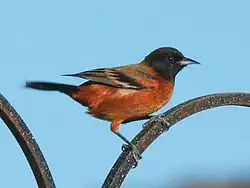 Kacyk kasztanowaty (Icterus spurius) | |||
| Systematyka | |||
| Domena | |||
|---|---|---|---|
| Królestwo | |||
| Typ | |||
| Podtyp | |||
| Gromada | |||
| Podgromada | |||
| Infragromada | |||
| Rząd | |||
| Podrząd | |||
| Rodzina | |||
| Podrodzina |
kacyki | ||
| Typ nomenklatoryczny | |||
|
Oriolus icterus Linnaeus, 1766 | |||
| Synonimy | |||
| |||
| Rodzaje | |||
|
| |||
Kacyki[4] (Icterinae) – monotypowa podrodzina ptaków z rodziny kacykowatych (Icteridae).
Zasięg występowania
Morfologia
Długość ciała 15–27 cm; masa ciała samców 22,1–88 g, samic 20,8–73,1 g[6].
Systematyka
Etymologia
- Icterus: łac. icterus – wilga, od gr. ικτερος ikteros – żółty ptak, prawdopodobnie wilga, którego spojrzenie miało leczyć żółtaczkę[7].
- Andriopsar: gr. ανδρειος andreios – silny, odważny, od ανηρ anēr, ανδρος andros – mężczyzna; ψαρ psar, ψαρος psaros – szpak[8]. Gatunek typowy: Psarocolius gularis Wagler, 1829.
Podział systematyczny
Podrodzina obejmuje jeden rodzaj, do którego należą następujące gatunki[4]:
- Icterus parisorum Bonaparte, 1838 – kacyk cytrynowy
- Icterus chrysater (Lesson, 1844) – kacyk czarnoskrzydły
- Icterus graduacauda Lesson, 1839 – kacyk czarnogłowy
- Icterus leucopteryx (Wagler, 1827) – kacyk jasnoskrzydły
- Icterus auratus Bonaparte, 1850 – kacyk złoty
- Icterus gularis (Wagler, 1829) – kacyk duży
- Icterus nigrogularis (Hahn, 1819) – kacyk czarnogardły
- Icterus bullockiorum (Swainson, 1827) – kacyk złotobrewy
- Icterus pustulatus (Wagler, 1829) – kacyk pąsowogłowy
- Icterus abeillei (Lesson, 1839) – kacyk czarnogrzbiety
- Icterus galbula (Linnaeus, 1758) – kacyk północny
- Icterus mesomelas (Wagler, 1829) – kacyk plantacjowy
- Icterus pectoralis (Wagler, 1829) – kacyk plamisty
- Icterus graceannae Cassin, 1867 – kacyk białoskrzydły
- Icterus jamacaii (J.F. Gmelin, 1788) – kacyk modrooki
- Icterus icterus (Linnaeus, 1766) – kacyk plamoskrzydły
- Icterus croconotus (Wagler, 1829) – kacyk szafranowy
- Icterus maculialatus Cassin, 1848 – kacyk żółtobrzuchy
- Icterus wagleri P.L. Sclater, 1857 – kacyk czarnorzytny
- Icterus cucullatus Swainson, 1827 – kacyk maskowy
- Icterus prosthemelas (Strickland, 1850) – kacyk bananowy
- Icterus spurius (Linnaeus, 1766) – kacyk kasztanowaty
- Icterus northropi J.A. Allen, 1890 – kacyk bahamski – takson wyodrębniony z I. dominicensis[9][10][11]
- Icterus melanopsis (Wagler, 1829) – kacyk kubański – takson wyodrębniony z I. dominicensis[9][10][11]
- Icterus bonana (Linnaeus, 1766) – kacyk kasztanowogłowy
- Icterus portoricensis H. Bryant, 1866 – kacyk portorykański – takson wyodrębniony z I. dominicensis[9][10][11]
- Icterus oberi Lawrence, 1880 – kacyk ochrowy
- Icterus laudabilis P.L. Sclater, 1871 – kacyk złotobrzuchy
- Icterus dominicensis (Linnaeus, 1766) – kacyk haitański
- Icterus auricapillus Cassin, 1848 – kacyk płomiennogłowy
- Icterus pyrrhopterus (Vieillot, 1819) – kacyk melodyjny – takson wyodrębniony z I. cayanensis[12][13][10]
- Icterus cayanensis (Linnaeus, 1766) – kacyk epoletowy
Przypisy
- ↑ J. Cassin. A third study of the Icteridæ. „Proceedings of the Academy of Natural Sciences of Philadelphia”. 19, s. 49, 1867. (ang.).
- ↑ Icterus, [w:] Integrated Taxonomic Information System [dostęp 2017-08-10] (ang.).
- ↑ M.J. Brisson: Ornithologie, ou, Méthode contenant la division des oiseaux en ordres, sections, genres, especes & leurs variétés: a laquelle on a joint une description exacte de chaque espece, avec les citations des auteurs qui en ont traité, les noms quils leur ont donnés, ceux que leur ont donnés les différentes nations, & les noms vulgaires. T. 2. Parisiis: Ad Ripam Augustinorum, apud Cl. Joannem-Baptistam Bauche, bibliopolam, ad Insigne S. Genovesae, & S. Joannis in Deserto, 1760, s. 86. (fr.).
- 1 2 Systematyka i nazwy polskie za: P. Mielczarek & M. Kuziemko: Podrodzina: Icterinae Vigors, 1825 - kacyki (wersja: 2024-01-18). [w:] Kompletna lista ptaków świata [on-line]. Instytut Nauk o Środowisku Uniwersytetu Jagiellońskiego. [dostęp 2025-04-22].
- ↑ F. Gill, D. Donsker & P. Rasmussen (red.): Oropendolas, orioles, blackbirds. IOC World Bird List (v10.2). [dostęp 2021-01-03]. (ang.).
- ↑ R. Fraga: Family Icteridae (New World Blackbirds). W: J. del Hoyo, A. Elliott, D.A. Christie: Handbook of the Birds of the World. Cz. 16: Tanagers to New World Blackbirds. Barcelona: Lynx Edicions, 2011, s. 758–774. ISBN 978-84-96553-78-1. (ang.).
- ↑ The Key to Scientific Names ↓, Icterus [dostęp 2017-11-03].
- ↑ The Key to Scientific Names ↓, Andriopsar [dostęp 2017-11-03].
- 1 2 3 O.H. Garrido, J.W. Wiley & A. Kirkconnell. The genus Icterus in the West Indies. „Ornitologia Neotropical”. 16 (4), s. 449–470, 2005. (ang.).
- 1 2 3 4 R.J. Sturge, F. Jacobsen, B.B. Rosensteel, R.J. Neale & K.E. Omland. Colonization of South America from Caribbean Islands Confirmed by Molecular Phylogeny with Increased Taxon Sampling. „The Condor”. 111 (3), s. 575–579, 2009. DOI: 10.1525/cond.2009.080048. (ang.).
- 1 2 3 J.T. Weir, E. Bermingham & D. Schluter. The Great American Biotic Interchange in birds. „Proceedings of the National Academy Sciences”. 106 (51), s. 21737–21742, 2009. DOI: 10.1073/pnas.0903811106. (ang.).
- ↑ K.E. Omland, S.M. Lanyon & S.J. Fritz. A Molecular Phylogeny of the NewWorld Orioles (Icterus): The Importance of Dense Taxon Sampling. „Molecular Phylogenetics nad Evolution”. 12 (2), s. 224–239, 1999. DOI: 10.1006/mpev.1999.0611. (ang.).
- ↑ F. Mendonça D’Horta, J.M. Cardoso Da Silva & C. Cherem Ribas. Species limits and hybridization zones in Icterus cayanensis–chrysocephalus group (Aves: Icteridae). „Biological Journal of the Linnean Society”. 95 (3), s. 583–597, 2008. DOI: 10.1111/j.1095-8312.2008.01059.x. (ang.).
Bibliografia
- The Key to Scientific Names, J.A. Jobling (red.), [w:] Birds of the World, S.M. Billerman et al. (red.), Cornell Lab of Ornithology, Ithaca (ang.).