Krety (plemię ssaków)
| Talpini | |||||
| G. Fischer, 1814[1] | |||||
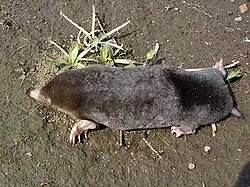 Kretowiec mały (Mogera imaizumii) | |||||
| Systematyka | |||||
| Domena | |||||
|---|---|---|---|---|---|
| Królestwo | |||||
| Typ | |||||
| Podtyp | |||||
| Gromada | |||||
| Podgromada | |||||
| Infragromada | |||||
| Rząd | |||||
| Podrząd | |||||
| Rodzina | |||||
| Podrodzina | |||||
| Plemię |
krety | ||||
| Typ nomenklatoryczny | |||||
|
Talpa Linnaeus, 1758 | |||||
| |||||
| Rodzaje | |||||
| |||||
Krety[15] (Talpini) – plemię ssaków z podrodziny kretów (Talpinae) w obrębie rodziny kretowatych (Talpidae).
Zasięg występowania
Systematyka
Do plemienia należą następujące występujące współcześnie rodzaje[18][16][15]:
- Talpa Linnaeus, 1758 – kret
- Oreoscaptor Kawada, 2016 – jedynym przedstawicielem jest Oreoscaptor mizura (A. Günther, 1880) – azjokret górski
- Mogera Pomel, 1848 – kretowiec
- Euroscaptor G.S. Miller, 1940 – azjokret
- Parascaptor Gill, 1875 – kretowczyk – jedynym przedstawicielem jest Parascaptor leucurus (E. Blyth, 1850) – kretowczyk białoognowy
- Scaptochirus A. Milne-Edwards, 1867 – piżmokret – jedynym żyjącym współcześnie przedstawicielem jest Scaptochirus moschatus A. Milne-Edwards, 1867 – piżmokret krótkolicy
Opisano również rodzaj wymarły[19][20]:
- Skoczenia Rzebik-Kowalska, 2014 – jedynym przedstawicielem był Skoczenia copernici (Skoczeń, 1980)
Przypisy
- ↑ G. Fischer: Zoognosia tabulis synopticis illustrata. Cz. 3. Moskwa: Typis Nicolai S. Vsevolozsky, 1814, s. x. (łac.).
- ↑ C.S. Rafinesque: Analyse de la nature, or, Tableau de l’univers et des corps organisés. Palerme: Aux dépens de l’auteur, 1815, s. 59. (fr.).
- 1 2 J.E. Gray. An Outline of an Attempt at the Disposition of Mammalia into Tribes and Families, with a List of the Genera apparently appertaining to each Tribe. „Annals of Philosophy”. New Series. 10, s. 339, 1825. (ang.).
- ↑ G.T. Burnett. Illustrations of the Quadrupeda, or Quadrupeds, being the arrangement of the true four-footed Beasts indicated in outline. „Quarterly Journal of Science, Literature and the Arts”. July to December, 1829, s. 349, 1829. (ang.).
- ↑ R.-P. Lesson: Nouveau Tableau du Règne Animal: Mammifères. Paris: Arthus Bertrand, 1842, s. 86. (fr.).
- ↑ A.N. Pomel. Études sur les carnassiers insectivores (Extrait). Seconde partie.—Classification des insectivores. „Archives des sciences physiques et naturelles”. 9, s. 246, 1848. (fr.).
- ↑ W.C.H. Peters. Über die Säugethiergattung Solenodon. „Abhandlungen der Königlichen Akademie der Wissenschaften zu Berlin”. Aus dem Jahre 1864, s. 21, 1864. (niem.).
- ↑ E. Haeckel: Generelle morphologie der organismen. Allgemeine grundzüge der organischen formen-wissenschaft, mechanisch begründet durch die von Charles Darwin reformirte descendenztheorie. Cz. 2. Berlin: G. Reimer, 1866, s. clx. (niem.).
- ↑ A. Murray: The Geographical Distribution of Mammals. London: Day and Son, 1866, s. 319. (ang.).
- ↑ É.L. Trouessart. Synopsis sytematicus et geographicus mammalium. „Revue et magasin de zoologie pure et appliquée”. 3e série. 7, s. 270, 1879. (fr.).
- ↑ G.E. Dobson: A Monograph of the Insectivora, Systematic and Anatomical: Including the families Erinaceidæ, Centetidæ, and Solenodontidæ. Cz. 2. London: J. Van Voorst, 1883, s. 128. (ang.).
- ↑ A.N.Ch. Acloque: Faune de France: contenant la description des espèces indigènes disposées en tableaux analytiques; et illustrée de figures représentant les types caractéristiques des genres. Paris: Librairie J.-B. Baillière et Fils, 19 rue Hautefeuille, près du boulevard Saint-Germain, 1900, s. 30. (fr.).
- ↑ H. Winge. Udsigt over Insektædernes indbyrdes Slægtskab. „Videnskabelige Meddelelser fra Dansk naturhistorisk Forening i Kjøbenhavn”. 68, s. 124, 1917. (szw.).
- ↑ M.J. Novacek. Insectivora and Proteutheria of the later Eocene (Uintan) of San Diego County, California. „Contributions in science”. 283, s. 10, 1976. (ang.).
- 1 2 Nazwy zwyczajowe za: W. Cichocki, A. Ważna, J. Cichocki, E. Rajska-Jurgiel, A. Jasiński & W. Bogdanowicz: Polskie nazewnictwo ssaków świata. Warszawa: Muzeum i Instytut Zoologii PAN, 2015, s. 76-77. ISBN 978-83-88147-15-9. (pol. • ang.).
- 1 2 C.J. Burgin, D.E. Wilson, R.A. Mittermeier, A.B. Rylands, T.E. Lacher & W. Sechrest: Illustrated Checklist of the Mammals of the World. Cz. 2: Eulipotyphla to Carnivora. Barcelona: Lynx Edicions, 2020, s. 80–86. ISBN 978-84-16728-35-0. (ang.).
- ↑ D.E. Wilson & D.M. Reeder (redaktorzy): Tribe Talpini. [w:] Mammal Species of the World. A Taxonomic and Geographic Reference (Wyd. 3) [on-line]. Johns Hopkins University Press, 2005. [dostęp 2021-01-14].
- ↑ C.J. Burgin, J.S. Zijlstra, M.A. Becker, H. Handika, J.M. Alston, J. Widness, S. Liphardt, D.G. Huckaby & N.S. Upham: The ASM Mammal Diversity Database. [w:] ASM Mammal Diversity Database (Version 2.1) [on-line]. American Society of Mammalogists. [dostęp 2025-04-15]. (ang.).
- ↑ J.S. Zijlstra, Talpini Fischer, 1814, Hesperomys project (Version 23.8.1), DOI: 10.5281/zenodo.7654755 [dostęp 2023-10-25] (ang.).
- ↑ B. Rzebik-Kowalska. Review of the Pliocene and Pleistocene Talpidae (Soricomorpha, Mammalia) of Poland. „Palaeontologia Electronica”. 17 (2; 26A), s. 17, 2014. (ang.).