Leptodeira
| Leptodeira[1] | |||
| Fitzinger, 1843[2] | |||
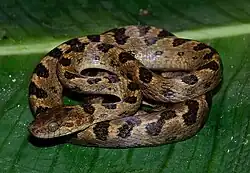 Leptodeira annulata | |||
| Systematyka | |||
| Domena | |||
|---|---|---|---|
| Królestwo | |||
| Typ | |||
| Podtyp | |||
| Gromada | |||
| Podgromada | |||
| Rząd | |||
| Podrząd | |||
| Infrarząd | |||
| Nadrodzina |
Colubroidea | ||
| Rodzina | |||
| Podrodzina | |||
| Rodzaj |
Leptodeira | ||
| Typ nomenklatoryczny | |||
|
Coluber annulatus Linnaeus, 1758 | |||
| Synonimy | |||
|
| |||
| Gatunki | |||
| |||
Leptodeira – rodzaj węży z podrodziny ślimaczarzy (Dipsadinae) w rodzinie połozowatych (Colubridae).
Zasięg występowania
Rodzaj obejmuje gatunki występujące w Stanach Zjednoczonych (Teksas), Meksyku, Belize, Gwatemali, Salwadorze, Hondurasie, Nikaragui, Kostaryce, Panamie, Kolumbii, Wenezueli, Trynidadzie i Tobago, na Arubie, w Gujanie, Surinamie, Gujanie Francuskiej, Brazylii, Ekwadorze, Peru, Boliwii, Paragwaju i Argentynie[5][6].
Systematyka
Etymologia
- Leptodeira: gr. λεπτος leptos „delikatny, drobny”; δειρη deirē „szyja”[7].
- Megalops: gr. μεγας megas, μεγαλη megalē „wielki”[8]; ωψ ōps, ωπος ōpos „twarz, oblicze, oczy”[9]. Gatunek typowy: Megalops maculatus Hallowell, 1860.
- Anoplophallus: gr. ανοπλος anoplos „bez tarczy, nieuzbrojony”, od negatywnego przedrostka αν- an- „bez”; ὁπλον hoplon „duża tarcza, zbroja, oręż”[10]; φαλλος phallos „penis”[11]. Nazwa zastępcza dla Megalops Hallowell, 1860 (nazwa zajęta przez Megalops Lacépède, 1803 (Megalopidae)).
Podział systematyczny
Do rodzaju należą następujące gatunki[5]:
- Leptodeira annulata (Linnaeus, 1758)
- Leptodeira approximans (Günther, 1872)
- Leptodeira ashmeadii (Hallowell, 1845)
- Leptodeira bakeri Ruthven, 1936
- Leptodeira frenata (Cope, 1886)
- Leptodeira larcorum Schmidt & Walker, 1943
- Leptodeira maculata (Hallowell, 1861)
- Leptodeira misinawui Torres-Carvajal, Sánchez-Nivicela, Posse, Celi & Koch, 2020
- Leptodeira nigrofasciata Günther, 1868
- Leptodeira ornata (Bocourt, 1884)
- Leptodeira pulchriceps Duellman, 1958
- Leptodeira punctata (Peters, 1866)
- Leptodeira rhombifera Günther, 1872
- Leptodeira rubricata (Cope, 1893)
- Leptodeira septentrionalis (Kennicott, 1859)
- Leptodeira splendida Günther, 1885
- Leptodeira tarairiu Costa, Graboski, Grazziotin, Zaher, Rodrigues & Prudente, 2022
- Leptodeira uribei (Bautista & Smith, 1992)
Przypisy
- ↑ Leptodeira, [w:] Integrated Taxonomic Information System (ang.).
- ↑ L.J.F.J. Fitzinger: Systema reptilium. Fasciculus primus, Amblyglossae. Vindobonae: Braumüller et Seidel, 1843, s. 27. (łac.).
- ↑ E. Hallowell. Report upon the Reptilia of the North Pacific Exploring Expedition, under command of Capt. John Rogers, U. S. N. „Proceedings of the Academy of Natural Sciences of Philadelphia”. 12, s. 488, 1861. (ang.).
- ↑ E.D. Cope. Prodromus of a new system of non-venomous snakes. „The American Naturalist”. 27 (1), s. 480, 1893. (ang.).
- 1 2 P. Uetz & J. Hallermann: Genus: Leptodeira. The Reptile Database. [dostęp 2025-05-28]. (ang.).
- ↑ Rune Midtgaard, Genus Leptodeira, [w:] RepFocus – A Survey of the Reptiles of the World [online] [dostęp 2025-05-28] (ang.).
- ↑ Reptilia. W: L. Agassiz: Nomenclator zoologicus, continens nomina systematica generum animalium tam viventium quam fossilium, secundum ordinem alphabeticum disposita, adjectis auctoribus, libris, in quibus reperiuntur, anno editionis, etymologia et familiis, ad quas pertinent, in singulis classibus. Soloduri: Jent et Gassmann, 1842–1846, s. 26. (łac.).
- ↑ Jaeger 1944 ↓, s. 133.
- ↑ Jaeger 1944 ↓, s. 155.
- ↑ Jaeger 1944 ↓, s. 17.
- ↑ Jaeger 1944 ↓, s. 169.
Bibliografia
- Edmund C. Jaeger, Source-book of biological names and terms, wyd. 1, Springfield: Charles C. Thomas, 1944, s. 1–256, OCLC 637083062 (ang.).