Lichenostomus
| Lichenostomus[1] | |||
| Cabanis, 1851[2] | |||
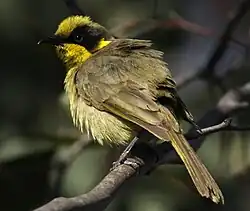 Przedstawiciel rodzaju – eukaliptusowczyk żółtoczelny (L. melanops) | |||
| Systematyka | |||
| Domena | |||
|---|---|---|---|
| Królestwo | |||
| Typ | |||
| Podtyp | |||
| Gromada | |||
| Podgromada | |||
| Infragromada | |||
| Rząd | |||
| Podrząd | |||
| Rodzina | |||
| Rodzaj |
Lichenostomus | ||
| Typ nomenklatoryczny | |||
|
Lichenostomus occidentalis[a] Cabanis, 1853 | |||
| Synonimy | |||
|
| |||
| Gatunki | |||
| |||
Lichenostomus – rodzaj ptaków z rodziny miodojadów (Meliphagidae).
Zasięg występowania
Morfologia
Długość ciała 16–21 cm, masa ciała 12–41 g[5].
Systematyka
Etymologia
Podział systematyczny
Uwagi
Przypisy
- ↑ Lichenostomus, [w:] Integrated Taxonomic Information System (ang.).
- ↑ J. Cabanis: Museum Heineanum: Verzeichniss der ornithologischen Sammlung des Oberamtmann Ferdinand Heine, auf Gut St. Burchard vor Halberstadt. T. 1: Singvögel. Halberstadt: In Commission bei R. Frantz, 1850–1851, s. 119. (niem.).
- ↑ G.M. Mathews. A Reference-List to the Birds of Australia. „Novitates zoologicae”. 18 (3), s. 414, 1911–1912. (ang.).
- ↑ F. Gill, D. Donsker & P. Rasmussen (redaktorzy), Honeyeaters [online], IOC World Bird List (v13.1) [dostęp 2023-05-30] (ang.).
- ↑ D.W. Winkler, S.M. Billerman & I.J. Lovette, Honeyeaters (Meliphagidae), version 1.0, [w:] S.M. Billerman, B.K. Keeney, P.G. Rodewald & T.S. Schulenberg (redaktorzy), Birds of the World, Cornell Lab of Ornithology, Ithaca, NY 2021, DOI: 10.2173/bow.meliph3.01 [dostęp 2023-05-30] (ang.).

- ↑ The Key to Scientific Names ↓, Lichenostomus [dostęp 2023-05-30].
- ↑ The Key to Scientific Names ↓, Lophoptilotis [dostęp 2023-05-30].
- ↑ Systematyka i nazwy polskie za: P. Mielczarek & M. Kuziemko, Rodzina: Meliphagidae Vigors, 1825 – miodojady – Honeyeaters (wersja: 2023-01-01), [w:] Kompletna lista ptaków świata [online], Instytut Nauk o Środowisku Uniwersytetu Jagiellońskiego [dostęp 2023-05-30].
Bibliografia
- The Key to Scientific Names, J.A. Jobling (red.), [w:] Birds of the World, S.M. Billerman et al. (red.), Cornell Lab of Ornithology, Ithaca (ang.).