Lycodon
| Lycodon[1] | |||||
| Fitzinger, 1826[2] | |||||
 Wilkoząb dwubarwny (L. striatus) | |||||
| Systematyka | |||||
| Domena | |||||
|---|---|---|---|---|---|
| Królestwo | |||||
| Typ | |||||
| Podtyp | |||||
| Gromada | |||||
| Podgromada | |||||
| Rząd | |||||
| Podrząd | |||||
| Infrarząd | |||||
| Nadrodzina |
Colubroidea | ||||
| Rodzina | |||||
| Podrodzina | |||||
| Rodzaj |
Lycodon | ||||
| Typ nomenklatoryczny | |||||
|
Coluber aulicus Linnaeus, 1758 | |||||
| |||||
| Gatunki | |||||
| |||||
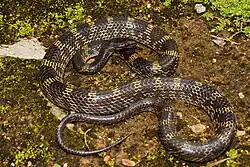
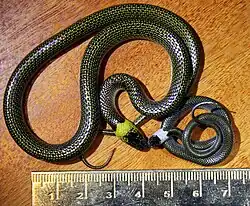
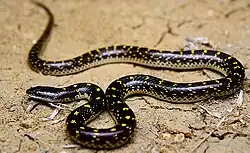
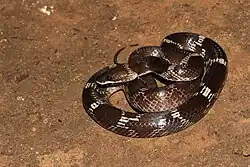
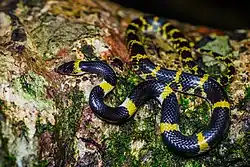
Lycodon – rodzaj węży z podrodziny Colubrinae w rodzinie połozowatych (Colubridae).
Zasięg występowania
Rodzaj obejmuje gatunki występujące w Iranie, Turkmenistanie, Uzbekistanie, Tadżykistanie, Afganistanie, Pakistanie, Indiach, Malediwach, Sri Lance, Nepalu, Chinach (włącznie z Tajwanem), Rosji (Kraj Nadmorski), Bhutanie, Bangladeszu, Mjanmie, Laosie, Wietnamie, Kambodży, Tajlandii, Malezji, Singapurze, Indonezji, Brunei, Timorze Wschodnim, Korei, Japonii, na Filipinach, Nowej Gwinei i w Australii (na Wyspie Bożego Narodzenia)[18][19].
Systematyka
Etymologia
- Lycodon: gr. λυκος lukos „wilk”[20]; οδους odous, οδοντος odontos „ząb”[21].
- Cercaspis: gr. κερκος kerkos „ogon”; ασπις aspis, ασπιδος aspidos „tarcza”[3]. Gatunek typowy: Hurria carinata Kuhl, 1820.
- Ophites: gr. οφιτης ophitēs „wężowaty, podobny do węża”[22]. Gatunek typowy: Lycodon subcinctus F. Boie, 1827.
- Dinodon: gr. δεινος deinos „straszny, groźny”[23]; οδους odous, οδοντος odontos „ząb”[21]. Gatunek typowy: Dinodon cancellatum Duméril, 1853 (= Lycodon rufozonatus Cantor, 1842).
- Odontomus: gr. οδους odous, οδοντος odontos „ząb”[21]; ομος omos „wspólny, złączony”[24]. Gatunek typowy: Coluber nympha Daudin, 1803.
- Sphecodes: gr. σφηκωδης sphēkōdēs „smukły jak osa”[25]. Gatunek typowy: Sphecodes albofuscus A.M.C. Duméril, Bibron & A.H.A. Duméril, 1854.
- Dryocalamus: gr. δρυς drus, δρυος druos „drzewo, zwłaszcza dąb”[26]; καλαμος kalamos „trzcina”[27]. Gatunek typowy: Dryocalamus tristrigatus Günther, 1858.
- Leptorhytaon: gr. λεπτος leptos „drobny”[28]; ῥυτις rhutis, ῥυτιδος rhutidos „fałda, zmarszczka”[29]. Gatunek typowy: Coluber jara Shaw, 1802.
- Tetragonosoma: gr. τετραγωνος tetragōnos „kwadrat”, od τετρα- tetra- „cztery”, od τεσσαρες tessares „cztery”[30]; σωμα sōma, σωματος sōmatos „ciało”[31]. Gatunek typowy: Lycodon effraenis Cantor, 1847.
- Eumesodon: gr. ευ eu „ładny, dobry”[32]; μεσος mesos „środkowy”[33]; οδους odous, οδοντος odontos „ząb”[21]. Gatunek typowy: Eumesodon semicarinatus Cope, 1860.
- Euprotodon: gr. ευ eu „ładny, dobry”[32]; πρωτος prōtos „przedni”[34]; οδους odous, οδοντος odontos „ząb”[21]. Gatunek typowy: Coluber aulicus Linnaeus, 1758.
- Lepidocephalus: gr. λεπις lepis, λεπιδος lepidos „łuska, płytka”, od λεπω lepō „łuszczyć”[28]; -κεφαλος -kephalos „-głowy”, od κεφαλη kephalē „głowa”[35]. Gatunek typowy: Lepidocephalus fasciatus Hallowell, 1860 (= Eumesodon semicarinatus Cope, 1860).
- Hydrophobus: gr. ὑδρο- hudro- „wodny-”, od ὑδωρ hudōr, ὑδατος hudatos „woda”[36]; φοβος phobos „strach, panika, paniczna ucieczka”, od φεβομαι phebomai „uciekać ze strachu, umykać”[37]. Gatunek typowy: Hydrophobus semifasciatus Günther, 1862 (= Coluber nympha Daudin, 1803).
- Nymphophidium: gr. νυμφη numphē „nimfa”[38]; οφιδιον ophidion „mały wąż”, zdrobnienie od οφις ophis, οφεως opheōs „wąż”[39]. Gatunek typowy: Nymphodidium maculatum Günther, 1864.
- Tytleria: płk Robert Christopher Tytler (1818–1872), oficer British Army w Indiach w latach 1835–1864, przyrodnik, pionier fotografii, kolekcjoner[14]. Gatunek typowy: Tytleria hypsirhinoides Theobald, 1868.
- Ulupe: etymologia nieznana, Blanford nie wyjaśnił pochodzenia nazwy rodzajowej[15]. Gatunek typowy: Ulupe davisoni Blanford, 1878.
- Lepturophis: gr. λεπτος leptos „delikatny, smukły”[28]; ουρα oura „ogon”[40]; οφις ophis, οφεως opheōs „wąż”[39]. Gatunek typowy: Lepturophis borneensis Boulenger, 1900 (= Sphecodes albofuscus A.M.C. Duméril, Bibron & A.H.A. Duméril, 1854).
- Haplonodon: gr. ἁπλοος haploos „pojedynczy”; νωδον nōdoς „bezzębny”[17]. Gatunek typowy: Haplonodon philippinensis Griffin, 1910 (= Lycodon muelleri A.M.C. Duméril, Bibron & A.H.A. Duméril, 1854).
Podział systematyczny
Do rodzaju należą następujące gatunki[18]:
- Lycodon albofuscus (Duméril, Bibron & Duméril, 1854)
- Lycodon alcalai Ota & Ross, 1994
- Lycodon anakradaya Nguyen, Duong, Wood & Grismer, 2022
- Lycodon aulicus (Linnaeus, 1758)
- Lycodon banksi Luu, Bonkowski, Nguyen, Le, Calame & Ziegler, 2018
- Lycodon bibonius Ota & Ross, 1994
- Lycodon bicolor (Nikolsky, 1903)
- Lycodon butleri Boulenger, 1900
- Lycodon capucinus Boie, 1827
- Lycodon cardamomensis Daltry & Wüster, 2002
- Lycodon carinatus (Kuhl, 1820)
- Lycodon cathaya Wang, Qi, Lyu, Zeng & Wang, 2020
- Lycodon cavernicolus Grismer, Quah, Anuar M.S., Muin, Wood & Nor, 2014
- Lycodon chapaensis (Angel & Bourret, 1933)
- Lycodon chithrasekarai (Wickramasinghe, Vidanapathirana, Pushpamal & Wickramasinghe, 2020)
- Lycodon chrysoprateros Ota & Ross, 1994
- Lycodon davidi Vogel, Nguyen, Kingsada & Ziegler, 2012
- Lycodon davisonii (Blanford, 1878)
- Lycodon deccanensis Ganesh, Deuti, Punith, Achyuthan, Mallik, Adhikari & Vogel, 2020
- Lycodon dumerilii (Boulenger, 1893)
- Lycodon effraenis Cantor, 1847
- Lycodon fasciatus (Anderson, 1879)
- Lycodon fasciolatus (Shaw, 1802)
- Lycodon fausti Gaulke, 2002
- Lycodon ferroni Lanza, 1999
- Lycodon flavicollis Mukherjee & Bhupathy, 2007
- Lycodon flavomaculatus Wall, 1907
- Lycodon flavozonatus (Pope, 1928)
- Lycodon futsingensis (Pope, 1928)
- Lycodon gammiei (Blanford, 1878)
- Lycodon gibsonae Vogel & David, 2019
- Lycodon gongshan Vogel & Luo, 2011
- Lycodon gracilis (Günther, 1864)
- Lycodon hypsirhinoides (Theobald, 1868)
- Lycodon jara (Shaw, 1802)
- Lycodon kundui Smith, 1943
- Lycodon laoensis Günther, 1864 – wilkoząb laotański[41]
- Lycodon latifasciatus Nguyen, Lee, Jiang, Ding, Chit, Poyarkov & Vogel, 2025
- Lycodon liuchengchaoi Zhang, Jiang, Vogel & Rao, 2011
- Lycodon muelleri Duméril, Bibron & Duméril, 1854
- Lycodon multifasciatus (Maki, 1931)
- Lycodon multizonatus (Zhao & Jiang, 1981)
- Lycodon neomaculatus (Nguyen, Lee, Pauwels, Kennedy-Gold, Poyarkov, David & Vogel, 2024)
- Lycodon nympha (Daudin, 1803)
- Lycodon obvelatus Wang, Yu, Vogel & Che, 2020
- Lycodon ophiophagus Vogel, David, Pauwels, Sumontha, Norval, Hendrix, Vu & Ziegler, 2009
- Lycodon orientalis (Hilgendorf, 1880)
- Lycodon paucifasciatus Rendahl, 1943
- Lycodon philippinus (Griffin, 1909)
- Lycodon pictus Janssen, Pham, Ngo, Le, Nguyen & Ziegler, 2019
- Lycodon poyarkovi Nguyen & Vogel, 2025
- Lycodon rosozonatus (Hu & Zhao, 1972)
- Lycodon rufozonatus Cantor, 1842
- Lycodon ruhstrati (Fischer, 1886)
- Lycodon sealei Leviton, 1955
- Lycodon semicarinatus (Cope, 1860)
- Lycodon septentrionalis (Günther, 1875)
- Lycodon serratus Wang, Yu, Vogel & Che, 2020
- Lycodon sidiki Wostl, Hamidy, Kurniawan & Smith, 2017
- Lycodon solivagus Ota & Ross, 1994
- Lycodon stormi Boettger, 1892
- Lycodon striatus (Shaw, 1802) – wilkoząb dwubarwny
- Lycodon subannulatus (Duméril, Bibron & Duméril, 1854)
- Lycodon subcinctus Boie, 1827
- Lycodon synaptor Vogel & David, 2010
- Lycodon tessellatus Jan, 1863
- Lycodon tiwarii Biswas & Sanyal, 1965
- Lycodon travancoricus (Beddome, 1870)
- Lycodon tristrigatus (Günther, 1858)
- Lycodon truongi Nguyen, Duong, Wood & Grismer, 2022
- Lycodon yunnanensis (Werner, 1922)
- Lycodon zawi Slowinski, Pawar, Win, Thin, Gyi, Oo & Tun, 2001
- Lycodon zayuensis Jiang, Wang, Jin & Che, 2020
- Lycodon zoosvictoriae Neang, Hartmann, Hun, Souter & Furey, 2014
Przypisy
- ↑ Lycodon, [w:] Integrated Taxonomic Information System (ang.).
- ↑ L.J.F.J. Fitzinger: Neue classification der reptilien nach ihren natürlichen verwandtschaften: nebst einer verwandtschafts-tafel und einem verzeichnisse der reptilien-sammlung des K. K. zoologischen museum’s zu Wien. Wien: J.G. Heubner, 1826, s. 29, 57. (niem.).
- 1 2 Wagler 1830 ↓, s. 191.
- ↑ Wagler 1830 ↓, s. 186.
- 1 2 Duméril 1853 ↓, s. 463.
- ↑ Duméril 1853 ↓, s. 461.
- ↑ Günther 1858 ↓, s. 121.
- ↑ Günther 1858 ↓, s. 205.
- ↑ Günther 1858 ↓, s. 253.
- 1 2 E.D. Cope. Catalogue of the Colubridae in the Museum of the Academy of Natural Sciences of Philadelphia, with notes and descriptions of new species. Part II. „Proceedings of the Academy of Natural Sciences of Philadelphia”. 12, s. 262, 1860. (ang.).
- ↑ E. Hallowell. Report upon the Reptilia of the North Pacific Exploring Expedition, under command of Capt. John Rogers, U. S. N.. „Proceedings of the Academy of Natural Sciences of Philadelphia”. 12 (1860), s. 498, 1861. (ang.).
- ↑ A.C.L.G. Günther. On new species of snakes in the collection of the British Museum. „The Annals and Magazine of Natural History”. Third Series. 9, s. 127, 1862. (ang.).
- ↑ A.C.L.G. Günther: The reptiles of British India. London: Pub. for the Ray society by R. Hardwicke, 1864, s. 235. (ang.).
- 1 2 W. Theobald. Catalogue of the reptiles of British Birna [sic], embracing the provinces of Pegu, Martaban, and Tenasserim; with descriptions of new or little-known species. „The Journal of the Linnean Society of London. Zoology”. 10, s. 49, 1870. (ang.).
- 1 2 W.T. Blanford. Notes on Reptilia from the Himalayas and Assam. „Proceedings of the Asiatic Society of Bengal”. 1878 (January to December), s. 141, 1878. (ang.).
- ↑ G.A. Boulenger. Descriptions of new reptiles and batrachians from Borneo. „Proceedings of the Zoological Society of London”. 1900, s. 183, 1900. (ang.).
- 1 2 L.E. Griffin. A list of snakes from the island of Polillo, P. I., with descriptions of a new genus and two new species. „The Philippine Journal of Science”. 5 (D), s. 211, 1910. (ang.).
- 1 2 P. Uetz & J. Hallermann: Genus: Lycodon. The Reptile Database. [dostęp 2025-05-30]. (ang.).
- ↑ R. Midtgaard, Genus Lycodon, [w:] RepFocus – A Survey of the Reptiles of the World [online] [dostęp 2025-05-30] (ang.).
- ↑ Jaeger 1944 ↓, s. 128.
- 1 2 3 4 5 Jaeger 1944 ↓, s. 151.
- ↑ Reptilia. W: L. Agassiz: Nomenclator zoologicus, continens nomina systematica generum animalium tam viventium quam fossilium, secundum ordinem alphabeticum disposita, adjectis auctoribus, libris, in quibus reperiuntur, anno editionis, etymologia et familiis, ad quas pertinent, in singulis classibus. Soloduri: Jent et Gassmann, 1842–1846, s. 30. (łac.).
- ↑ Jaeger 1944 ↓, s. 72.
- ↑ Jaeger 1944 ↓, s. 153.
- ↑ Jaeger 1944 ↓, s. 217.
- ↑ Jaeger 1944 ↓, s. 76.
- ↑ Jaeger 1944 ↓, s. 37.
- 1 2 3 Jaeger 1944 ↓, s. 122.
- ↑ Jaeger 1944 ↓, s. 198.
- ↑ Jaeger 1944 ↓, s. 233.
- ↑ Jaeger 1944 ↓, s. 215.
- 1 2 Jaeger 1944 ↓, s. 86.
- ↑ Jaeger 1944 ↓, s. 135.
- ↑ Jaeger 1944 ↓, s. 185.
- ↑ Jaeger 1944 ↓, s. 44.
- ↑ Jaeger 1944 ↓, s. 106.
- ↑ Jaeger 1944 ↓, s. 171.
- ↑ Jaeger 1944 ↓, s. 149.
- 1 2 Jaeger 1944 ↓, s. 154.
- ↑ Jaeger 1944 ↓, s. 247.
- ↑ Praca zbiorowa: Zwierzęta: encyklopedia ilustrowana. Warszawa: Wydawnictwo Naukowe PWN, 2005, s. 404. ISBN 83-01-14344-4.
Bibliografia
- J.G. Wagler: Natürliches System der Amphibien, mit vorangehender Classification der Säugethiere und Vögel. Ein Beitrag zur vergleichenden Zoologie. München, Stuttgart und Tübingen: In der J.G. Cotta’scchen Buchhandlung, 1830, s. 1–354. (niem.).
- A.M.C. Duméril. Prodrome de la classification des reptiles ophidiens. „Mémoires de l’Académie des sciences de l’Institut de France”. 23, s. 399–535, 1853. (fr.).
- A.C.L.G. Günther: Catalogue of colubrine snakes in the collection of the British Museum. London: Printed by order of the Trustees, 1858, s. 1–281. (ang.).
- Edmund C. Jaeger, Source-book of biological names and terms, wyd. 1, Springfield: Charles C. Thomas, 1944, s. 1–256, OCLC 637083062 (ang.).