Mecistops
| Mecistops[1] | |||
| Gray, 1844[2] | |||
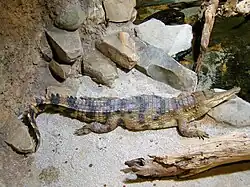 Przedstawiciel rodzaju – krokodyl wąskopyski (M. cataphractus) | |||
| Systematyka | |||
| Domena | |||
|---|---|---|---|
| Królestwo | |||
| Typ | |||
| Podtyp | |||
| Gromada | |||
| Podgromada | |||
| Rząd | |||
| Rodzina | |||
| Rodzaj |
Mecistops | ||
| Typ nomenklatoryczny | |||
|
Mecistops bennettii Gray, 1844 (= Crocodilus cataphractus Cuvier, 1825) | |||
| Gatunki | |||
| |||
Mecistops – rodzaj zauropsyda z rodziny krokodylowatych (Crocodylidae).
Zasięg występowania
Rodzaj obejmuje gatunki występujące w Afryce (Gambia, Gwinea, Sierra Leone, Liberia, Wybrzeże Kości Słoniowej, Ghana, Togo, Nigeria, Kamerun, Republika Środkowoafrykańska, Gwinea Równikowa, Gabon, Kongo, Demokratyczna Republika Konga, Burundi, Tanzania, Zambia i Angola)[3][4].
Systematyka
Etymologia
Mecistops: gr. μηκιστος mēkistos „najdłuższy”, forma wyższa od μακρος makros „długi”[5]; ωψ ōps, ωπος ōpos „wygląd, oblicze”[6].
Podział systematyczny
Do rodzaju należą następujące gatunki[3]:
- Mecistops cataphractus Cuvier, 1825 – krokodyl wąskopyski
- Mecistops leptorhynchus (Bennett, 1835)
Przypisy
- ↑ Mecistops, [w:] Integrated Taxonomic Information System (ang.).
- ↑ J.E. Gray: Catalogue of the tortoises, crocodiles, and amphisbaenians, in the collection of the British Museum. London: The Trustees, 1844, s. 57. (ang.).
- 1 2 P. Uetz & J. Hallermann: Genus: Mecistops. The Reptile Database. [dostęp 2021-02-27]. (ang.).
- ↑ R. Midtgaard: Mecistops. RepFocus. [dostęp 2021-02-27]. (ang.).
- ↑ Jaeger 1944 ↓, s. 133.
- ↑ Jaeger 1944 ↓, s. 155.
Bibliografia
- Edmund C. Jaeger, Source-book of biological names and terms, wyd. 1, Springfield: Charles C. Thomas, 1944, s. 1–256, OCLC 637083062 (ang.).