Mionectes
| Mionectes[1] | |||
| Cabanis, 1844[2] | |||
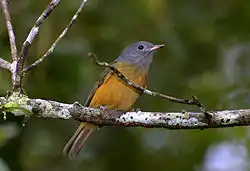 Przedstawiciel rodzaju – muchotyranik szarogłowy (M. rufiventris) | |||
| Systematyka | |||
| Domena | |||
|---|---|---|---|
| Królestwo | |||
| Typ | |||
| Podtyp | |||
| Gromada | |||
| Podgromada | |||
| Infragromada | |||
| Rząd | |||
| Podrząd | |||
| Rodzina | |||
| Podrodzina | |||
| Rodzaj |
Mionectes | ||
| Typ nomenklatoryczny | |||
|
M[uscicapa]. striaticollis d’Orbigny & Lafresnaye, 1837 | |||
| Synonimy | |||
|
| |||
| Gatunki | |||
| |||
Mionectes – rodzaj ptaków z podrodziny muchotyraników (Pipromorphinae) w rodzinie muchotyranikowatych (Pipromorphidae).
Zasięg występowania
Rodzaj obejmuje gatunki występujące w południowym Meksyku, Ameryce Centralnej i Południowej[5][6].
Morfologia
Długość ciała 12–14 cm; masa ciała 7,5–18,5 g[5].
Systematyka
Etymologia
- Mionectes: gr. μειονεκτης meionektēs „mało, ktoś kto poniósł stratę”, od μειονεκτεω meionekteō „mieć za mało, ponieść stratę”[7].
- Pipromorpha: rodzaj Pipra Linnaeus, 1764 (gorzyk); gr. μορφη morphē „wygląd, kształt”[8]. Gatunek typowy: Muscicapa oleagina M.H.C. Lichtenstein, 1823.
- Anomalopterus: gr. ανωμαλος anōmalos „dziwny”, od negatywnego przedrostka αν- an-; ομαλος omalos „równo”; -πτερος -pteros „-skrzydły”, od πτερον pteron „skrzydło”[9]. Gatunek typowy: Mionectes poliocephalus von Tschudi, 1844 (= M[uscicapa]. striaticollis d’Orbigny & Lafresnaye, 1837).
Podział systematyczny
Do rodzaju należą następujące gatunki[10]:
- Mionectes striaticollis (d’Orbigny & Lafresnaye, 1837) – muchotyranik cętkowany
- Mionectes olivaceus Lawrence, 1868 – muchotyranik oliwkowy
- Mionectes oleagineus (M.H.C. Lichtenstein, 1823) – muchotyranik ochrowy
- Mionectes macconnelli (C. Chubb, 1919) – muchotyranik rdzawy
- Mionectes roraimae (C. Chubb, 1919) – muchotyranik zielonawy
- Mionectes rufiventris Cabanis, 1846 – muchotyranik szarogłowy
Przypisy
- ↑ Mionectes, [w:] Integrated Taxonomic Information System (ang.).
- ↑ J. Cabanis. Avium Conspectus. „Archiv für Naturgeschichte”. 10, s. 275, 1844. (niem.).
- ↑ Ch.-L. Bonaparte. Conspectus systematis ornithologiæ. „Annales des sciences naturelles, Zoologie”. Quatrième série. 1, s. 134, 1854. (fr.).
- ↑ G.R. Gray: Catalogue of the genera and subgenera of birds contained in the British Museum. London: The Trustees, 1855, s. 50. (ang.).
- 1 2 D.W. Winkler, S.M. Billerman & I.J. Lovette: Tyrant Flycatchers (Tyrannidae), version 1.0. W: S.M. Billerman, B.K. Keeney, P.G. Rodewald & T.S. Schulenberg (red.): Birds of the World. Ithaca, NY: Cornell Lab of Ornithology, 2020. DOI: 10.2173/bow.tyrann2.01. [dostęp 2020-05-28]. (ang.).

- ↑ F. Gill, D. Donsker & P. Rasmussen (red.): Tyrant flycatchers. IOC World Bird List (v11.1). [dostęp 2021-02-06]. (ang.).
- ↑ Mionectes, [w:] The Key to Scientific Names, J.A. Jobling (red.), [w:] Birds of the World, S.M. Billerman et al. (red.), Cornell Lab of Ornithology, Ithaca [dostęp 2022-01-18] (ang.).
- ↑ Pipromorpha, [w:] The Key to Scientific Names, J.A. Jobling (red.), [w:] Birds of the World, S.M. Billerman et al. (red.), Cornell Lab of Ornithology, Ithaca [dostęp 2022-01-18] (ang.).
- ↑ Anomalopterus, [w:] The Key to Scientific Names, J.A. Jobling (red.), [w:] Birds of the World, S.M. Billerman et al. (red.), Cornell Lab of Ornithology, Ithaca [dostęp 2022-01-18] (ang.).
- ↑ Systematyka i nazwy polskie za: P. Mielczarek & M. Kuziemko: Podrodzina: Pipromorphinae - muchotyraniki (wersja: 2020-12-25). [w:] Kompletna lista ptaków świata [on-line]. Instytut Nauk o Środowisku Uniwersytetu Jagiellońskiego. [dostęp 2021-02-06].