Nyctidromus
| Nyctidromus[1] | |||
| Gould, 1838[2] | |||
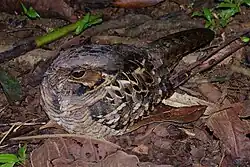 Lelkowiec białoszyi (N. albicollis) | |||
| Systematyka | |||
| Domena | |||
|---|---|---|---|
| Królestwo | |||
| Typ | |||
| Podtyp | |||
| Gromada | |||
| Podgromada | |||
| Infragromada | |||
| Rząd | |||
| Rodzina | |||
| Podrodzina | |||
| Rodzaj |
Nyctidromus | ||
| Typ nomenklatoryczny | |||
|
Nyctidromus derbyanus Gould, 1838 | |||
| Synonimy | |||
|
| |||
| Gatunki | |||
| |||
Nyctidromus – rodzaj ptaków z podrodziny lelków (Caprimulginae) w rodzinie lelkowatych (Caprimulgidae).
Zasięg występowania
Morfologia
Długość ciała 18–28 cm; masa ciała samców 32–87 g, samic 31–90 g[4].
Systematyka
Etymologia
- Nyctidromus: gr. νυκτι- nukti- „nocny”, od νυξ nux, νυκτος nuktos „noc”; -δρομος -dromos „biegacz”, od τρεχω trekhō „biegać”[5].
- Eucapripodus: gr. ευ eu „dobry”; łac. capra „koza”; gr. πους pous, ποδος podos „stopa”[6]. Gatunek typowy: Eucapripodus rutilus Lesson, 1843 (= Caprimulgus albicollis J.F. Gmelin, 1789).
Podział systematyczny
Do rodzaju należą następujące gatunki[7]:
- Nyctidromus albicollis (J.F. Gmelin, 1789) – lelkowiec białoszyi
- Nyctidromus anthonyi (Chapman, 1923) – lelkowiec ekwadorski – takson wyodrębniony z Caprimulgus[8][9].
Przypisy
- ↑ Nyctidromus, [w:] Integrated Taxonomic Information System (ang.).
- ↑ J. Gould: Icones Avium, or, figures and descriptions of new and interesting species of birds from various parts of the world. Cz. 2: Monograph of the Caprimulgidae. London: Published by the Author, 1838, s. ryc. 12 i tekst. (ang.).
- ↑ R.-P. Lesson. Index ornithologique. „L’Écho du monde savant et l’Hermès”. 10, s. 109, 1843. (fr.).
- 1 2 N. Cleere: Family Caprimulgidae (Nightjars). W: J. del Hoyo, A. Elliott & J. Sargatal: Handbook of the Birds of the World. Cz. 5: Barn-owls to Hummingbirds. Barcelona: Lynx Edicions, 1999, s. 343, 354. ISBN 84-87334-25-3. (ang.).
- ↑ Nyctidromus, [w:] The Key to Scientific Names, J.A. Jobling (red.), [w:] Birds of the World, S.M. Billerman et al. (red.), Cornell Lab of Ornithology, Ithaca [dostęp 2022-01-27] (ang.).
- ↑ Eucapripodus, [w:] The Key to Scientific Names, J.A. Jobling (red.), [w:] Birds of the World, S.M. Billerman et al. (red.), Cornell Lab of Ornithology, Ithaca [dostęp 2022-01-27] (ang.).
- ↑ Systematyka i nazwy polskie za: P. Mielczarek & M. Kuziemko: Podrodzina: Caprimulginae Vigors, 1825 - lelki (wersja: 2024-10-02). [w:] Kompletna lista ptaków świata [on-line]. Instytut Nauk o Środowisku Uniwersytetu Jagiellońskiego. [dostęp 2025-02-11].
- ↑ K.-L. Han, M.B. Robbins & M.J. Braun. A Multi-gene Estimate of Phylogeny in the Nightjars and Nighthawks (Caprimulgidae). „Molecular Phylogenetics and Evolution”. 55 (2), s. 443–453, 2010. DOI: 10.1016/j.ympev.2010.01.023. (ang.).
- ↑ K.-L. Han. Molecular Systematics of Nightjars and Nighthawks (Caprimulgidae). „Praca doktorska, University of Maryland”, 2006. (ang.).