Periporphyrus
| Periporphyrus | |||
| Reichenbach, 1850[1] | |||
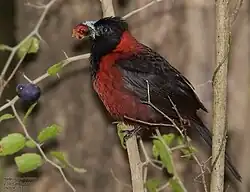 Przedstawiciel rodzaju – kostogryz szkarłatny (P. celaeno) | |||
| Systematyka | |||
| Domena | |||
|---|---|---|---|
| Królestwo | |||
| Typ | |||
| Podtyp | |||
| Gromada | |||
| Podgromada | |||
| Infragromada | |||
| Rząd | |||
| Podrząd | |||
| Rodzina | |||
| Rodzaj |
Periporphyrus | ||
| Typ nomenklatoryczny | |||
|
Loxia erythromelas J.F. Gmelin, 1789 | |||
| Synonimy | |||
| |||
| Gatunki | |||
| |||
Periporphyrus – rodzaj ptaków z rodziny kardynałów (Cardinalidae).
Występowanie
Rodzaj obejmuje gatunki występujące w Meksyku, Wenezueli, Gujanie, Surinamie, Gujanie Francuskiej i Brazylii[3][4].
Morfologia
Długość ciała 20,5–22 cm, masa ciała 48–60 g[4].
Systematyka
Rodzaj zdefiniował w 1850 roku niemiecki botanik i zoolog Ludwig Reichenbach w książce swojego autorstwa o tytule Avium systema naturale[1]. Reichenbach nie wskazał gatunku typowego; w ramach późniejszego oznaczenia w 1855 roku angielski ornitolog George Robert Gray na typ nomenklatoryczny wyznaczył kostogryza czerwonego (P. erythromelas)[5].
Etymologia
- Periporphyrus: gr. περι peri ‘niezmiernie’; πορφυρεος porphureos ‘ciemnoczerwony’[6].
- Rhodothraupis: gr. ῥοδον rhodon ‘róża’; θραυπις thraupis ‘nieznany mały ptak’, być może jakiś gatunek zięby[7]. Typ nomenklatoryczny (oryginalne oznaczenie): Fringilla celaeno M.C.H. Lichtenstein, 1830 (= Tanagra Celaeno Deppe, 1830).
Podział systematyczny
Do rodzaju należą następujące gatunki[8]:
- Periporphyrus celaeno (Deppe, 1830) – kostogryz szkarłatny
- Periporphyrus erythromelas (J.F. Gmelin, 1789) – kostogryz czerwony
Przypisy
- 1 2 H.G.L. Reichenbach: Avium systema naturale. Das natürliche system der vögel mit hundert tafeln grösstentheils original-abbildungen der bis jetzt entdecken fast zwölfhundert typischen formen. Vorlaüfer einer iconographie der arten der vögel aller welttheile. Dresden und Leipzig: Expedition der vollständigsten naturgeschichte, 1850, s. ryc. lxxvii. (niem.).
- ↑ R. Ridgway. Descriptions of Supposed New Genera, Species, and Subspecies of American Birds. I. Fringillidæ. „The Auk”. 15 (3), s. 226, 1898. (ang.).
- ↑ F. Gill, D. Donsker & P. Rasmussen (red.): Cardinals, grosbeaks and “tanager” allies. IOC World Bird List (v13.2). [dostęp 2023-10-11]. (ang.).
- 1 2 D.W. Winkler, S.M. Billerman & I.J. Lovette, Cardinals and Allies (Cardinalidae), version 1.0, [w:] S.M. Billerman, B.K. Keeney, P.G. Rodewald & T.S. Schulenberg (redaktorzy), Birds of the World, Ithaca, NY: Cornell Lab of Ornithology, 2020, Periporphyrus, Rhodothraupis, DOI: 10.2173/bow.cardin1.01 [dostęp 2023-10-11] (ang.).

- ↑ G.R. Gray: Catalogue of the genera and subgenera of birds contained in the British Museum. London: The Trustees, 1855, s. 75. (ang.).
- ↑ The Key to Scientific Names ↓, Periporphyrus [dostęp 2023-10-11].
- ↑ The Key to Scientific Names ↓, Rhodothraupis [dostęp 2023-10-11].
- ↑ Systematyka i nazwy polskie za: P. Mielczarek & M. Kuziemko: Rodzina: Cardinalidae Ridgway, 1901 - kardynały - Cardinals, grosbeaks and allies (wersja: 2023-08-05). [w:] Kompletna lista ptaków świata [on-line]. Instytut Nauk o Środowisku Uniwersytetu Jagiellońskiego. [dostęp 2023-10-11].
Bibliografia
- The Key to Scientific Names, J.A. Jobling (red.), [w:] Birds of the World, S.M. Billerman et al. (red.), Cornell Lab of Ornithology, Ithaca (ang.).