Phaenicophaeus
| Phaenicophaeus | |||
| Stephens, 1815[1] | |||
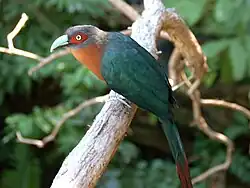 Kukuła sundajska (P. curvirostris) | |||
| Systematyka | |||
| Domena | |||
|---|---|---|---|
| Królestwo | |||
| Typ | |||
| Podtyp | |||
| Gromada | |||
| Podgromada | |||
| Infragromada | |||
| Rząd | |||
| Rodzina | |||
| Podrodzina | |||
| Plemię | |||
| Rodzaj |
Phaenicophaeus | ||
| Typ nomenklatoryczny | |||
|
Cuculus pyrrhocephalus Pennant, 1769 | |||
| Synonimy | |||
|
| |||
| Gatunki | |||
| |||
Phaenicophaeus – rodzaj ptaków z podrodziny kukułek (Cuculinae) w obrębie rodziny kukułkowatych (Cuculidae).
Rozmieszczenie geograficzne
Morfologia
Długość ciała 38–50 cm; masa ciała 57–190 g[10].
Systematyka
Rodzaj zdefiniował w 1815 roku zoolog James Francis Stephens w części dotyczącej ptaków w publikacji pod redakcją George’a Shawa poświęconej zoologii[1]. Gatunkiem typowym jest (późniejsze oznaczenie)[11] kukuła białobrzucha (P. pyrrhocephalus).
Etymologia
- Phaenicophaeus: gr. φοινικοφαης phoinikophaēs ‘ze szkarłatnym wizerunkiem, błyszczący czerwony’, od φοινιξ phoinix, φοινικος phoinikos ‘karmazynowy’; φαω phaō ‘świecić’[12].
- Malcoha: syng. nazwa Māl kōhā dla kukuły białobrzuchej[13]. Gatunek typowy (oznaczenie monotypowe): Cuculus pyrrhocephalus Pennant, 1769.
- Melias: w mitologii greckiej Meliady były nimfami zamieszkującymi drzewa owocowe, od μηλον mēlon „owoc”[14].
- Carpophaga: gr. καρπος karpos ‘owoc’; -φαγος -phagos ‘jedzenie’, od φαγειν phagein ‘jeść’[15].
- Alectorops: gr. αλεκτωρ alektōr, αλεκτορος alektoros ‘kogucik’; ωψ ōps, ωπος ōpos ‘twarz, oblicze’[16]. Gatunek typowy (oznaczenie monotypowe): Cuculus pyrrhocephalus Pennant, 1769.
- Rhopodytes: gr. ῥωψ rhōps, ῥωπος rhōpos ‘krzak’; δυτης dutēs ‘nurek’, od δυω duō ‘nurkować’[17].
- Poliococcyx: gr. πολιος polios ‘szary’; κοκκυξ kokkux, κοκκυγος kokkugos ‘kukułka’[18]. Gatunek typowy (oryginalne oznaczenie): Cuculus sumatranus Raffles, 1822.
- Dryococcyx: gr. δρυς drus, δρυος druos ‘drzewo’; κοκκυξ kokkux, κοκκυγος kokkugos ‘kukułka’[19]. Gatunek typowy (oznaczenie monotypowe): Dryococcyx harringtoni Sharpe, 1877[c].
- Urococcyx: gr. ουρα oura ‘ogon’; κοκκυξ kokkux, κοκκυγος kokkugos ‘kukułka’[20]. Gatunek typowy (oryginalne oznaczenie): Phoenicophaeus erythrognathus Hartlaub, 1844 (= Cuculus curvirostris Shaw, 1810).
Podział systematyczny
Do rodzaju należą następujące gatunki[21]:
- Phaenicophaeus pyrrhocephalus (Pennant, 1769) – kukuła białobrzucha
- Phaenicophaeus viridirostris (Jerdon, 1840) – kukuła niebieskooka
- Phaenicophaeus diardi (Lesson, 1830) – kukuła czarnobrzucha
- Phaenicophaeus sumatranus (Raffles, 1822) – kukuła rdzawobrzucha
- Phaenicophaeus tristis (Lesson, 1830) – kukuła długosterna
- Phaenicophaeus oeneicaudus J. Verreaux & E. Verreaux, 1855 – kukuła zielonobrzucha
- Phaenicophaeus curvirostris (Shaw, 1810) – kukuła sundajska
Uwagi
Przypisy
- 1 2 J.F. Stephens: Phænicophæus. Malkoha. W: G. Shaw: General zoology, or Systematic natural history. T. 9: Aves. Cz. 1. London: Printed for G. Kearsley, 1815, s. 58. (ang.).
- ↑ G. Cuvier & H.R. Schinz: Das Thierreich eingetheilt nach dem Bau der Thiere als Grundlage ihrer Naturgeschichte und der vergleichenden Anatomie. Cz. 1: Säugethiere und Vögel. Stuttgart: J.S. Cotta, 1821, s. xxxvi, 665. (niem.).
- ↑ C.W.L. Gloger. Etwas über einige ornithologische Gattungsbez nennungen. „Notizen aus dem Gebiete der Natur- und Heilkunde”. 16, s. kol. 278, 1827. (niem.).
- ↑ G.J. Billberg: Synopsis Faunae Scandinaviae. T. 1. Cz. 2: Aves. Holmiae: Ex officina typogr. Caroli Deleen, 1828, s. tab. A. (łac.).
- ↑ J. Verreaux & E. Verreaux. Notice sur le genre Phænicophæus, Vieill., Malcoha, Cuv.. „Revue et Magasin de Zoologie pure et appliquée”. 2e Série. 7, s. 356, 1855. (fr.).
- ↑ J. Cabanis & F. Heine: Museum Heineanum: Verzeichniss der ornithologischen Sammlung des Oberamtmann Ferdinand Heine, auf Gut St. Burchard vor Halberstadt. T. 4: Klettervögel. Cz. 1: Kuckuke und Faulvögel. Halberstadt: In Commission bei R. Frantz, 1862–1863, s. 61. (niem.).
- ↑ R.B. Sharpe. On the Cuculidae of the Ethiopian Region. „Proceedings of the Zoological Society of London”. 1873, s. 606, 1873. (ang.).
- ↑ R.B. Sharpe. On the Birds collected by Professor J.B. Steere in the Philippine Archipelago. „Transactions of the Linnean Society of London”. Second Series (Zoology). 1, s. 321, 1877. (ang.).
- ↑ G.E. Shelley: Catalogue of the Picariæ in the collection of the British Museum. Cz. 19. Printed by order of the Trustees: London, 1871, s. 398, seria: Catalogue of the Birds in the British Museum. (ang.).
- 1 2 D.W. Winkler, S.M. Billerman & I.J. Lovette, Cuckoos (Cuculidae), version 1.0, [w:] S.M. Billerman, B.K. Keeney, P.G. Rodewald & T.S. Schulenberg (redaktorzy), Birds of the World, Cornell Lab of Ornithology, Ithaca, NY 2020, Phaenicophaeus, DOI: 10.2173/bow.cuculi1.01 [dostęp 2024-11-08] (ang.).

- ↑ J.L. Peters: Check-list of birds of the world. Cz. 4. Cambridge: Harvard University Press, 1940, s. 56. (ang.).
- ↑ The Key to Scientific Names ↓, Phaenicophaeus [dostęp 2019-11-05].
- ↑ The Key to Scientific Names ↓, Malcoha [dostęp 2019-11-05].
- ↑ The Key to Scientific Names ↓, Melias [dostęp 2019-11-05].
- ↑ The Key to Scientific Names ↓, Carpophaga [dostęp 2019-11-05].
- ↑ The Key to Scientific Names ↓, Alectorops [dostęp 2019-11-05].
- ↑ The Key to Scientific Names ↓, Rhopodytes [dostęp 2019-11-05].
- ↑ The Key to Scientific Names ↓, Poliococcyx [dostęp 2019-11-05].
- ↑ The Key to Scientific Names ↓, Dryococcyx [dostęp 2019-11-05].
- ↑ The Key to Scientific Names ↓, Urococcyx [dostęp 2019-11-05].
- ↑ Systematyka i nazwy polskie za: P. Mielczarek & M. Kuziemko: Plemię: Phaenicophaeini Horsfield, 1822 (wersja: 2024-09-30). [w:] Kompletna lista ptaków świata [on-line]. Instytut Nauk o Środowisku Uniwersytetu Jagiellońskiego. [dostęp 2024-11-08].
Bibliografia
- The Key to Scientific Names, J.A. Jobling (red.), [w:] Birds of the World, S.M. Billerman et al. (red.), Cornell Lab of Ornithology, Ithaca (ang.).