Pithecopus
| Pithecopus[1] | |||
| Cope, 1866[2] | |||
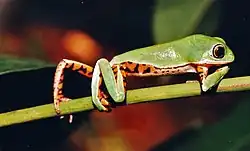 Przedstawiciel rodzaju – P. azureus | |||
| Systematyka | |||
| Domena | |||
|---|---|---|---|
| Królestwo | |||
| Typ | |||
| Podtyp | |||
| Gromada | |||
| Rząd | |||
| Rodzina | |||
| Podrodzina | |||
| Rodzaj |
Pithecopus | ||
| Typ nomenklatoryczny | |||
|
Phyllomedusa azurea Cope, 1862 | |||
| Synonimy | |||
| |||
| Gatunki | |||
| |||
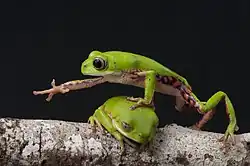
Pithecopus – rodzaj płazów bezogonowych z podrodziny Phyllomedusinae w rodzinie rzekotkowatych (Hylidae).
Zasięg występowania
Rodzaj obejmuje gatunki występujące w tropikalnej Ameryce Południowej na wschód od Andów od południowej Wenezueli do północnej Argentyny[4].
Morfologia
Długość ciała do 45 mm[5]. Pierwszy palec jest znacznie dłuższy i przeciwstawny do drugiego[5]. Nie posiadają „zębów lemieszowych” (ang. vomerine teeth)[5].
Systematyka
Etymologia
- Pithecopus: gr. πιθηκος pithēkos „małpa”[6]; πους pous, ποδος podos „stopa”[7].
- Bradymedusa: gr. βραδυς bradus „powolny”[8]; Meduza (gr. Μεδουσα Medousa, łac. Medusa), w mitologii greckiej najmłodsza z trzech Gorgon[9]. Gatunek typowy: Bradymedusa moschata Miranda-Ribeiro, 1926 (= Phyllomedusa rohdei Mertens, 1926).
Podział systematyczny
Do rodzaju należą następujące gatunki[4]:
- Pithecopus araguaius Haga, Andrade, Bruschi, Recco-Pimentel & Giaretta, 2017
- Pithecopus ayeaye Lutz, 1966
- Pithecopus azureus (Cope, 1862)
- Pithecopus centralis (Bokermann, 1965)
- Pithecopus gonzagai Andrade, Haga, Ferreira, Recco-Pimentel, Toledo & Bruschi, 2020
- Pithecopus hypochondrialis (Daudin, 1800)
- Pithecopus megacephalus (Miranda-Ribeiro, 1926)
- Pithecopus nordestinus (Caramaschi, 2006)
- Pithecopus oreades (Brandão, 2002)
- Pithecopus palliatus (Peters, 1873) – chwytnica jaguaroboka[10]
- Pithecopus rohdei (Mertens, 1926)
- Pithecopus rusticus (Bruschi, Lucas, Garcia & Recco-Pimentel, 2014)
Przypisy
- ↑ Pithecopus, [w:] Integrated Taxonomic Information System (ang.).
- ↑ E.D. Cope. On the structures and distribution of the genera of the arciferous Anura. „Journal of the Academy of Natural Sciences of Philadelphia”. Second Series. 6, s. 86, 1866. (ang.).
- ↑ A. de Miranda-Ribeiro. Notas para servirem ao estudo dos Gymnobatrachios (Anura) Brasileiros. „Archivos do Museu Nacional do Rio de Janeiro”. 27, s. 104, 1926. (port.).
- 1 2 D. Frost: Pithecopus Cope, 1866. [w:] Amphibian Species of the World 6.2, an Online Reference [on-line]. American Museum of Natural History. [dostęp 2024-06-22]. (ang.).
- 1 2 3 J. Faivovich, C.F.B. Haddad, P.C. de A. Garcia, D.R. Frost, J.A. Campbell & W.C. Wheeler. Systematic review of the frog family Hylidae, with special reference to Hylinae: a phylogenetic analysis and taxonomic revision. „Bulletin of the American Museum of Natural History”. 294, s. 32, 2007. (ang.).
- ↑ Jaeger 1944 ↓, s. 176.
- ↑ Jaeger 1944 ↓, s. 180.
- ↑ Jaeger 1944 ↓, s. 34.
- ↑ Jaeger 1944 ↓, s. 133.
- ↑ Praca zbiorowa: Zwierzęta: encyklopedia ilustrowana. Warszawa: Wydawnictwo Naukowe PWN, 2005, s. 439. ISBN 83-01-14344-4.
Bibliografia
- Edmund C. Jaeger, Source-book of biological names and terms, wyd. 1, Springfield: Charles C. Thomas, 1944, s. 1–256, OCLC 637083062 (ang.).