Platalea
| Platalea[1] | |||
| Linnaeus, 1758[2] | |||
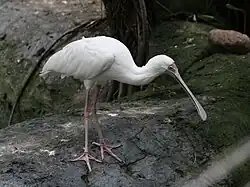 Przedstawiciel rodzaju – warzęcha żółtodzioba (P. flavipes) | |||
| Systematyka | |||
| Domena | |||
|---|---|---|---|
| Królestwo | |||
| Typ | |||
| Podtyp | |||
| Gromada | |||
| Podgromada | |||
| Infragromada | |||
| Rząd | |||
| Podrząd | |||
| Rodzina | |||
| Rodzaj |
Platalea | ||
| Typ nomenklatoryczny | |||
|
Platalea leucorodia Linnaeus, 1758 | |||
| Synonimy | |||
|
| |||
| Gatunki | |||
| |||
Platalea – rodzaj ptaków z rodziny ibisów (Threskiornithidae).
Zasięg występowania
Rodzaj obejmuje gatunki brodzące, zamieszkujące głównie strefy klimatów równikowych, zwrotnikowych i podzwrotnikowych Starego Świata (w Nowym Świecie występuje jedynie warzęcha różowa)[8].
Morfologia
Długość ciała 60–100 cm, rozpiętość skrzydeł 110–135 cm; masa ciała 1130–2070 g[8]. Ptaki te różnią się od ibisów kształtem dzioba, który mają długi, prosty, szeroki z charakterystycznym rozszerzeniem na końcu.
Systematyka
Etymologia
- Platalea: łac. platalea „warzęcha”[9].
- Pelecanus: gr. πελεκαν pelekan, πελεκανος pelekanos „pelikan”[9]. Gatunek typowy: Platalea leucorodia Linnaeus, 1758.
- Ajaia: nazwa Ayayá lub Ajajá w języku tupi dla warzęchy różowej (por. epitet gatunkowy Platalea ajaja Linnaeus, 1758)[9]. Gatunek typowy: Platalea ajaja Linnaeus, 1758.
- Leucerodia: gr. λευκερωδιος leukerōdios „warzęcha”, od λευκος leukos „biały”; ερωδιος erōdios „czapla”[9]. Gatunek typowy: Platalea alba Scopoli, 1786.
- Spatherodia: gr. σπαθη spathē „łopatka, łyżka”; ερωδιος erōdios „czapla”[9]. Gatunek typowy: Platalea regia Gould, 1838.
- Platibis: łac. platea „warzęcha”; ibis, ibidis „ibis”, od gr. ιβις ibis, ιβιδος ibidos „ibis”[9]. Gatunek typowy: Platalea flavipes Gould, 1838.
- Mystrorhamphus: gr. μυστρον mustron „łyżka”, od μυστιλη mustilē „kawałek chleba wydrążony w kształcie łyżki”; ῥαμφος rhamphos „dziób”[9]. Nowa nazwa dla Ajaia Reichenbach, 1852 ze względu na puryzm.
Podział systematyczny
Do rodzaju należą następujące gatunki[10]:
- Platalea flavipes Gould, 1838 – warzęcha żółtodzioba
- Platalea ajaja Linnaeus, 1758 – warzęcha różowa
- Platalea alba Scopoli, 1786 – warzęcha czerwonolica
- Platalea leucorodia Linnaeus, 1758 – warzęcha zwyczajna
- Platalea minor Temminck & Schlegel, 1849 – warzęcha mała
- Platalea regia Gould, 1838 – warzęcha królewska
Przypisy
- ↑ Platalea, [w:] Integrated Taxonomic Information System (ang.).
- ↑ C. Linnaeus: Systema naturae per regna tria naturae, secundum classes, ordines, genera, species, cum characteribus, differentiis, synonymis, locis. Wyd. 10. T. 1. Holmiae: Impensis Direct. Laurentii Salvii, 1758, s. 139. (łac.).
- ↑ P.H.G. Möhring: Geslachten der vogelen. Amsteldam: Pieter Meijer, 1758, s. 4, 47. (niderl.).
- ↑ Reichenbach 1850 ↓, s. 25, xvi.
- 1 2 Reichenbach 1850 ↓, s. xvi.
- ↑ Ch.-L. Bonaparte. Tableaux synoptiques de l’ordre des Hérons. „Comptes rendus hebdomadaires de l’Académie des Sciences”. 40, s. 724, 1855. (fr.).
- ↑ F. Heine & A. Reichenow: Nomenclator Musei Heineani Ornithologici; Verzeichniss der Vogel-Sammlung des Kgl. Oberamtmanns Ferdinand Heine. Berlin: R. Friedländer & Sohn, 1882–1890, s. 313. (niem.).
- 1 2 D.W. Winkler, S.M. Billerman & I.J. Lovette: Ibises and Spoonbills (Threskiornithidae), version 1.0.. W: S.M. Billerman, B.K. Keeney, P.G. Rodewald & T.S. Schulenberg (red.): Birds of the World. Ithaca, NY: Cornell Lab of Ornithology, 2020. DOI: 10.2173/bow.thresk1.01. [dostęp 2020-05-25]. (ang.).

- 1 2 3 4 5 6 7 Etymologia za: The Key to Scientific Names, J.A. Jobling (red.), [w:] Birds of the World, S.M. Billerman et al. (red.), Cornell Lab of Ornithology, Ithaca (ang.).
- ↑ Systematyka i nazwy polskie za: P. Mielczarek & M. Kuziemko: Rodzina: Threskiornithidae Poche, 1904 – ibisy – Ibises (wersja: 2019-10-12). [w:] Kompletna lista ptaków świata [on-line]. Instytut Nauk o Środowisku Uniwersytetu Jagiellońskiego. [dostęp 2020-02-23].
Bibliografia
- H.G.L. Reichenbach: Avium systema naturale. Das natürliche system der vögel mit hundert tafeln grösstentheils original-abbildungen der bis jetzt entdecken fast zwölfhundert typischen formen. Vorlaüfer einer iconographie der arten der vögel aller welttheile. Dresden und Leipzig: Expedition der vollständigsten naturgeschichte, 1850, s. 1–36, i–xxxi. (niem.).