Platysmurus
| Platysmurus | |||
| Reichenbach, 1850[1] | |||
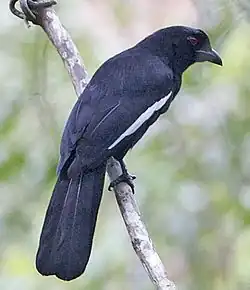 Srokowiec białoskrzydły (P. leucopterus) | |||
| Systematyka | |||
| Domena | |||
|---|---|---|---|
| Królestwo | |||
| Typ | |||
| Podtyp | |||
| Gromada | |||
| Podgromada | |||
| Infragromada | |||
| Rząd | |||
| Podrząd | |||
| Rodzina | |||
| Rodzaj |
Platysmurus | ||
| Typ nomenklatoryczny | |||
|
Glaucopis leucopterus Temminck, 1824 | |||
| Synonimy | |||
|
| |||
| Gatunki | |||
| |||
Platysmurus – rodzaj ptaków z rodziny krukowatych (Corvidae).
Rozmieszczenie geograficzne
Rodzaj obejmuje gatunki występujące w południowo-wschodniej Azji[4].
Morfologia
Długość ciała 39–41 cm; masa ciała 178–182 g[4].
Systematyka
Rodzaj utworzył w 1850 roku niemiecki zoolog Ludwig Reichenbach w publikacji własnego autorstwa poświęconej historii naturalnej ptaków[1]. Gatunkiem typowym jest (późniejsze oznaczenie)[5] srokowiec białoskrzydły (P. leucopterus).
Etymologia
- Glaucopis: gr. γλαυκος glaukos ‘niebiesko-szary, jaskrawy’; οψις opsis ‘wygląd’[6]. Gatunek typowy (późniejsze oznaczenie)[7]: Glaucopis leucopterus Temminck, 1824.
- Platysmurus: gr. πλατυσμα platusma ‘płaski przedmiot, płyta, ostrze’; -ουρος -ouros ‘-ogonowy’, od ουρα oura ‘ogon’[8].
- Glenargus: gr. γληνη glēnē ‘gałka oczna, oko’; αργος argos ‘biały, lśniący’[9].
Podział systematyczny
Do rodzaju należą następujące gatunki[10]:
- Platysmurus leucopterus (Temminck, 1824) – srokowiec białoskrzydły
- Platysmurus aterrimus (Temminck, 1829) – srokowiec czarny
Uwagi
- ↑ Nie Glaucopis J.F. Gmelin, 1788
- ↑ Nowa nazwa dla Glaucopis Temminck, 1824.
Przypisy
- 1 2 H.G.L. Reichenbach: Avium systema naturale. Das natürliche system der vögel mit hundert tafeln grösstentheils original-abbildungen der bis jetzt entdecken fast zwölfhundert typischen formen. Vorlaüfer einer iconographie der arten der vögel aller welttheile. Dresden und Leipzig: Expedition der vollständigsten naturgeschichte, 1850, s. lxxx. (niem.).
- ↑ C.J. Temminck: Nouveau recueil de planches coloriées d’oiseaux: pour servir de suite et de complément aux planches enluminées de Buffon, édition in-folio et in-4⁰ de l’Imprimerie royale, 1770. Paris: Chez Legras Imbert et Comp, wyd. zbiorcze 1838; t.2, s. ryc. 265. (fr.).
- ↑ J. Cabanis: Museum Heineanum: Verzeichniss der ornithologischen Sammlung des Oberamtmann Ferdinand Heine, auf Gut St. Burchard vor Halberstadt. T. 1: Singvögel. Halberstadt: In Commission bei R. Frantz, 1850–1851, s. 216. (niem.).
- 1 2 D.W. Winkler, S.M. Billerman & I.J. Lovette, Crows, Jays, and Magpies (Corvidae), version 1.0, [w:] S.M. Billerman, B.K. Keeney, P.G. Rodewald & T.S. Schulenberg (redaktorzy), Birds of the World, Cornell Lab of Ornithology, Ithaca, NY 2020, Pyrrhocorax, DOI: 10.2173/bow.corvid1.01 [dostęp 2024-11-20] (ang.).

- ↑ G.R. Gray: Catalogue of the genera and subgenera of birds contained in the British Museum. London: The Trustees, 1855, s. 63. (ang.).
- ↑ The Key to Scientific Names ↓, Glaucopis [dostęp 2024-11-20].
- ↑ G.R. Gray: A list of the genera of birds: with their synonyma an indication of the typical species of each genus. London: R. and J.E. Taylor, 1840, s. 38. (ang.).
- ↑ The Key to Scientific Names ↓, Platysmurus [dostęp 2024-11-20].
- ↑ The Key to Scientific Names ↓, Glenargus [dostęp 2024-11-20].
- ↑ Systematyka i nazwy polskie za: P. Mielczarek & M. Kuziemko: Rodzina: Corvidae Leach, 1820 - krukowate - Crows and Jays (wersja: 2024-10-14). [w:] Kompletna lista ptaków świata [on-line]. Instytut Nauk o Środowisku Uniwersytetu Jagiellońskiego. [dostęp 2024-11-20].
Bibliografia
- The Key to Scientific Names, J.A. Jobling (red.), [w:] Birds of the World, S.M. Billerman et al. (red.), Cornell Lab of Ornithology, Ithaca (ang.).