Podargus
| Podargus[1] | |||
| Vieillot, 1818[2] | |||
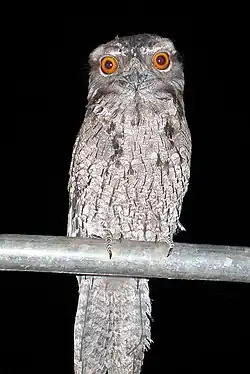 Paszczak marmurkowy (P. ocellatus) | |||
| Systematyka | |||
| Domena | |||
|---|---|---|---|
| Królestwo | |||
| Typ | |||
| Podtyp | |||
| Gromada | |||
| Podgromada | |||
| Infragromada | |||
| Rząd | |||
| Rodzina | |||
| Rodzaj |
Podargus | ||
| Typ nomenklatoryczny | |||
|
Podargus griseus Vieillot, 1818 (= Caprimulgus strigoides Latham, 1801) | |||
| Synonimy | |||
|
| |||
| Gatunki | |||
| |||
Podargus – rodzaj ptaków z rodziny paszczaków (Podargidae).
Zasięg występowania
Rodzaj obejmuje gatunki występujące na kontynencie australijskim, na Nowej Gwinei i sąsiednich wyspach[7].
Morfologia
Długość ciała 34–60 cm; masa ciała 132–680 g[7].
Systematyka
Etymologia
- Podargus: francuska nazwa „Podarge” nadana paszczakom przez Cuviera w 1817 roku, z adnotacją o ich krótkich nogach, od gr. ποδαγρος podagros „człowiek z podagrą”, od ποδαγραω podagraō „mieć podagrę”, od ποδαγρα podagra „podagra”[8].
- Celuro: gr. κηλας kēlas, κηλαδος kēlados „cętkowany”; ουρα oura „ogon”[9]. Gatunek typowy: Caprimulgus strigoides Latham, 1801.
- Cyphorhina: gr. κυφος kuphos „zgięty, zakrzywiony”, od κυπτω kuptō „pochylać się”; ῥις rhis, ῥινος rhinos „nos”[10]. Gatunek typowy: Podargus papuensis Quoy & Gaimard, 1830
- Micropodargus: gr. μικρος mikros „mały”; rodzaj Podargus Vieillot, 1818 (paszczak)[11]. Gatunek typowy: Podargus marmoratus Gould, 1855[a].
- Megapodargus: gr. μεγας megas, μεγαλη megalē „wielki”; rodzaj Podargus Vieillot, 1818 (paszczak)[12]. Gatunek typowy: Podargus papuensis Quoy & Gaimard, 1830.
Podział systematyczny
Do rodzaju należą następujące gatunki[13]:
- Podargus ocellatus Quoy & Gaimard, 1830 – paszczak marmurkowy
- Podargus papuensis Quoy & Gaimard, 1830 – paszczak papuaski
- Podargus strigoides (Latham, 1801) – paszczak australijski
Uwagi
- ↑ Podgatunek P. ocellatus.
Przypisy
- ↑ Podargus, [w:] Integrated Taxonomic Information System (ang.).
- ↑ L.J.P. Vieillot: Nouveau dictionnaire d’histoire naturelle, appliquée aux arts, à l’agriculture, à l’économie rurale et domestique, à la médecine, etc. Par une société de naturalistes et d’agriculteurs. Wyd. Nouv. éd. presqu' entièrement refondue et considérablement angmentée. T. 27. Paris: Chez Deterville, 1818, s. 151. (fr.).
- ↑ F. Jarocki: Zoologia czyli zwierzętopismo ogólne podług naynowszego systemu ułożone. T. 2: Ptáki. Warszawa: Drukarnia Łątkiewicza, 1821, s. 156. (pol.).
- ↑ R.-P. Lesson. Index ornithologique. „L’Écho du monde savant et l’Hermès”. 7, s. 1068, 1843. (łac.).
- ↑ Mathews 1913 ↓, s. 57.
- ↑ Mathews 1913 ↓, s. 62.
- 1 2 D.T. Holyoak: Family Podargidae (Frogmouths). W: J. del Hoyo, A. Elliott & J. Sargatal: Handbook of the Birds of the World. Cz. 5: Barn-owls to Hummingbirds. Barcelona: Lynx Edicions, 1999, s. 281–282. ISBN 84-87334-25-3. (ang.).
- ↑ The Key to Scientific Names ↓, Podargus [dostęp 2019-11-11].
- ↑ The Key to Scientific Names ↓, Celuro [dostęp 2019-11-11].
- ↑ The Key to Scientific Names ↓, Cyphorhina [dostęp 2019-11-11].
- ↑ The Key to Scientific Names ↓, Micropodargus [dostęp 2019-11-11].
- ↑ The Key to Scientific Names ↓, Megapodargus [dostęp 2019-11-11].
- ↑ Systematyka i nazwy polskie za: P. Mielczarek & M. Kuziemko: Rodzina: Podargidae Blyth, 1838 – paszczaki – Frogmouths (wersja: 2023-03-23). [w:] Kompletna lista ptaków świata [on-line]. Instytut Nauk o Środowisku Uniwersytetu Jagiellońskiego. [dostęp 2025-02-09].
Bibliografia
- G.M. Mathews. New Generic Names, with Some Notes on others. „Austral Avian Record”. 2 (2), s. 55–63, 1913. (ang.).
- The Key to Scientific Names, J.A. Jobling (red.), [w:] Birds of the World, S.M. Billerman et al. (red.), Cornell Lab of Ornithology, Ithaca (ang.).