Polyacanthonotus
| Polyacanthonotus | |||
| Bleeker, 1874[1] | |||
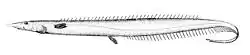 P. rissoanus | |||
| Systematyka | |||
| Domena | |||
|---|---|---|---|
| Królestwo | |||
| Typ | |||
| Podtyp | |||
| Gromada | |||
| Podgromada | |||
| Infragromada | |||
| Nadrząd | |||
| Rząd | |||
| Rodzina | |||
| Rodzaj |
Polyacanthonotus | ||
| Typ nomenklatoryczny | |||
|
Notacanthus rissoanus De Filippi & Verany, 1857 | |||
| Synonimy | |||
|
| |||
| Gatunki | |||
| |||
Polyacanthonotus – rodzaj ryb promieniopłetwych z rodziny łuskaczowatych (Notacanthidae).
Rozmieszczenie geograficzne
Do rodzaju należą gatunki występujące w słonych wodach całego globu[6][7].
Morfologia
Długość ciała do 60 cm[7].
Systematyka
Rodzaj zdefiniował w 1874 roku holenderski ichtiolog Pieter Bleeker w artykule poświęconym rodzajom ryb, opublikowanym w czasopiśmie Verslagen en mededeelingen der Koninklijke Akademie van Wetenschappen [1]. Gatunkiem typowym jest (oryginalne oznaczenie (również monotypowe)) P. rissoanus.
Etymologia
- Polyacanthonotus: gr. πολυς polus ‘wiele’; ακανθα akantha „cierń, kolec”, od ακη akē ‘punkt’; νωτον nōton ‘tył, grzbiet’[8].
- Zanotacanthus: gr. ζα- za- ‘bardzo’[9]; rodzaj Notacanthus Bloch, 1788. Gatunek typowy (oznaczenie monotypowe): Notacanthus rissoanus De Filippi & Verany, 1857.
- Paradoxichthys: gr. παραδοξος paradoxos ‘niezwykły’[10]; ιχθυς ikhthus ‘ryba’[11]. Gatunek typowy (oznaczenie monotypowe): Notacanthus rissoanus De Filippi & Verany, 1857.
- Macdonaldia: Marshall McDonald (1835–1895), amerykański inżynier, geolog, mineralog, hodowca ryb i naukowiec zajmujący się rybołówstwem[4]. Gatunek typowy (oryginalne oznaczenie (również monotypowe)): Notacanthus rostratus Collett, 1889 (= Notacanthus rissoanus De Filippi & Verany, 1857).
- Gnathonotacanthus: gr. γναθος gnathos ‘żuchwa’[12]; rodzaj Notacanthus Bloch, 1788[5]. Gatunek typowy (oryginalne oznaczenie): Polyacanthonotus vaillanti Fowler, 1934 (= Notacanthus challengeri Vaillant, 1888).
Podział systematyczny
Do rodzaju należą następujące gatunki[6]:
- Polyacanthonotus challengeri (Vaillant, 1888)
- Polyacanthonotus merretti Sulak, Crabtree & Hureau, 1984
- Polyacanthonotus rissoanus (De Filippi & Verany, 1857)
Przypisy
- 1 2 P. Bleeker. Typi nonnuli generici piscium neglecti. „Verslagen en mededeelingen der Koninklijke Akademie van Wetenschappen”. Afdeeling Natuurkunde. Tweede reeks. 8, s. 368, 1874. (łac.).
- ↑ T.N. Gill: Notacanthidae. W: F.A.P. Barnard & A. Guyot (redaktorzy): Johnson’s new universal cyclopædia: a scientific and popular treasury of useful knowledge. Cz. 3. New York: A.J. Johnson & Son, 1877, s. 883. (ang.).
- ↑ E.H. Giglioli. New and very rare fish from the Mediterranean. „Nature”. 25 (649), s. 535, 1882. (ang.).
- 1 2 G.B. Goode & T.H. Bean. Scientific results of explorations by the U. S. Fish Commission steamer Albatross. No.XXIX.—A revision of the order Heteromi, deep-sea fishes, with a description of the new generic types Macdonaldia and Lipogenys. „Proceedings of the United States National Museum”. 17 (1013), s. 467, 1895. (ang.).
- 1 2 H.W. Fowler. Descriptions of new fishes obtained 1907 to 1910, chiefly in the Philippine Islands and adjacent seas. „Proceedings of the Academy of Natural Sciences of Philadelphia”. 85, s. 266, 1934. JSTOR: 4064176. (ang.).
- 1 2 Ron Fricke, William Neil Eschmeyer, Richard van der Laan (red.), SEARCH, [w:] Eschmeyer’s Catalog of Fishes, California Academy of Sciences, 2 kwietnia 2024 [dostęp 2024-05-03] (ang.).
- 1 2 R. Froese & D. Pauly: Polyacanthonotus. FishBase (ver. (02/2024)). [dostęp 2024-05-03]. (ang.).
- ↑ Ch. Scharpf: Family Notacanthidae Rafinesque 1810 (Deep-sea Spiny Eels). The ETYFish Project. [dostęp 2024-05-03]. (ang.).
- ↑ Jaeger 1959 ↓, s. 285.
- ↑ Jaeger 1959 ↓, s. 183.
- ↑ Jaeger 1959 ↓, s. 123.
- ↑ Jaeger 1959 ↓, s. 111.
Bibliografia
- E.C. Jaeger: Source-book of biological names and terms. Wyd. 3 (Revised second printing). Springfield: Charles C. Thomas, 1959, s. 1–316. (ang.).