Polypedates
| Polypedates[1] | |||
| Tschudi, 1838[2] | |||
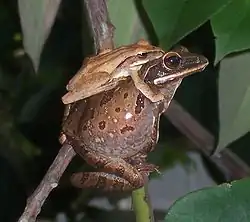 Para wielkostopek domowych (P. leucomystax) w stanie ampleksus | |||
| Systematyka | |||
| Domena | |||
|---|---|---|---|
| Królestwo | |||
| Typ | |||
| Podtyp | |||
| Gromada | |||
| Rząd | |||
| Rodzina | |||
| Podrodzina | |||
| Rodzaj |
Polypedates | ||
| Typ nomenklatoryczny | |||
|
Hyla leucomystax Gravenhorst, 1829 | |||
| Synonimy | |||
|
| |||
| Gatunki | |||
| |||
Polypedates – rodzaj płazów bezogonowych z podrodziny Rhacophorinae w rodzinie nogolotkowatych (Rhacophoridae).
Zasięg występowania
Rodzaj obejmuje gatunki występujące we wschodnich Indiach, południowo-wschodniej Azji, na Filipinach i Borneo[5].
Systematyka
Etymologia
- Polypedates (Polypedotes): πολυς polus „wiele, dużo”[6]; πηδαω pēdaō „skakać” lub [7].
- Trachyhyas: gr. τραχυς trakhus „chropowaty, szorstki”[8]; rodzaj Hyas[b] Wagler, 1830. Gatunek typowy: Polypedates rugosus A.M.C. Duméril & Bibron, 1841 (= Hyla leucomystax Gravenhorst, 1829).
Podział systematyczny
Do rodzaju należą następujące gatunki[5]:
- Polypedates assamensis Mathew & Sen, 2009
- Polypedates bengalensis Purkayastha, Das, Mondal, Mitra & Das, 2019
- Polypedates braueri (Vogt, 1911)
- Polypedates colletti (Boulenger, 1890)
- Polypedates cruciger Blyth, 1852
- Polypedates discantus Rujirawan, Stuart & Aowphol, 2013
- Polypedates hecticus Peters, 1863
- Polypedates himalayensis (Annandale, 1912)
- Polypedates impresus Yang, 2008
- Polypedates insularis Das, 1995
- Polypedates iskandari Riyanto, Mumpuni & McGuire, 2011
- Polypedates leucomystax (Gravenhorst, 1829) – wielkostopka domowa[9]
- Polypedates macrotis (Boulenger, 1891)
- Polypedates maculatus (J.E. Gray, 1830)
- Polypedates megacephalus Hallowell, 1861
- Polypedates mutus (Smith, 1940)
- Polypedates occidentalis Das & Dutta, 2006
- Polypedates otilophus (Boulenger, 1893) – wielkostopka kostnogłowa[9]
- Polypedates pseudocruciger Das & Ravichandran, 1998
- Polypedates pseudotilophus Matsui, Hamidy & Kuraishi, 2014
- Polypedates ranwellai Wickramasinghe, Munindradasa & Fernando, 2012
- Polypedates subansiriensis Mathew & Sen, 2009
- Polypedates taeniatus (Boulenger, 1906)
- Polypedates teraiensis (Dubois, 1987)
- Polypedates zed (Dubois, 1987)
Uwagi
Przypisy
- ↑ Polypedates, [w:] Integrated Taxonomic Information System (ang.).
- ↑ Tschudi 1838 ↓, s. 75.
- ↑ Tschudi 1838 ↓, s. 34.
- ↑ L.J.F.J. Fitzinger: Systema reptilium. Fasciculus primus, Amblyglossae. Vindobonae: Braumüller et Seidel, 1843, s. 31. (łac.).
- 1 2 D. Frost: Polypedates Tschudi, 1838. [w:] Amphibian Species of the World 6.2, an Online Reference [on-line]. American Museum of Natural History. [dostęp 2024-07-16]. (ang.).
- ↑ Jaeger 1944 ↓, s. 181.
- ↑ Jaeger 1944 ↓, s. 164.
- ↑ Jaeger 1944 ↓, s. 240.
- 1 2 Praca zbiorowa: Zwierzęta: encyklopedia ilustrowana. Warszawa: Wydawnictwo Naukowe PWN, 2005, s. 447. ISBN 83-01-14344-4.
Bibliografia
- J.J. von Tschudi: Classification der Batrachier mit Berücksichtigung der fossilen Thiere dieser Abtheilung der Reptilien. Neuchâtel: Petitpierre, 1838, s. 1–99. (niem.).
- Edmund C. Jaeger, Source-book of biological names and terms, wyd. 1, Springfield: Charles C. Thomas, 1944, s. 1–256, OCLC 637083062 (ang.).