Pseudastur
| Pseudastur | |||
| G.R. Gray, 1849[1] | |||
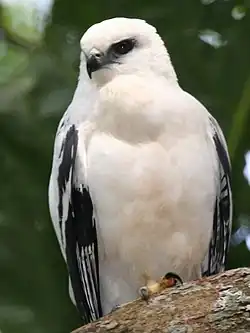 Przedstawiciel rodzaju – białostrząb duży (P. albicollis) | |||
| Systematyka | |||
| Domena | |||
|---|---|---|---|
| Królestwo | |||
| Typ | |||
| Podtyp | |||
| Gromada | |||
| Podgromada | |||
| Infragromada | |||
| Rząd | |||
| Rodzina | |||
| Podrodzina | |||
| Plemię | |||
| Rodzaj |
Pseudastur | ||
| Typ nomenklatoryczny | |||
|
Falco poecilonotus Temminck, 1820 (= Falco albicollis Latham, 1790) | |||
| Gatunki | |||
| |||
Pseudastur – rodzaj ptaków z podrodziny jastrzębi (Accipitrinae) w obrębie rodziny jastrzębiowatych (Accipitridae).
Rozmieszczenie geograficzne
Morfologia
Długość ciała 45–51 cm, rozpiętość skrzydeł 98–129 cm; masa ciała samic 660–855 g, samców 592–670 g[2].
Systematyka
Rodzaj zdefiniował w 1849 roku angielski ornitolog George Robert Gray w publikacji własnego autorstwa poświęconej opisowi rodzajów ptaków[1]. Gatunkiem typowym jest (oznaczenie monotypowe) białostrząb duży (P. albicollis).
Etymologia
Pseudastur: gr. ψευδος pseudos „fałszywy”; rodzaj Astur Lacépède, 1801[3].
Podział systematyczny
Taksony wyodrębnione z Leucopternis[4][5][6][7]. Do rodzaju należą następujące gatunki[8]:
- Pseudastur occidentalis (Salvin, 1876) – białostrząb szarogłowy
- Pseudastur albicollis (Latham, 1790) – białostrząb duży
- Pseudastur polionotus (Kaup, 1847) – białostrząb płaszczowy
Przypisy
- 1 2 G.R. Gray: The genera of birds, comprising their generic characters, a notice of the habits of each genus, and an extensive list of species referred to their several genera. Cz. 3. London: Longman, Brown, Green, and Longmans, 1849, s. 55. (ang.).
- 1 2 D.W. Winkler, S.M. Billerman & I.J. Lovette, Hawks, Eagles, and Kites (Accipitridae), version 1.0, [w:] S.M. Billerman, B.K. Keeney, P.G. Rodewald & T.S. Schulenberg (redaktorzy), Birds of the World, Cornell Lab of Ornithology, Ithaca, NY 2020, DOI: 10.2173/bow.accipi1.01 [dostęp 2024-08-10] (ang.), Pseudastur.

- ↑ Pseudastur, [w:] The Key to Scientific Names, J.A. Jobling (red.), [w:] Birds of the World, S.M. Billerman et al. (red.), Cornell Lab of Ornithology, Ithaca [dostęp 2022-02-02] (ang.).
- ↑ F.S. Raposo do Amaral, M.J. Miller, L.F. Silveira, E. Bermingham & A. Wajntal. Polyphyly of the hawk genera Leucopternis and Buteogallus (Aves, Accipitridae): multiple habitat shifts during the Neotropical buteonine diversification. „BMC Evolution Biology”. 6, s. 10, 2006. DOI: 10.1186/1471-2148-6-10. (ang.).
- ↑ F.S. Raposo do Amaral, F.H. Sheldon, A. Gamauf, E. Haring, M. Riesing, L.F. Silveira & A. Wajntal. Patterns and processes of diversification in a widespread and ecologically diverse avian group, the buteonine hawks (Aves, Accipitridae). „Molecular Phylogenetics and Evolution”. 53 (3), s. 703–715, 2009. DOI: 10.1016/j.ympev.2009.07.020. (ang.).
- ↑ A. Kocum. Phylogenie der Accipitriformes (Greifvögel) anhand verschiedener nuklearer und mitochondrialer DNA-Sequenzen. „Praca doktorska”, s. 1–250, 2007. (ang.).
- ↑ H.R.L. Lerner, M.C. Klaver & D.P. Mindell. Molecular Phylogenetics of the Buteonine Birds of Prey (Accipitridae). „The Auk”. 125 (2), s. 304–315, 2008. DOI: 10.1525/auk.2008.06161. (ang.).
- ↑ Systematyka i nazwy polskie za: P. Mielczarek & M. Kuziemko: Plemię: Accipitrini Vigors, 1824 (Wersja: 2024-04-07). [w:] Kompletna lista ptaków świata [on-line]. Instytut Nauk o Środowisku Uniwersytetu Jagiellońskiego. [dostęp 2024-08-10].