Pseudibis
| Pseudibis[1] | |||
| Hodgson, 1844[2] | |||
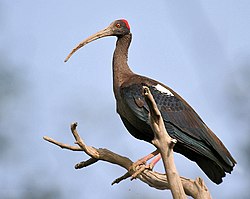 Przedstawiciel rodzaju – ibis czarny (P. papillosa) | |||
| Systematyka | |||
| Domena | |||
|---|---|---|---|
| Królestwo | |||
| Typ | |||
| Podtyp | |||
| Gromada | |||
| Podgromada | |||
| Infragromada | |||
| Rząd | |||
| Podrząd | |||
| Rodzina | |||
| Rodzaj |
Pseudibis | ||
| Typ nomenklatoryczny | |||
|
Ibis papillosa Temminck, 1824 | |||
| Synonimy | |||
| |||
| Gatunki | |||
| |||
Pseudibis – rodzaj ptaków z rodziny ibisów (Threskiornithidae).
Zasięg występowania
Morfologia
Długość ciała 60–106 cm, rozpiętość skrzydeł 90–115 cm; masa ciała do 3515 g[6].
Systematyka
Etymologia
- Pseudibis: gr. ψευδος pseudos „fałszywy”; ιβις ibis, ιβιδος ibidos „ibis”[7].
- Inocotis: gr. ινωδης inōdēs „włóknisty, żylasty” (por. ινιον inion „potylica, kark”); -ωτις -ōtis „-uchy”, od ους ous, ωτος ōtos „ucho”[7]. Gatunek typowy: Ibis papillosa Temminck, 1824.
- Graptocephalus: gr. γραπτος graptos „malowany, wyraźny”, od γραφω graphō „pisać”; -κεφαλος -kephalos „-głowy”, od κεφαλη kephalē „głowa”[7]. Gatunek typowy: Geronticus davisoni Hume, 1875.
- Thaumatibis: gr. θαυματος thaumatos „cudowny”, od θαυμα thauma, θαυματος thaumatos „cud, fenomen”; ιβις ibis, ιβιδος ibidos „ibis”[7]. Gatunek typowy: Ibis gigantea Oustalet, 1877.
Podział systematyczny
Do rodzaju należą następujące gatunki[8]:
- Pseudibis papillosa (Temminck, 1824) – ibis czarny
- Pseudibis davisoni (Hume, 1875) – ibis szarogłowy
- Pseudibis gigantea (Oustalet, 1877) – ibis olbrzymi
Przypisy
- ↑ Pseudibis, [w:] Integrated Taxonomic Information System (ang.).
- ↑ B.H. Hodgson: Catalogue of Nipalese Birds, collected between 1824 an 1844. W: J.E. Gray: The zoological miscellany: to be continued occasionally. London: Published by Treuttel, Wurtz and Co., G.B. Sowerby, W. Wood, 1844, s. 86. (ang.).
- ↑ H.G.L. Reichenbach: Avium systema naturale. Das natürliche system der vögel mit hundert tafeln grösstentheils original-abbildungen der bis jetzt entdecken fast zwölfhundert typischen formen. Vorlaüfer einer iconographie der arten der vögel aller welttheile. Dresden und Leipzig: Expedition der vollständigsten naturgeschichte, 1850, s. xiv. (niem.).
- ↑ Elliot 1877 ↓, s. 491.
- ↑ Elliot 1877 ↓, s. 489.
- 1 2 D.W. Winkler, S.M. Billerman & I.J. Lovette: Ibises and Spoonbills (Threskiornithidae), version 1.0.. W: S.M. Billerman, B.K. Keeney, P.G. Rodewald & T.S. Schulenberg (red.): Birds of the World. Ithaca, NY: Cornell Lab of Ornithology, 2020. DOI: 10.2173/bow.thresk1.01. [dostęp 2020-05-25]. (ang.).

- 1 2 3 4 Etymologia za: The Key to Scientific Names, J.A. Jobling (red.), [w:] Birds of the World, S.M. Billerman et al. (red.), Cornell Lab of Ornithology, Ithaca (ang.).
- ↑ Systematyka i nazwy polskie za: P. Mielczarek, M. Kuziemko: Rodzina: Threskiornithidae Poche, 1904 - ibisy - Ibises (Wersja: 2019-10-12). [w:] Kompletna lista ptaków świata [on-line]. Instytut Nauk o Środowisku Uniwersytetu Jagiellońskiego. [dostęp 2020-02-23].
Bibliografia
- D.G. Elliot. Review of the Ibidinæ, or Subfamily of the Ibises. „Proceedings of the Zoological Society of London”. For year 1877, s. 477–510, 1877. (ang.).