Psophodes
| Psophodes[1] | |||
| Vigors & Horsfield, 1827[2] | |||
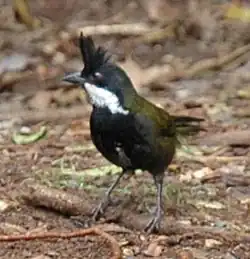 Przedstawiciel rodzaju – trzaskacz czarnoczuby (P. olivaceus) | |||
| Systematyka | |||
| Domena | |||
|---|---|---|---|
| Królestwo | |||
| Typ | |||
| Podtyp | |||
| Gromada | |||
| Podgromada | |||
| Infragromada | |||
| Rząd | |||
| Podrząd | |||
| Rodzina | |||
| Rodzaj |
Psophodes | ||
| Typ nomenklatoryczny | |||
|
Muscicapa crepitans Latham, 1801 (= Corvus olivaceus Latham, 1801) | |||
| Synonimy | |||
|
| |||
| Gatunki | |||
| |||
Psophodes – rodzaj ptaków z rodziny trzaskaczy (Psophodidae).
Zasięg występowania
Morfologia
Długość ciała 19–30 cm; masa ciała 30–75 g (samce są nieco większe i cięższe od samic)[8].
Systematyka
Etymologia
- Psophodes (Psofodes): gr. ψοφωδης psophōdēs „głośny, pełen brzmienia”, od ψοφος psophos „hałas”[9].
- Sphenostoma: gr. σφην sphēn, σφηνος sphēnos „klin”; στομα stoma, στοματος stomatos „usta”[10]. Typ nomenklatoryczny: Sphenostoma cristatum Gould, 1838.
- Phodopses: anagram nazwy rodzajowej Psophodes Vigors & Horsfield, 1827[11]. Typ nomenklatoryczny: Psophodes nigrogularis Gould, 1844.
Podział systematyczny
Uwagi
Przypisy
- ↑ Psophodes, [w:] Integrated Taxonomic Information System (ang.).
- ↑ N.A. Vigors & T. Horsfield. A Description of the Australian Birds in the Collection of the Linnean Society; with an Attempt at arranging them according to their natural Affinities. „Transactions of the Linnean Society of London”. 15 (1), s. 328, 1827. (ang.).
- ↑ W. Swainson: Northern Zoology. Merulidæ. W: J. Richardson & W. Swainson: Fauna boreali-americana, or, The zoology of the northern parts of British America: containing descriptions of the objects of natural history collected on the late northern land expeditions under command of Captain Sir John Franklin, R.N.. Cz. 2: The Birds. Londyn: John Murray, 1831, s. 127. (ang.).
- ↑ J. Gould: A synopsis of the birds of Australia, and the adjacent Islands. London: John Gould, 1837-1838, s. ryc. i tekst. (ang.).
- ↑ J. Palacký. Die geologischen Grundlagen der Vögelverbreitung, speciell bei Australien. „Journal für Ornithologie”. Vierte folge. 39 (196), s. 401, 1891. (niem.).
- ↑ R. Schodde & I.J. Mason: Directory of Australian Birds: Passerines. Clayotn: Csiro Publishing, 1999, s. ?. ISBN 0-643-10293-0. (ang.).
- ↑ F. Gill, D. Donsker & P. Rasmussen (redaktorzy), Australasian babblers, logrunners, satinbirds, painted berrypeckers, wattlebirds, whipbirds [online], IOC World Bird List (v13.1) [dostęp 2023-06-07] (ang.).
- ↑ D.W. Winkler, S.M. Billerman & I.J. Lovette, Whipbirds and Wedgebills (Psophodidae), version 1.0, [w:] S.M. Billerman, B.K. Keeney, P.G. Rodewald & T.S. Schulenberg (redaktorzy), Birds of the World, Cornell Lab of Ornithology, Ithaca, NY 2021, Psophodes, DOI: 10.2173/bow.psopho1.01 [dostęp 2023-06-07] (ang.).

- ↑ The Key to Scientific Names ↓, Psophodes [dostęp 2023-06-07].
- ↑ The Key to Scientific Names ↓, Sphenostoma [dostęp 2023-06-07].
- ↑ The Key to Scientific Names ↓, Phodopses [dostęp 2023-06-07].
- ↑ Systematyka i nazwy polskie za: P. Mielczarek & M. Kuziemko, Rodzina: Psophodidae Bonaparte, 1854 - trzaskacze - Whipbirds and Wedgebills (wersja: 2022-08-15), [w:] Kompletna lista ptaków świata [online], Instytut Nauk o Środowisku Uniwersytetu Jagiellońskiego [dostęp 2023-06-07].
Bibliografia
- The Key to Scientific Names, J.A. Jobling (red.), [w:] Birds of the World, S.M. Billerman et al. (red.), Cornell Lab of Ornithology, Ithaca (ang.).