Pyrrholaemus
| Pyrrholaemus[1] | |||
| Gould, 1841[2] | |||
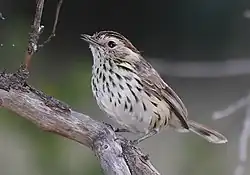 Pustkowik plamkowany (P. sagittatus) | |||
| Systematyka | |||
| Domena | |||
|---|---|---|---|
| Królestwo | |||
| Typ | |||
| Podtyp | |||
| Gromada | |||
| Podgromada | |||
| Infragromada | |||
| Rząd | |||
| Podrząd | |||
| Rodzina | |||
| Podrodzina | |||
| Rodzaj |
Pyrrholaemus | ||
| Typ nomenklatoryczny | |||
|
Pyrrholaemus brunneus Gould, 1841 | |||
| Synonimy | |||
|
| |||
| Gatunki | |||
| |||
Pyrrholaemus – rodzaj ptaków z podrodziny buszówek (Acanthizinae) w obrębie rodziny buszówkowatych (Acanthizidae).
Zasięg występowania
Morfologia
Długość ciała: 10,5–12,5 cm, masa ciała: 12–13,5 g[8].
Systematyka
Rodzaj zdefiniował w 1841 roku angielski zoolog John Gould na łamach „Proceedings of the Zoological Society of London”[2]. Gatunkiem typowym jest pustkowik rdzawogardły (Pyrrholaemus brunneus).
Etymologia
- Pyrrholaemus (Pyrrholoemus): gr. πυρρος purrhos „kolor płomienny, czerwony”, od πυρ pur, πυρος puros „ogień”; λαιμος laimos „gardło”[9].
- Chthonicola (Chtonicola): gr. χθων khthōn, χθονος khthonos „ziemia, grunt”; łac. -cola „mieszkaniec”, od colere „mieszkać”[10]. Typ nomenklatoryczny: Anthus minimus Vigors & Horsfield, 1827 (= Sylvia sagittata Latham, 1801).
- Senurus: etymologia niejasna, Reichenbach nie podał znaczenia nazwy rodzajowej[11]. Typ nomenklatoryczny: Sylvia sagittata Latham, 1801.
Podział systematyczny
Uwagi
Przypisy
- ↑ Pyrrholaemus, [w:] Integrated Taxonomic Information System (ang.).
- 1 2 J. Gould. Descriptions of new Birds from Australia. „Proceedings of the Zoological Society of London”. 8, s. 173, 1840. (ang.).
- ↑ J. Gould. Descriptions of New Species of Australian Birds. „Proceedings of the Zoological Society of London”. 15, s. 35, 1847. (ang.).
- ↑ H.G.L. Reichenbach: Avium systema naturale. Das natürliche system der vögel mit hundert tafeln grösstentheils original-abbildungen der bis jetzt entdecken fast zwölfhundert typischen formen. Vorlaüfer einer iconographie der arten der vögel aller welttheile. Dresden und Leipzig: Expedition der vollständigsten naturgeschichte, 1850, s. lix. (niem.).
- ↑ G.R. Gray: Catalogue of the genera and subgenera of birds contained in the British Museum. London: The Trustees, 1855, s. 37. (ang.).
- ↑ A. Reichenow: Die Vögel; Handbuch der systematischen Ornithologie. Cz. 2. F. Enke: Stuttgart, 1914, s. 531. (niem.).
- 1 2 F. Gill, D. Donsker & P. Rasmussen (redaktorzy), Bristlebirds, pardalotes, Australasian warblers [online], IOC World Bird List (v13.1) [dostęp 2023-05-31] (ang.).
- ↑ D.W. Winkler, S.M. Billerman & I.J. Lovette, Thornbills and Allies (Acanthizidae), version 1.0, [w:] S.M. Billerman, B.K. Keeney, P.G. Rodewald & T.S. Schulenberg (redaktorzy), Birds of the World, Cornell Lab of Ornithology, Ithaca, NY 2020, Pyrrholaemus, DOI: 10.2173/bow.acanth2.01 [dostęp 2025-03-19] (ang.).

- ↑ The Key to Scientific Names ↓, Pyrrholaemus [dostęp 2023-05-31].
- ↑ The Key to Scientific Names ↓, Chthonicola [dostęp 2023-05-31].
- ↑ The Key to Scientific Names ↓, Senurus [dostęp 2023-05-31].
- ↑ Systematyka i nazwy polskie za: P. Mielczarek & M. Kuziemko, Podrodzina: Acanthizinae Bonaparte, 1854 - buszówki (wersja: 2024-06-20), [w:] Kompletna lista ptaków świata [online], Instytut Nauk o Środowisku Uniwersytetu Jagiellońskiego [dostęp 2025-03-19].
Bibliografia
- The Key to Scientific Names, J.A. Jobling (red.), [w:] Birds of the World, S.M. Billerman et al. (red.), Cornell Lab of Ornithology, Ithaca (ang.).