Rhinobothryum
| Rhinobothryum[1] | |||
| Wagler, 1830[2] | |||
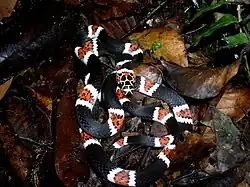 Przedstawiciel rodzaju – R. lentiginosum | |||
| Systematyka | |||
| Domena | |||
|---|---|---|---|
| Królestwo | |||
| Typ | |||
| Podtyp | |||
| Gromada | |||
| Podgromada | |||
| Rząd | |||
| Podrząd | |||
| Infrarząd | |||
| Nadrodzina |
Colubroidea | ||
| Rodzina | |||
| Podrodzina | |||
| Rodzaj |
Rhinobothryum | ||
| Typ nomenklatoryczny | |||
|
Coluber macrorhinus Wagler, 1830 (= Coluber lentiginosus Scopoli, 1785) | |||
| Gatunki | |||
| |||
Rhinobothryum – rodzaj węży z podrodziny Colubrinae w rodzinie połozowatych (Colubridae).
Zasięg występowania
Rodzaj obejmuje gatunki występujące w Hondurasie, Nikaragui, Kostaryce, Panamie, Kolumbii, Ekwadorze, Wenezueli, Gujanie, Gujanie Francuskiej, Brazylii, Boliwia i Peru[3].
Systematyka
Etymologia
Rhinobothryum: gr. ῥις rhis, ῥινος rhinos „nos”; βοθρυον bothruon „otwór”[2].
Podział systematyczny
Do rodzaju należą następujące gatunki[3]:
- Rhinobothryum bovallii
- Rhinobothryum lentiginosum
Przypisy
- ↑ Rhinobothryum, [w:] Integrated Taxonomic Information System (ang.).
- 1 2 J.G. Wagler: Natürliches System der Amphibien, mit vorangehender Classification der Säugethiere und Vögel. Ein Beitrag zur vergleichenden Zoologie. München, Stuttgart und Tübingen: In der J.G. Cotta’scchen Buchhandlung, 1830, s. 186. (niem.).
- 1 2 P. Uetz & J. Hallermann: Genus: Rhinobothryum. The Reptile Database. [dostęp 2019-04-18]. (ang.).