Sericornis
| Sericornis[1] | |||
| Gould, 1838[2] | |||
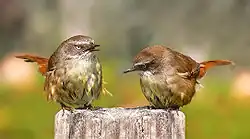 Solniki białobrewe (S. frontalis) | |||
| Systematyka | |||
| Domena | |||
|---|---|---|---|
| Królestwo | |||
| Typ | |||
| Podtyp | |||
| Gromada | |||
| Podgromada | |||
| Infragromada | |||
| Rząd | |||
| Podrząd | |||
| Rodzina | |||
| Podrodzina | |||
| Rodzaj |
Sericornis | ||
| Typ nomenklatoryczny | |||
| Synonimy | |||
|
| |||
| Gatunki | |||
| |||
Sericornis – rodzaj ptaków z podrodziny buszówek (Acanthizinae) w obrębie rodziny buszówkowatych (Acanthizidae).
Występowanie
Rodzaj obejmuje gatunki występujące w Australii (włącznie z Tasmanią) i na Nowej Gwinei[5].
Morfologia
Długość ciała 10,5–14,5 cm; masa ciała 10–21,5 g[6].
Systematyka
Etymologia
- Sericornis: gr. σηρικον sērikon „jedwab”, od σειρες seres „ludzie, którzy zbierają jedwab, Chińczycy”; ορνις ornis, ορνιθος ornithos „ptak”; w aluzji do miękkiego, jedwabistego upierzenia solnika białobrewego[7].
- Tasmanornis: Tasmania, Australia; gr. ορνις ornis, ορνιθος ornithos „ptak”[8]. Typ nomenklatoryczny: Sericornis humilis Gould, 1838.
- Megathiza: gr. μεγας megas, μεγαλη megalē „wielki”; rodzaj Acanthiza Vigors & Horsfield, 1827 (buszówka)[9]. Typ nomenklatoryczny: Sericornis magnirostris keri Mathews, 1920.
Podział systematyczny
Do rodzaju należą następujące gatunki[10]:
- Sericornis magnirostra (Gould, 1838) – solnik wielkodzioby
- Sericornis beccarii Salvadori, 1874 – solnik okularowy
- Sericornis nouhuysi van Oort, 1909 – solnik krzykliwy
- Sericornis maculatus Gould, 1847 – solnik plamisty
- Sericornis humilis Gould, 1838 – solnik brązowy
- Sericornis keri Mathews, 1920 – solnik ubogi
- Sericornis frontalis (Vigors & Horsfield, 1827) – solnik białobrewy
Przypisy
- ↑ Sericornis, [w:] Integrated Taxonomic Information System (ang.).
- ↑ J. Gould: A synopsis of the birds of Australia, and the adjacent Islands. London: John Gould, 1838, s. ryc. 58. (ang.).
- ↑ G.M. Mathews. A Reference-List to the Birds of Australia. „Novitates Zoologicae”. 18 (3), s. 353, 1911. (ang.).
- ↑ G.M. Mathews: The Birds of Australia. Cz. 10. London: H.F. & G. Witherby, 1922, s. 1. (ang.).
- ↑ F. Gill, D. Donsker & P. Rasmussen (redaktorzy), Bristlebirds, pardalotes, Australasian warblers [online], IOC World Bird List (v13.1) [dostęp 2023-05-31] (ang.).
- ↑ D.W. Winkler, S.M. Billerman & I.J. Lovette, Thornbills and Allies (Acanthizidae), version 1.0, [w:] S.M. Billerman, B.K. Keeney, P.G. Rodewald & T.S. Schulenberg (redaktorzy), Birds of the World, Cornell Lab of Ornithology, Ithaca, NY 2020, Sericornis, DOI: 10.2173/bow.acanth2.01 [dostęp 2025-03-19] (ang.).

- ↑ The Key to Scientific Names ↓, Sericornis [dostęp 2023-05-31].
- ↑ The Key to Scientific Names ↓, Tasmanornis [dostęp 2023-05-31].
- ↑ The Key to Scientific Names ↓, Megathiza [dostęp 2023-05-31].
- ↑ Systematyka i nazwy polskie za: P. Mielczarek & M. Kuziemko, Podrodzina: Acanthizinae Bonaparte, 1854 – buszówki (wersja: 2024-06-20), [w:] Kompletna lista ptaków świata [online], Instytut Nauk o Środowisku Uniwersytetu Jagiellońskiego [dostęp 2025-03-19].
Bibliografia
- The Key to Scientific Names, J.A. Jobling (red.), [w:] Birds of the World, S.M. Billerman et al. (red.), Cornell Lab of Ornithology, Ithaca (ang.).