Sibon
| Sibon[1] | |||
| Fitzinger, 1826[2] | |||
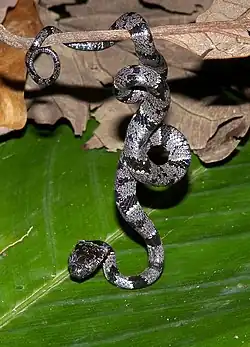 Sibon nebulatus | |||
| Systematyka | |||
| Domena | |||
|---|---|---|---|
| Królestwo | |||
| Typ | |||
| Podtyp | |||
| Gromada | |||
| Podgromada | |||
| Rząd | |||
| Podrząd | |||
| Infrarząd | |||
| Nadrodzina |
Colubroidea | ||
| Rodzina | |||
| Podrodzina | |||
| Rodzaj |
Sibon | ||
| Typ nomenklatoryczny | |||
|
Coluber nebulatus Linnaeus, 1758 | |||
| Synonimy | |||
| |||
| Gatunki | |||
| |||
Sibon – rodzaj węży z podrodziny ślimaczarzy (Dipsadinae) w rodzinie połozowatych (Colubridae).
Zasięg występowania
Rodzaj obejmuje gatunki występujące w Meksyku, Belize, Gwatemali, Salwadorze, Hondurasie, Nikaragui, Kostaryce, Panamie, Kolumbii, Wenezueli, Trynidadzie i Tobago, Gujanie Francuskiej, Brazylii, Ekwadorze i Peru[6][7], być może też w Gujanie i Surinamie[7].
Systematyka
Etymologia
- Sibon (Sibynon): etymologia nieznana, Fitzinger nie wyjaśnił znaczenia nazwy rodzajowej[2]; być może pochodzi od łac. sibonis „rodzaj włóczni myśliwskiej”[8].
- Petalognathus: gr. πεταλον petalon „płatek metalu, blaszka”; γναθος gnathos „żuchwa”[4]. Gatunek typowy: Coluber nebulatus Linnaeus, 1758.
- Asthenognathus: gr. ασθενης asthenēs „nieistotny, słaby”, od negatywnego przedrostka α a; σθενος sthenos „siła, moc”[9]; γναθος gnathos „żuchwa”[10]. Gatunek typowy: Petalognathus multifasciatus Bocourt, 1884 (= Leptognathus dimidiatus Günther, 1872).
Podział systematyczny
Do rodzaju należą następujące gatunki[6]:
- Sibon annulatus (Günther, 1872)
- Sibon anthracops (Cope, 1868)
- Sibon argus (Cope, 1875)
- Sibon ayerbeorum Vera-Pérez, 2019
- Sibon bevridgelyi Arteaga et al., 2018
- Sibon canopy Arteaga & Batista, 2023[11]
- Sibon carri (Shreve, 1951)
- Sibon dimidiatus (Günther, 1872)
- Sibon dunni J.A. Peters, 1957
- Sibon irmelindicaprioae Arteaga & Batista, 2023[11]
- Sibon lamari Solórzano, 2001
- Sibon leucomelas (Boulenger, 1896)
- Sibon linearis Pérez-Higareda, López-Luna & H.M. Smith, 2002
- Sibon longifrenis (Stejneger, 1909)
- Sibon manzanaresi McCranie, 2007
- Sibon marleyae Arteaga & Batista, 2023[11]
- Sibon merendonensis Rovito, Papenfuss & Vásquez-Almazán, 2012
- Sibon miskitus McCranie, 2006
- Sibon nebulatus (Linnaeus, 1758)
- Sibon noalamina Lotzkat, Hertz & G. Köhler, 2012
- Sibon perissostichon G. Köhler, Lotzkat & Hertz, 2010
- Sibon vieirai Arteaga & Batista, 2023[11]
Przypisy
- ↑ Sibon, [w:] Integrated Taxonomic Information System (ang.).
- 1 2 L.J.F.J. Fitzinger: Neue classification der reptilien nach ihren natürlichen verwandtschaften: nebst einer verwandtschafts-tafel und einem verzeichnisse der reptilien-sammlung des K. K. zoologischen museum’s zu Wien. Wien: J. G. Heubner, 1826, s. 29, 60. (niem.).
- ↑ L.J.F.J. Fitzinger: Systema reptilium. Fasciculus primus, Amblyglossae. Vindobonae: Braumüller et Seidel, 1843. (łac.).
- 1 2 A.M.C. Duméril & G. Bibron: Erpétologie générale, ou, Histoire naturelle complète des reptiles. T. 7. Cz. 1. Paris: Roret, 1854, s. 463. (fr.).
- ↑ M.-F. Bocourt. Note sur quelques Ophidiens nouveaux, provenant de l’Amérique inter-tropicale. „Bulletin de la Société philomathique de Paris”. Septième Série. 8, s. 141, 1884. (fr.).
- 1 2 P. Uetz & J. Hallermann: Genus: Sibon. The Reptile Database. [dostęp 2025-05-27]. (ang.).
- 1 2 Rune Midtgaard, Genus Sibon, [w:] RepFocus – A Survey of the Reptiles of the World [online] [dostęp 2025-05-28] (ang.).
- ↑ J.C. Lee: The amphibians and reptiles of the Yucatán Peninsula. Ithaca: Comstock Publishing Associates, 1996, s. 1–562. ISBN 0-8014-2450-X. (ang.).
- ↑ Jaeger 1944 ↓, s. 25.
- ↑ Jaeger 1944 ↓, s. 98.
- 1 2 3 4 Alejandro Arteaga, Abel Batista. A consolidated phylogeny of snail-eating snakes (Serpentes, Dipsadini), with the description of five new species from Colombia, Ecuador, and Panama. „ZooKeys”, s. 1–49, 2023. DOI: 10.3897/zookeys.1143.93601.
Bibliografia
- Edmund C. Jaeger, Source-book of biological names and terms, wyd. 1, Springfield: Charles C. Thomas, 1944, s. 1–256, OCLC 637083062 (ang.).