Torboszczury
| Peroryctinae | |||
| Groves & Flannery, 1990[1] | |||
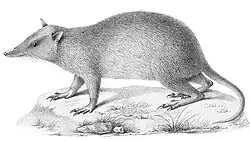
_(18407912601).jpg) Torboszczur ciemny (P. raffrayana) na ilustracji z 1878 roku | |||
| Systematyka | |||
| Domena | |||
|---|---|---|---|
| Królestwo | |||
| Typ | |||
| Podtyp | |||
| Gromada | |||
| Podgromada | |||
| Nadrząd | |||
| Rząd | |||
| Rodzina | |||
| Podrodzina |
torboszczury | ||
| Typ nomenklatoryczny | |||
|
Perameles raffrayana Milne-Edwards, 1878 | |||
| Synonimy | |||
| |||
| Rodzaje i Gatunki | |||
| |||
Torboszczury[6] (Peroryctinae) – monotypowa podrodzina ssaków z rodziny jamrajowatych (Peramelidae).
Rozmieszczenie geograficzne
Podrodzina obejmuje gatunki występujące na Nowej Gwinei[7][8][9].
Morfologia
Długość ciała 27,5–55,8 cm, długość ogona 9,5–22,9 cm; masa ciała 0,65–4,9 kg; samce są większe i cięższe od samic[8][10].
Systematyka
Podrodzinę (w randze rodziny) wyodrębnili w 1990 roku australijscy teriolodzy Colin Peter Groves i Tim Flannery, w rozdziale o tytule Ponowne omówienie rodzin i rodzajów jamrajów opublikowanym w publikacji zatytułowanej Jamraja i wielkouchy[1]. Rodzaj Peroryctes zdefiniował w 1906 roku angielski zoolog Oldfield Thomas w artykule zatytułowanym O ssakach zebranych w południowo-zachodniej Australii dla pana W.E. Balstona, opublikowanym w czasopiśmie „Proceedings of the Zoological Society of London”[5]. Gatunkiem typowym jest (oryginalne oznaczenie) torboszczur ciemny (P. raffrayana).
Etymologia
Podział systematyczny
Do podrodziny należy jeden rodzaj torboszczur[6] z następującymi występującymi współcześnie gatunkami[13][7][6]:
| Grafika | Gatunek | Autor i rok opisu | Nazwa zwyczajowa[6] | Podgatunki[8][7][10] | Rozmieszczenie geograficzne[8][7][10] | Podstawowe wymiary[8][10][b] | Status IUCN[14] |
|---|---|---|---|---|---|---|---|
| Peroryctes broadbentii | (E.P. Ramsay, 1879) | torboszczur większy | gatunek monotypowy | endemit Papui- Nowej Gwinei: południowo-wschodnia półwyspowa część; zakres wysokości: 50–1000 m n.p.m. | DC: 34–56 cm DO: 9,5–23 cm MC: 0,9–4,9 kg |
EN | |
 |
Peroryctes raffrayana | (A. Milne-Edwards, 1878) | torboszczur ciemny | gatunek monotypowy | Indonezja i Papua-Nowa Gwinea: większość Nowej Gwinei oraz wyspa Yapen; zakres wysokości: 50–3900 m n.p.m. | DC: 27–39 cm DO: 13,2–17,9 cm MC: 0,6–1,1 kg |
LC |
Kategorie IUCN: LC – gatunek najmniejszej troski, EN – gatunek zagrożony.
Opisano również wymarły gatunek z plejstocenu–holocenu indonezyjskiej wyspy Kobroor[4][15]:
- Peroryctes aruensis (Kear, Aplin & Westerman, 2016)
Uwagi
- ↑ Nomen nudum.
- ↑ DC – długość ciała; DO – długość ogona; MC – masa ciała
Przypisy
- 1 2 3 C.P. Groves & T. Flannery: Revision of the families and genera of bandicoots. W: J.H. Seebeck, R.L. Wallis, P.R. Brown & C.M. Kemper: Bandicoots and bilbies. Sydney: Surrey Beatty and Sons, 1990, s. 2. ISBN 978-0-949324-33-7. (ang.).
- ↑ M. Archer, H. Godthelp, S.J. Hand & D. Megirian. Fossil mammals of Riversleigh, northwestern Queensland: Preliminary overview of biostratigraphy, correlation and environmental change. „Australian Zoologist”. 25 (2), s. 32, 1989. DOI: 10.7882/AZ.1989.001. (ang.).
- ↑ M.C. McKenna & S.K. Bell: Classification of mammals above the species level. Nowy Jork: Columbia University Press, 1997, s. 57. ISBN 978-0-231-11013-6. (ang.).
- 1 2 3 B.P. Kear, K.P. Aplin & M. Westerman. Bandicoot fossils and DNA elucidate lineage antiquity amongst xeric-adapted Australasian marsupials. „Scientific Reports”. 6 (37537), s. 3, 2016. DOI: 10.1038/srep37537. (ang.).
- 1 2 O. Thomas. On mammals collected in south-west Australia for Mr. W.E. Balston. „Proceedings of the Zoological Society of London”. 76 (3–4), s. 476, 1906. (ang.).
- 1 2 3 4 5 W. Cichocki, A. Ważna, J. Cichocki, E. Rajska-Jurgiel, A. Jasiński & W. Bogdanowicz: Polskie nazewnictwo ssaków świata. Warszawa: Muzeum i Instytut Zoologii PAN, 2015, s. 10. ISBN 978-83-88147-15-9. (pol. • ang.).
- 1 2 3 4 C.J. Burgin, D.E. Wilson, R.A. Mittermeier, A.B. Rylands, T.E. Lacher & W. Sechrest: Illustrated Checklist of the Mammals of the World. Cz. 1: Monotremata to Rodentia. Barcelona: Lynx Edicions, 2020, s. 72. ISBN 978-84-16728-34-3. (ang.).
- 1 2 3 4 5 Ch. Dickman: Family Peramelidae (Bandicoots and Echymiperas). W: D.E. Wilson & R.A. Mittermeier (redaktorzy): Handbook of the Mammals of the World. Cz. 5: Monotremes and Marsupials. Barcelona: Lynx Edicions, 2015, s. 393. ISBN 978-84-96553-99-6. (ang.).
- ↑ D.E. Wilson & D.M. Reeder (redaktorzy): Genus Peroryctes. [w:] Mammal Species of the World. A Taxonomic and Geographic Reference (Wyd. 3) [on-line]. Johns Hopkins University Press, 2005. [dostęp 2020-10-24].
- 1 2 3 4 Class Mammalia. W: Lynx Nature Books: All the Mammals of the World. Barcelona: Lynx Edicions, 2023, s. 50–51. ISBN 978-84-16728-66-4. (ang.).
- ↑ Jaeger 1959 ↓, s. 188.
- ↑ Jaeger 1959 ↓, s. 178.
- ↑ C.J. Burgin, J.S. Zijlstra, M.A. Becker, H. Handika, J.M. Alston, J. Widness, S. Liphardt, D.G. Huckaby & N.S. Upham: The ASM Mammal Diversity Database. [w:] ASM Mammal Diversity Database (Version 2.0) [on-line]. American Society of Mammalogists. [dostęp 2025-03-20]. (ang.).
- ↑ Taxonomy: Peroryctes – Genus. The IUCN Red List of Threatened Species. [dostęp 2025-03-20]. (ang.).
- ↑ K.J. Travouillon & M.J. Phillips. Total evidence analysis of the phylogenetic relationships of bandicoots and bilbies (Marsupialia: Peramelemorphia): reassessment of two species and description of a new species. „Zootaxa”. 4378 (2), s. 224–256, 2018. DOI: 10.11646/zootaxa.4378.2.3. (ang.).
Bibliografia
- E.C. Jaeger: Source-book of biological names and terms. Wyd. 3 (Revised second printing). Springfield: Charles C. Thomas, 1959, s. 1–316. (ang.).