Uraeotyphlus
| Uraeotyphlus | |||
| Peters, 1880[1] | |||
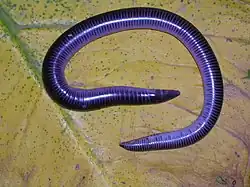 U. oxyurus | |||
| Systematyka | |||
| Domena | |||
|---|---|---|---|
| Królestwo | |||
| Typ | |||
| Podtyp | |||
| Gromada | |||
| Rząd | |||
| Rodzina | |||
| Rodzaj |
Uraeotyphlus | ||
| Typ nomenklatoryczny | |||
| Synonimy | |||
|
| |||
| Gatunki | |||
| |||
Uraeotyphlus – rodzaj płazów beznogich z rodziny łusecznikowatych (Ichthyophiidae).
Rozmieszczenie geograficzne
Rodzaj obejmuje gatunki występujące w Ghatach Zachodnich w południowo-zachodnich Indiach[3].
Systematyka
Rodzaj zdefiniował w 1880 roku niemiecki zoolog Wilhelm Peters w artykule zatytułowanym O klasyfikacji płazów beznogich, w szczególności o rodzajach Rhinatrema i Gymnopis, opublikowanym w czasopiśmie „Monatsberichte der Königlichen Preussische Akademie des Wissenschaften zu Berlin”[1]. Gatunkiem typowym jest (późniejsze oznaczenie)[4] U. oxyurus.
Etymologia
Uraeotyphlus (Uraetyphlus): gr. ουραιος ouraios ‘ogonowy’, od ουρα oura ‘ogon’; τυφλος tuphlos ‘ciemny’[1].
Podział systematyczny
Do rodzaju należą następujące gatunki[3]:
- Uraeotyphlus bombayensis (Taylor, 1960)
- Uraeotyphlus gansi Gower, Rajendran, Nussbaum & Wilkinson, 2008
- Uraeotyphlus interruptus Pillai & Ravichandran, 1999
- Uraeotyphlus malabaricus (Beddome, 1870)
- Uraeotyphlus menoni Annandale, 1913
- Uraeotyphlus narayani Seshachar, 1939
- Uraeotyphlus oommeni Gower & Wilkinson, 2007
- Uraeotyphlus oxyurus (Duméril & Bibron, 1841)
Uwagi
- ↑ Niepoprawna późniejsza pisownia Uraeotyphlus Peters, 1880.
Przypisy
- 1 2 3 W. Peters. Über die Eintheilung der Caecilien und insbesondere über die Gattungen Rhinatrema und Gymnopis. „Monatsberichte der Königlichen Preussische Akademie des Wissenschaften zu Berlin”. Aus dem Jahre 1879, s. 933, 1880. (niem.).
- ↑ F. Werner. Ueber Reptilien und Batrachier aus Togoland, Kamerun und Deutsch-Neu-Guinea. „Verhandlungen des Zoologisch-Botanischen Vereins in Wien”. 49, s. 144, 1899. (niem.).
- 1 2 Darrel R. Frost: Uraeotyphlus Peters, 1880. [w:] Amphibian Species of the World 6.2, an Online Reference [on-line]. American Museum of Natural History. [dostęp 2025-02-07]. (ang.).
- ↑ G.K. Noble. Contributions to the herpetology of the Belgian Congo based on the collection of the American Museum Congo Expedition, 1909–1915. Part 3, Amphibia. „Bulletin of the American Museum of Natural History”. 49, s. 3057, 1924. (ang.).