Wombatowiec
| Lasiorhinus | |||
| J.E. Gray, 1863[1] | |||
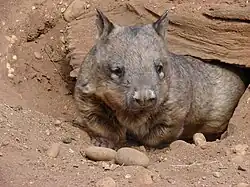 Wombatowiec szerokogłowy (L. latifrons) | |||
| Systematyka | |||
| Domena | |||
|---|---|---|---|
| Królestwo | |||
| Typ | |||
| Podtyp | |||
| Gromada | |||
| Podgromada | |||
| Infragromada | |||
| Nadrząd | |||
| Rząd | |||
| Podrząd | |||
| Rodzina | |||
| Rodzaj |
wombatowiec | ||
| Typ nomenklatoryczny | |||
|
Lasiorhinus mcoyi J.E. Gray, 1863 (= Phascolomys latifrons R. Owen, 1845) | |||
| Synonimy | |||
|
| |||
| Gatunki | |||
| |||
Wombatowiec[4] (Lasiorhinus) – rodzaj ssaka z rodziny wombatowatych (Vombatidae).
Rozmieszczenie geograficzne
Rodzaj obejmuje gatunki występujące endemicznie w Australii[5][6].
Morfologia
Systematyka
Rodzaj zdefiniował w 1863 roku angielski zoolog John Edward Gray w artykule poświęconym opisowi trzech wombatów z Ogrodów Towarzystwa Zoologicznego w Londynie, opublikowanym w czasopiśmie The Annals and Magazine of Natural History[1]. Gatunkiem typowym jest (oznaczenie monotypowe) wombatowiec szerokogłowy (L. latifrons).
Etymologia
Podział systematyczny
Do rodzaju należą następujące występujące współcześnie gatunki[11][12]:
| Grafika | Gatunek | Autor i rok opisu | Nazwa zwyczajowa[4] | Podgatunki[5][12][7] | Rozmieszczenie geograficzne[5][12][7] | Podstawowe wymiary[5][7][b] | Status IUCN[13] |
|---|---|---|---|---|---|---|---|
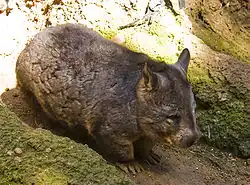 |
Lasiorhinus latifrons | (R. Owen, 1845) | wombatowiec szerokogłowy | gatunek monotypowy | południowo-wschodnia Australia Zachodnia (zachodnie nizina Nullarbor) i południowa Australia Południowa (na wschód do rzeki Murray); introdukowany na wyspę Wedge Island (Australia Południowa) | DC: 84–111 cm DO: 2,5–6 cm MC: 17,5–36 kg |
NT |
.jpg) |
Lasiorhinus krefftii | (R. Owen, 1873) | wombatowiec szorstkowłosy | gatunek monotypowy | Epping Forest National Park (środkowy Queensland) | DC: około 108 cm DO: brak danych MC: około 32 kg |
CR |
Kategorie IUCN: NT – gatunek bliski zagrożenia, CR – gatunek krytycznie zagrożony.
Opisano również gatunek wymarły z plejstocenu Australii[14]:
- Lasiorhinus angustidens (De Vis, 1891)
Uwagi
- ↑ Nomen nudum.
- ↑ DC – długość ciała; DO – długość ogona; MC – masa ciała
Przypisy
- 1 2 J.E. Gray. Notice of three wombats in the Zoological Gardens. „The Annals and Magazine of Natural History”. Third Series. 11 (66), s. 458, 1863. (ang.).
- ↑ T. Iredale & E. Le G. Troughton. A check-list of the mammals recorded from Australia. „The Australian Museum Memoir”. 6, s. 35, 1934. (ang.).
- ↑ E.L.G. Troughton: Furred animals of Australia. Melbourne: Angus & Robertson, 1941, s. 145, 148. (ang.).
- 1 2 Nazwy polskie za: W. Cichocki, A. Ważna, J. Cichocki, E. Rajska-Jurgiel, A. Jasiński & W. Bogdanowicz: Polskie nazewnictwo ssaków świata. Warszawa: Muzeum i Instytut Zoologii PAN, 2015, s. 10–11. ISBN 978-83-88147-15-9. (pol. • ang.).
- 1 2 3 4 5 R. Wells: Family Vombatidae (Wombats). W: D.E. Wilson & R.A. Mittermeier (redaktorzy): Handbook of the Mammals of the World. Cz. 5: Monotremes and Marsupials. Barcelona: Lynx Edicions, 2015, s. 433–434. ISBN 978-84-96553-99-6. (ang.).
- ↑ D.E. Wilson & D.M. Reeder (redaktorzy): Genus Lasiorhinus. [w:] Mammal Species of the World. A Taxonomic and Geographic Reference (Wyd. 3) [on-line]. Johns Hopkins University Press, 2005. [dostęp 2020-10-24].
- 1 2 3 4 Class Mammalia. W: Lynx Nature Books (A. Monadjem (przedmowa) & C.J. Burgin (wstęp)): All the Mammals of the World. Barcelona: Lynx Edicions, 2023, s. 52. ISBN 978-84-16728-66-4. (ang.).
- ↑ T.S. Palmer. Index Generum Mammalium: a List of the Genera and Families of Mammals. „North American Fauna”. 23, s. 365, 1904. (ang.).
- ↑ The Key to Scientific Names, J.A. Jobling (red.), [w:] Birds of the World, S.M. Billerman et al. (red.), Cornell Lab of Ornithology, Ithaca (ang.).
- ↑ E.C. Jaeger: Source-book of biological names and terms. Wyd. 3 (Revised second printing). Springfield: Charles C. Thomas, 1959, s. 275. (ang.).
- ↑ N. Upham, C. Burgin, J. Widness, M. Becker, C. Parker, S. Liphardt, I. Rochon & D. Huckaby: Treeview of Mammalian Taxonomy Hierarchy. [w:] ASM Mammal Diversity Database (Version 1.11) [on-line]. American Society of Mammalogists. [dostęp 2023-08-01]. (ang.).
- 1 2 3 C.J. Burgin, D.E. Wilson, R.A. Mittermeier, A.B. Rylands, T.E. Lacher & W. Sechrest: Illustrated Checklist of the Mammals of the World. Cz. 1: Monotremata to Rodentia. Barcelona: Lynx Edicions, 2020, s. 76. ISBN 978-84-16728-34-3. (ang.).
- ↑ Taxonomy: Lasiorhinus – Genus. The IUCN Red List of Threatened Species. [dostęp 2024-09-09]. (ang.).
- ↑ Ch.W. De Vis. Remarks on post-Tertiary Phascolomyidae. „Proceedings of the Linnean Society of New South Wales”. Second series. 16 (2), s. 243, 1891. (ang.).