Xenochrophis
| Xenochrophis[1] | |||
| Günther, 1864[2] | |||
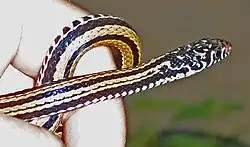 Przedstawiciel rodzaju – X. vittatus | |||
| Systematyka | |||
| Domena | |||
|---|---|---|---|
| Królestwo | |||
| Typ | |||
| Podtyp | |||
| Gromada | |||
| Podgromada | |||
| Rząd | |||
| Podrząd | |||
| Infrarząd | |||
| Nadrodzina |
Colubroidea | ||
| Rodzina | |||
| Podrodzina | |||
| Rodzaj |
Xenochrophis | ||
| Typ nomenklatoryczny | |||
|
Psammophis cerasogaster Cantor, 1839 | |||
| Synonimy | |||
|
| |||
| Gatunki | |||
| |||
Xenochrophis – rodzaj węży z podrodziny zaskrońcowatych (Natricinae) w rodzinie połozowatych (Colubridae).
Zasięg występowania
Rodzaj obejmuje gatunki występujące w Azji (Afganistan, Chiny, Pakistan, Indie, Sri Lanka, Nepal, Bhutan, Bangladesz, Mjanma, Laos, Wietnam, Kambodża, Tajlandia, Malezja, Singapur, Brunei i Indonezja)[5][6].
Systematyka
Etymologia
- Xenochrophis: gr. ξενος xenos „dziwny”[7]; χροα khroa, χροας khroas „barwa, kolor”[8]; οφις ophis, οφεως opheōs „wąż”[9].
- Fowlea: „Schwytany przez E. Fowle’a, Esq., który jest jednym z niewielu, którzy liberalnie pomogli mi w badaniu naszych indyjskich gadów”[3]. Gatunek typowy: Fowlea peguensis Theobald, 1868 (= Tropidonotus punctulatus Günther, 1858).
- Ceratophallus: gr. κερας keras, κερατος keratos „róg”[10]; φαλλος phallos „penis”[11]. Gatunek typowy: Coluber vittatus Linnaeus, 1758.
Podział systematyczny
Do rodzaju należą następujące gatunki[5]:
Przypisy
- ↑ Xenochrophis, [w:] Integrated Taxonomic Information System (ang.).
- ↑ A.C.L.G. Günther: The reptiles of British India. London: Pub. for the Ray society by R. Hardwicke, 1864, s. 273. (ang.).
- 1 2 W. Theobald: Catalogue of reptiles in the Museum of the Asiatic Society of Bengal. Calcutta: Baptist Mission Press, 1868, s. 57. (ang.).
- ↑ E.D. Cope. Prodromus of a new system of non-venomous snakes. „The American Naturalist”. 27 (1), s. 483, 1893. (ang.).
- 1 2 P. Uetz & J. Hallermann: Genus: Xenochrophis. The Reptile Database. [dostęp 2025-01-19]. (ang.).
- ↑ R. Midtgaard: Xenochrophis. RepFocus. [dostęp 2019-08-03]. (ang.).
- ↑ Jaeger 1944 ↓, s. 253.
- ↑ Jaeger 1944 ↓, s. 50.
- ↑ Jaeger 1944 ↓, s. 154.
- ↑ Jaeger 1944 ↓, s. 44.
- ↑ Jaeger 1944 ↓, s. 169.
Bibliografia
- Edmund C. Jaeger, Source-book of biological names and terms, wyd. 1, Springfield: Charles C. Thomas, 1944, s. 1–256, OCLC 637083062 (ang.).