Caladeniinae
 | |
| Systematyka[1][2] | |
| Domena | |
|---|---|
| Królestwo | |
| Podkrólestwo | |
| Nadgromada | |
| Gromada | |
| Podgromada | |
| Nadklasa | |
| Klasa | |
| Nadrząd | |
| Rząd | |
| Rodzina | |
| Podrodzina | |
| Plemię |
Caladeniinae |
| Nazwa systematyczna | |
| Caladeniinae Pfitzer Entwurf einer naturlichen Anordnung der Orchideen 97. 1887.[3] | |
| Typ nomenklatoryczny | |
|
Caladenia R. Br.[3] | |
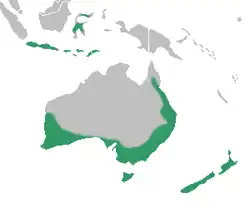
Caladeniinae – podplemię roślin z rodziny storczykowatych (Orchidaceae). Obejmuje 11 rodzajów, 2 hybrydy i około 300 gatunków występujących w Azji, Australii i Oceanii[4].
Systematyka
Podplemię sklasyfikowane do plemienia Diurideae z podrodziny storczykowych (Orchidoideae) w rodzinie storczykowatych (Orchidaceae), rząd szparagowce (Asparagales) w obrębie roślin jednoliściennych[4][5].
- Adenochilus Hook.f.
- Aporostylis Rupp & Hatch
- Caladenia R.Br.
- Cyanicula Hopper & A.P.Br.
- Elythranthera (Endl.) A.S.George
- Ericksonella Hopper & A.P.Br.
- Eriochilus R.Br.
- Glossodia R.Br.
- Leptoceras (R.Br.) Lindl.
- Pheladenia D.L.Jones & M.A.Clem.
- Praecoxanthus Hopper & A.P.Br.
- × Calassodia M.A.Clem.
- × Cyanthera Hopper & A.P.Br.
Przypisy
- ↑ Michael A. Ruggiero i inni, A Higher Level Classification of All Living Organisms, „PLOS One”, 10 (4), 2015, art. nr e0119248, DOI: 10.1371/journal.pone.0119248, PMID: 25923521, PMCID: PMC4418965 [dostęp 2023-03-01] (ang.).
- ↑ Peter F. Stevens, Angiosperm Phylogeny Website, Missouri Botanical Garden, 2001– [dostęp 2023-03-01] (ang.).
- 1 2 Index Nominum Genericorum (ING). Smithsonian Institution. [dostęp 2023-03-01].
- 1 2 Caladeniinae. Tropicos.org. [dostęp 2023-03-01].
- 1 2 3 Caladeniinae. NCBI. [dostęp 2023-03-01].
- 1 2 Caladeniinae. NCBI. [dostęp 2023-03-01].
Identyfikatory zewnętrzne (takson):