Geotrygon
| Geotrygon[1] | |||
| Gosse, 1847[2] | |||
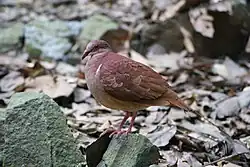 Błyskotek rdzawy (G. montana) | |||
| Systematyka | |||
| Domena | |||
|---|---|---|---|
| Królestwo | |||
| Typ | |||
| Podtyp | |||
| Gromada | |||
| Podgromada | |||
| Infragromada | |||
| Rząd | |||
| Rodzina | |||
| Podrodzina | |||
| Plemię | |||
| Rodzaj |
Geotrygon | ||
| Typ nomenklatoryczny | |||
|
Geotrygon sylvatica Gosse, 1847 = Columbigallina versicolor Lafresnaye, 1846 | |||
| Synonimy | |||
| |||
| Gatunki | |||
| |||
Geotrygon – rodzaj ptaków z podrodziny gołębi (Columbinae) w rodzinie gołębiowatych (Columbidae).
Zasięg występowania
Morfologia
Długość ciała 19–31 cm; masa ciała 77–225 g[9].
Systematyka
Etymologia
- Geotrygon: gr. γεω- geo- „ziemny-”, od γη gē „ziemia”; τρυγων trugon, τρυγονος trugonos „gołąb”[10].
- Oreopeleia (Oropeleia, Oropelia, Oreopelia): gr. ορος oros, ορεος oreos „góra” (tj. góry Martyniki); πελεια peleia „gołąb”[11]. Gatunek typowy: Columba montana Linnaeus, 1758.
- Osculatia: Gaetano Osculati (1808–1884), włoski entomolog, podróżnik, kolekcjoner[12]. Gatunek typowy: Geotrygon saphirina Bonaparte, 1855.
Podział systematyczny
Do rodzaju należą następujące gatunki[13]:
- Geotrygon purpurata (Salvin, 1878) – błyskotek purpurogłowy – takson wyodrębniony ostatnio z G. saphirina[14][15][16][8][17]
- Geotrygon saphirina Bonaparte, 1855 – błyskotek szafirowy
- Geotrygon versicolor (Lafresnaye, 1846) – błyskotek czubaty
- Geotrygon montana (Linnaeus, 1758) – błyskotek rdzawy
- Geotrygon violacea (Temminck, 1809) – błyskotek fioletowy
- Geotrygon caniceps (Gundlach, 1852) – błyskotek szaroczelny
- Geotrygon leucometopia (Chapman, 1917) – błyskotek białoczelny – takson wyodrębniony ostatnio z G. caniceps[18]
- Geotrygon chrysia Bonaparte, 1855 – błyskotek zielonogłowy
- Geotrygon mystacea (Temminck, 1811) – błyskotek białowąsy
Przypisy
- ↑ Geotrygon, [w:] Integrated Taxonomic Information System (ang.).
- ↑ P.H. Gosse: The birds of Jamaica. London: J. Van Voorst, 1847, s. 316. (ang.).
- ↑ H.G.L. Reichenbach: Avium systema naturale. Das natürliche system der vögel mit hundert tafeln grösstentheils original-abbildungen der bis jetzt entdecken fast zwölfhundert typischen formen. Vorlaüfer einer iconographie der arten der vögel aller welttheile. Dresden und Leipzig: Expedition der vollständigsten naturgeschichte, 1850, s. xxv. (niem.).
- ↑ Ch.-L. Bonaparte. Conspectus Systematis Ornithologie. „Annales des Sciences Naturelles, Zoologie”. Quatrième Série. 1, s. 140, 1854. (fr.).
- ↑ Ch.-L. Bonaparte. Coup d’œil sur les Pigeons (cinquième partie). „Comptes rendus hebdomadaires de l’Académie des Sciences”. 40, s. 102, 1855. (fr.).
- ↑ G.R. Gray: List of the specimens of birds in the collection of the British Museum. Cz. 4: Columbæ. London: Printed by the order of the Trustees, 1856, s. 51. (ang.).
- ↑ H.C.C. Burmeister: Systematische Uebersicht der Thiere Brasiliens: welche während einer Reise durch die Provinzen von Rio de Janeiro und Minas geraës gesammlt oder beobachtet Wurden. T. 3: Vögel (Aves). Berlin: G. Reimer, 1856, s. 306. (niem.).
- 1 2 F. Gill, D. Donsker & P. Rasmussen (red.): IOC World Bird List (v11.2). [dostęp 2021-07-22]. (ang.).
- ↑ L.F. Baptista, P.W. Trail & H.M. Horblit: Family Columbidae (Pigeons and Doves). W: J. del Hoyo, A. Elliott & J. Sargatal: Handbook of the Birds of the World. Cz. 4: Sandgrouse to Cuckoos. Barcelona: Lynx Edicions, 1997, s. 174–176. ISBN 84-87334-22-9. (ang.).
- ↑ The Key to Scientific Names ↓, Geotrygon [dostęp 2025-02-26].
- ↑ The Key to Scientific Names ↓, Oreopeleia [dostęp 2025-02-26].
- ↑ The Key to Scientific Names ↓, Osculatia [dostęp 2025-02-26].
- ↑ Systematyka i nazwy polskie za: P. Mielczarek & M. Kuziemko: Podrodzina: Columbinae Leach, 1819 – gołębie (wersja: 2024-09-29). [w:] Kompletna lista ptaków świata [on-line]. Instytut Nauk o Środowisku Uniwersytetu Jagiellońskiego. [dostęp 2025-02-26].
- ↑ D. Gibbs: Pigeons and Doves. Pica Press, 2001. ISBN 1-873403-60-7. (ang.).
- ↑ R.S. Ridgely & P.J. Greenfield: The Birds of Ecuador. Cz. 2. Londyn: Christopher Helm, 2001. ISBN 0-7136-6117-8. (ang.).
- ↑ T.M. Donegan & P. Salaman. Vocal differentiation and conservation of Indigo-crowned Quail-Dove Geotrygon purpurata. „Conservacion Colombiana”. 17 (1), s. 15–19, 2011. (ang.).
- ↑ R.C. Banks, J.D. Weckstein, J.V. Remsen, Jr, & K.P. Johnson. Classification of a clade of New World doves (Columbidae: Zenaidini). „Zootaxa”. 3669 (2), s. 184–188, 2013. (ang.).
- ↑ O.H. Garrido, G.M. Kirwan & D.R. Capper. Species limits within the Grey-headed Quail-dove Geotrygon caniceps and implications for the conservation of a globally threatened species. „Bird Conservation International”. 12, s. 169–187, 2002. DOI: 10.1017/S0959270902002101. (ang.).
Bibliografia
- The Key to Scientific Names, J.A. Jobling (red.), [w:] Birds of the World, S.M. Billerman et al. (red.), Cornell Lab of Ornithology, Ithaca (ang.).