Gracula
| Gracula[1] | |||
| Linnaeus, 1758[2] | |||
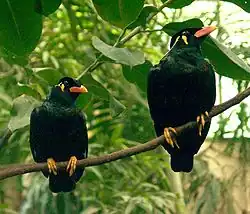 Gwarek czczony (G. religiosa) | |||
| Systematyka | |||
| Domena | |||
|---|---|---|---|
| Królestwo | |||
| Typ | |||
| Podtyp | |||
| Gromada | |||
| Podgromada | |||
| Infragromada | |||
| Rząd | |||
| Podrząd | |||
| Rodzina | |||
| Podrodzina | |||
| Rodzaj |
Gracula | ||
| Typ nomenklatoryczny | |||
|
Gracula religiosa Linnaeus, 1758 | |||
| Synonimy | |||
|
| |||
| Gatunki | |||
| |||
Gracula – rodzaj ptaków z podrodziny gwarków (Mainatinae) w rodzinie szpakowatych (Sturnidae).
Zasięg występowania
Rodzaj obejmuje gatunki występujące w południowej i południowo-wschodniej Azji[6].
Morfologia
Długość ciała 23–32 cm; masa ciała 126–229 g[7].
Systematyka
Etymologia
- Gracula: łac. graculus „nieznany ptak”, utożsamiany z kawką ze względu na jej okrzyki brzmiące jak „gra gra”[8].
- Eulabes: gr. ευλαβης eulabēs „pobożny, pełen szacunku”, od ευσεβης eusebēs „religijny”, od ευ eu „prawdziwie”; σεβω sebō „czcić”[9]. Gatunek typowy: Gracula religiosa Linnaeus, 1758.
- Mainatus: fr. Mainate, nazwa dla gwarków lub wilgowrona, od hindi Mainā lub Maynā, nazwa dla gwarka czczonego[10]. Gatunek typowy: Mainatus major Vieillot, 1817 (= Gracula religiosa Linnaeus, 1758).
Podział systematyczny
Do rodzaju należą następujące gatunki[11]:
- Gracula ptilogenys Blyth, 1846 – gwarek cejloński
- Gracula indica (Cuvier, 1829) – gwarek malabarski – takson wyodrębniony z G. religiosa[12][13]
- Gracula religiosa Linnaeus, 1758 – gwarek czczony
Uwagi
Przypisy
- ↑ Gracula, [w:] Integrated Taxonomic Information System (ang.).
- ↑ C. Linnaeus: Systema naturae per regna tria naturae: secundum classes, ordines, genera, species, cum characteribus, differentiis, synonymis, locis. Wyd. 10. T. 1. Holmiae: Impensis Direct. Laurentii Salvii, 1758, s. 108. (łac.).
- ↑ C.S. Rafinesque: Analyse de la nature: or, Tableau de l’univers et des corps organisés. Palerme: Aux dépens de l’auteur, 1815, s. 68. (fr.).
- ↑ G. Cuvier: Le règne animal distribué d’après son organisation: pour servir de base a l’histoire naturelle des animaux et d’introduction a l’anatomie comparée. T. 1. Paris: Chez Déterville, 1817, s. 401. (fr.).
- ↑ L.J.P. Vieillot: Nouveau dictionnaire d’histoire naturelle, appliquée aux arts, à l’agriculture, à l’économie rurale et domestique, à la médecine, etc.. Wyd. 2. T. 18. Paris: Chez Detervill, 1817, s. 410. (fr.).
- ↑ F. Gill, D. Donsker & P. Rasmussen (red.): IOC World Bird List (v15.1). [dostęp 2025-04-08]. (ang.).
- ↑ A. Craig & Ch. Feare: Family Sturnidae (Starlings). W: J. del Hoyo, A. Elliott & D.A. Christie: Handbook of the Birds of the World. Cz. 14: Bush-shrikes to Old World Sparrows. Barcelona: Lynx Edicions, 2009, s. 713–715. ISBN 978-84-96553-50-7. (ang.).
- ↑ Gracula, [w:] The Key to Scientific Names, J.A. Jobling (red.), [w:] Birds of the World, S.M. Billerman et al. (red.), Cornell Lab of Ornithology, Ithaca [dostęp 2022-01-19] (ang.).
- ↑ Eulabes, [w:] The Key to Scientific Names, J.A. Jobling (red.), [w:] Birds of the World, S.M. Billerman et al. (red.), Cornell Lab of Ornithology, Ithaca [dostęp 2022-01-19] (ang.).
- ↑ Mainatus, [w:] The Key to Scientific Names, J.A. Jobling (red.), [w:] Birds of the World, S.M. Billerman et al. (red.), Cornell Lab of Ornithology, Ithaca [dostęp 2022-01-19] (ang.).
- ↑ Systematyka i nazwy polskie za: P. Mielczarek & M. Kuziemko: Podrodzina: Mainatinae Lesson, 1831 - gwarki (wersja: 2024-12-24). [w:] Kompletna lista ptaków świata [on-line]. Instytut Nauk o Środowisku Uniwersytetu Jagiellońskiego. [dostęp 2025-04-08].
- ↑ Ch. Feare & A. Craig: Starlings and Mynas. Londyn: Christopher Helm, 1998. ISBN 0-691-00496-X. (ang.).
- ↑ P.C. Rasmussen & J.C. Anderton: Birds of South Asia: The Ripley Guide. Cz. 2. Waszyngton i Barcelona: Smithsonian Inst. and Lynx Edicions, 2005. ISBN 84-87334-67-9. (ang.).