Jasnotek
| Antrozous | |||
| H. Allen, 1862[1] | |||
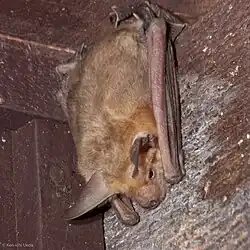 Jasnotek amerykański (A. pallidus) | |||
| Systematyka | |||
| Domena | |||
|---|---|---|---|
| Królestwo | |||
| Typ | |||
| Podtyp | |||
| Gromada | |||
| Podgromada | |||
| Infragromada | |||
| Rząd | |||
| Podrząd | |||
| Nadrodzina | |||
| Rodzina | |||
| Podrodzina | |||
| Plemię | |||
| Rodzaj |
jasnotek | ||
| Typ nomenklatoryczny | |||
|
Vespertilio pallidus Le Conte, 1856 | |||
| Gatunki | |||
| |||
Jasnotek[2] (Antrozous) – rodzaj ssaków z podrodziny mroczków (Vespertilioninae) w obrębie rodziny mroczkowatych (Vespertilionidae).
Zasięg występowania
Rodzaj obejmuje gatunki występujące w Ameryce Północnej[3][4][5].
Morfologia
Długość ciała (bez ogona) 57–82 mm, długość ogona 35–53 mm; masa ciała 14–29 g[4][6].
Systematyka
Rodzaj zdefiniował w 1862 roku amerykański zoolog Harrison Allen w artykule zatytułowanym Opisy dwóch nowych gatunków Vespertilionidae i kilka uwag na temat rodzaju Antrozous, opublikowanym w czasopiśmie „Proceedings of the Academy of Natural Sciences of Philadelphia”[1]. Gatunkiem typowym jest (oznaczenie monotypowe) jasnotek amerykański (A. pallidus).
Etymologia
Antrozous: gr. αντρον antron ‘jaskinia, grota’; ζωον zōon ‘zwierzę’[7].
Podział systematyczny
Do rodzaju należą następujące gatunki[8][6][3][2]:
| Grafika | Gatunek | Autor i rok opisu | Nazwa zwyczajowa[2] | Podgatunki[4][3][6] | Rozmieszczenie geograficzne[4][3][6] | Podstawowe wymiary[4][6][a] | Status IUCN[9] |
|---|---|---|---|---|---|---|---|
 |
Antrozous pallidus | (Le Conte, 1856) | jasnotek amerykański | 5 podgatunków | południowo-zachodnia Kanada (Kolumbia Brytyjska), zachodnie i środkowe Stany Zjednoczone oraz północny i środkowy Meksyk (wraz z Półwyspem Kalifornijskim); zakres wysokości: do 2440 m n.p.m. | DC: 5,7–8,2 cm DO: 3,5–5,3 cm DP: 4,5–6 cm MC: 14–29 g |
LC |
| Antrozous koopmani | Orr & Silva Taboada, 1960 | gatunek monotypowy | endemit Kuby[b] | DC: brak danych DO: brak danychcm DP: brak danychcm MC: brak danych |
NE |
Kategorie IUCN: LC – gatunek najmniejszej troski; NE – gatunki niepoddane jeszcze ocenie.
Opisano również wymarły gatunek z pliocenu dzisiejszych Stanów Zjednoczonych[11]:
- Antrozous wheeleri (Dalquest & Patrick, 1989)
Uwagi
Przypisy
- 1 2 H. Allen. Descriptions of two new species of Vespertilionidae, and some remarks on the genus Antrozous. „Proceedings of the Academy of Natural Sciences of Philadelphia”. 14, s. 248, 1866. (ang.).
- 1 2 3 Nazwy zwyczajowe za: W. Cichocki, A. Ważna, J. Cichocki, E. Rajska-Jurgiel, A. Jasiński & W. Bogdanowicz: Polskie nazewnictwo ssaków świata. Warszawa: Muzeum i Instytut Zoologii PAN, 2015, s. 125. ISBN 978-83-88147-15-9. (pol. • ang.).
- 1 2 3 4 C.J. Burgin, D.E. Wilson, R.A. Mittermeier, A.B. Rylands, T.E. Lacher & W. Sechrest: Illustrated Checklist of the Mammals of the World. Cz. 2: Eulipotyphla to Carnivora. Barcelona: Lynx Edicions, 2020, s. 240. ISBN 978-84-16728-35-0. (ang.).
- 1 2 3 4 5 R. Moratelli, C. Burgin, V. Cláudio, R. Novaes, A. López-Baucells & R. Haslauer: Family Vespertilionidae (Vesper Bats). W: D.E. Wilson & R.A. Mittermeier (redaktorzy): Handbook of the Mammals of the World. Cz. 9: Bats. Barcelona: Lynx Edicions, 2019, s. 856. ISBN 978-84-16728-19-0. (ang.).
- ↑ D.E. Wilson & D.M. Reeder (redaktorzy): Genus Antrozous. [w:] Mammal Species of the World. A Taxonomic and Geographic Reference (Wyd. 3) [on-line]. Johns Hopkins University Press, 2005. [dostęp 2023-11-19]. (ang.).
- 1 2 3 4 5 Class Mammalia. W: Lynx Nature Books: All the Mammals of the World. Barcelona: Lynx Edicions, 2023, s. 544. ISBN 978-84-16728-66-4. (ang.).
- ↑ T.S. Palmer. Index Generum Mammalium: a List of the Genera and Families of Mammals. „North American Fauna”. 23, s. 110, 1904. (ang.).
- ↑ N. Upham, C. Burgin, J. Widness, M. Becker, C. Parker, S. Liphardt, I. Rochon & D. Huckaby: The Mammal Diversity Database. [w:] ASM Mammal Diversity Database (Version 2.0) [on-line]. American Society of Mammalogists. [dostęp 2025-03-14]. (ang.).
- ↑ Taxonomy: Antrozous – Genus. The IUCN Red List of Threatened Species. [dostęp 2025-03-12]. (ang.).
- ↑ N. Upham, C. Burgin, J. Widness, M. Becker, C. Parker, S. Liphardt, I. Rochon & D. Huckaby: Antrozous koopmani. [w:] ASM Mammal Diversity Database (Version 2.0) [on-line]. American Society of Mammalogists. [dostęp 2025-03-14]. (ang.).
- ↑ W.W. Dalquest & D.B. Patrick. Small mammals from the early and medial Hemphillian of Texas, with descriptions of a new bat and gopher. „Journal of Vertebrate Paleontology”. 9 (1), s. 79, 1989. DOI: 10.2307/4523239. (ang.).